
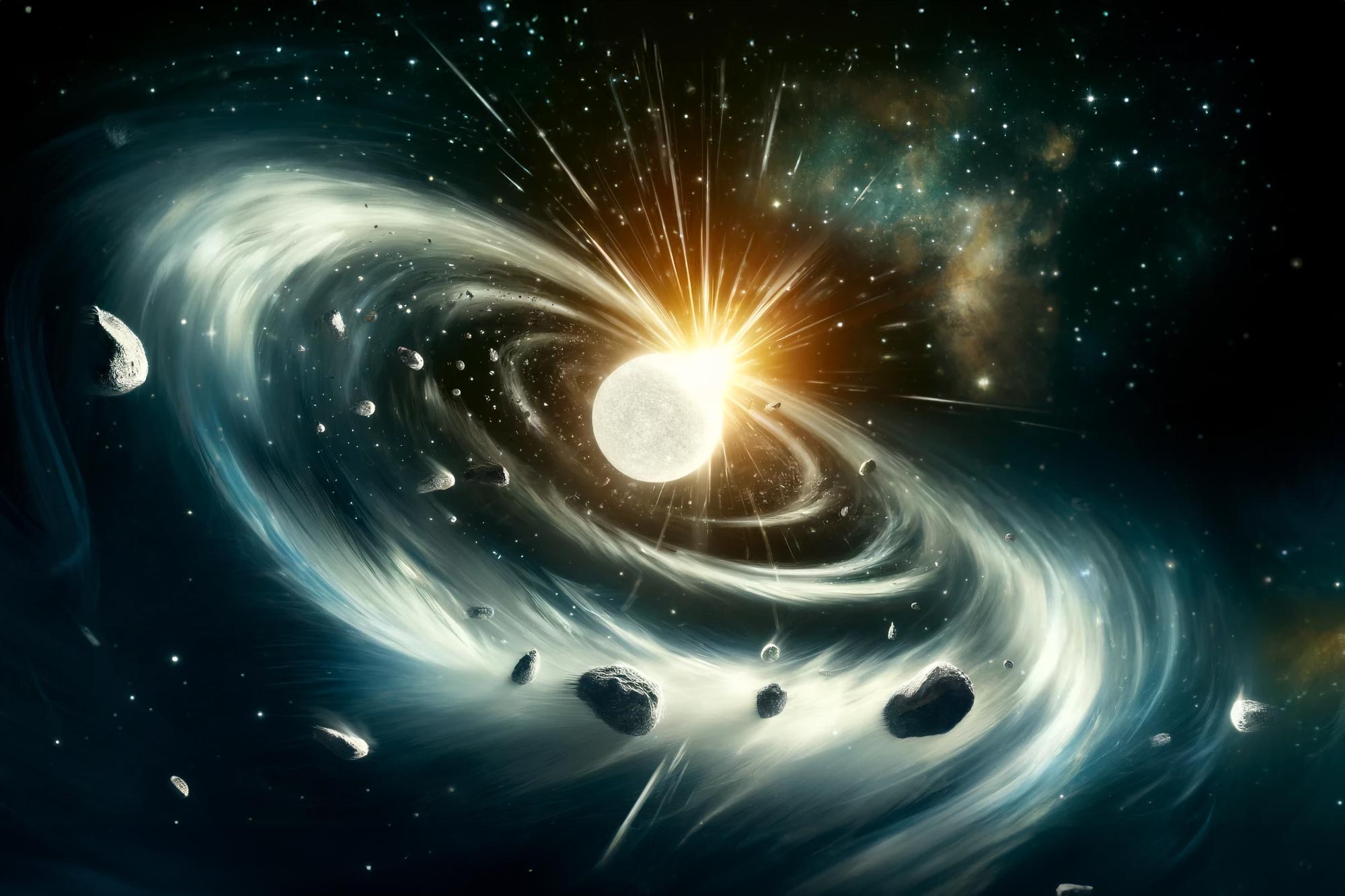
Recent research reveals that white dwarfs consume nearby planetesimals due to a “natal kick” during their formation. This dynamic alteration affects their motion and the dynamics of surrounding material, explaining the presence of heavy metals on white dwarfs’ surfaces and offering new insights into the evolution of solar systems, including our own.
Dead stars known as white dwarfs, have a mass like the Sun while being similar in size to Earth. They are common in our galaxy, as 97% of stars are white dwarfs. As stars reach the end of their lives, their cores collapse into the dense ball of a white dwarf, making our galaxy seem like an ethereal graveyard.
Despite their prevalence, the chemical makeup of these stellar remnants has been a conundrum for astronomers for years. The presence of heavy metal elements—like silicon, magnesium, and calcium—on the surface of many of these compact objects is a perplexing discovery that defies our expectations of stellar behavior.
“We know that if these heavy metals are present on the surface of the white dwarf, the white dwarf is dense enough that these heavy metals should very quickly sink toward the core,” explains JILA graduate student Tatsuya Akiba. “So, you shouldn’t see any metals on the surface of a white dwarf unless the white dwarf is actively eating something.”
White Dwarf Consumption
While white dwarfs can consume various nearby objects, such as comets or asteroids (known as planetesimals), the intricacies of this process have yet to be fully explored. However, this behavior could hold the key to unraveling the mystery of a white dwarf’s metal composition, potentially leading to exciting revelations about white dwarf dynamics.
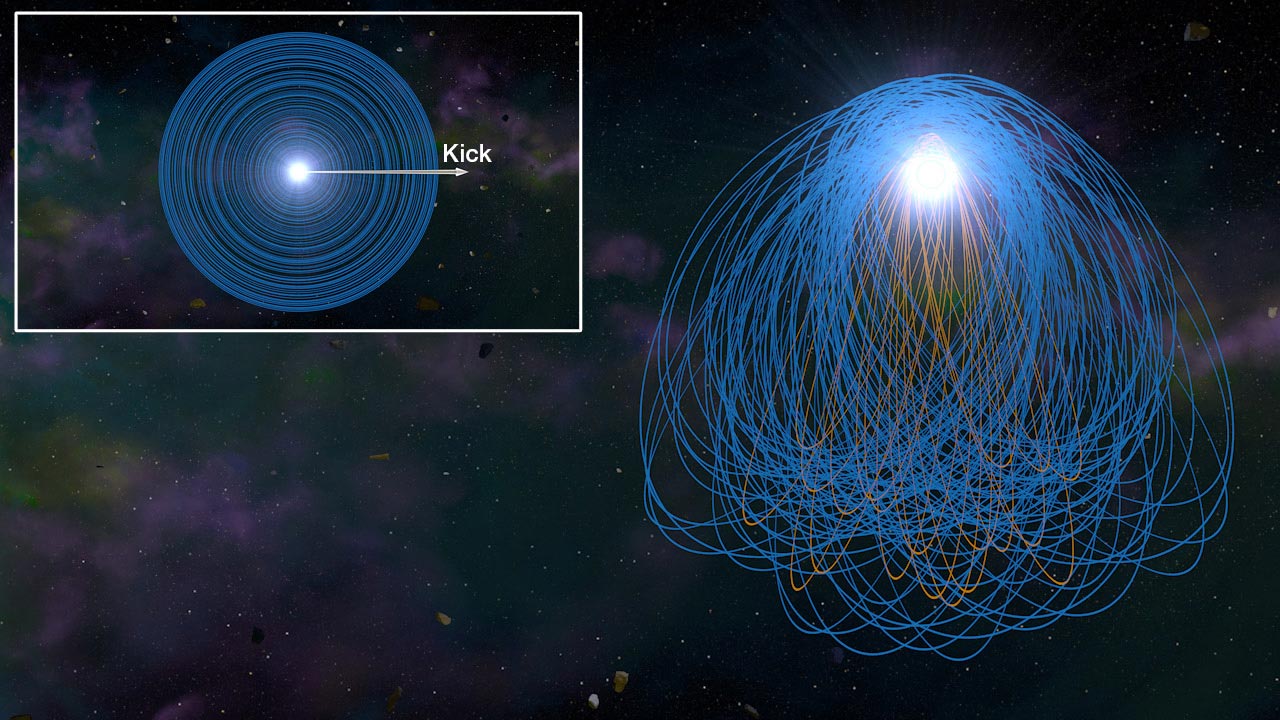
In results reported in a new paper in The Astrophysical Journal Letters, Akiba, along with JILA Fellow and University of Colorado Boulder Astrophysical and Planetary Sciences professor Ann-Marie Madigan and undergraduate student Selah McIntyre, believe they have found a reason why these stellar zombies eat their nearby planetesimals. Using computer simulations, the researchers simulated the white dwarf receiving a “natal kick” during its formation (which has been observed) caused by asymmetric mass loss, altering its motion and the dynamics of any surrounding material.
Simulation Results
In 80% of their test runs, the researchers observed that, from the kick, the orbits of comets and asteroids within a range of 30 to 240 AU of the white dwarf (corresponding to the Sun–Neptune distance and beyond) became elongated and aligned. Furthermore, around 40% of subsequently eaten planetesimals come from counter-rotating (retrograde) orbits.
The researchers also extended their simulations to examine the white dwarf’s dynamics after 100 million years. They found that the white dwarf’s nearby planetesimals still had elongated orbits and moved as one coherent unit, a result never seen before.
“This is something I think is unique about our theory: we can explain why the accretion events are so long-lasting,” states Madigan. “While other mechanisms may explain an original accretion event, our simulations with the kick show why it still happens hundreds of millions of years later.”
These results explain why the heavy metals are found on the surface of a white dwarf, as that white dwarf continuously consumes smaller objects in its path.
Gravitational Dynamics Studies
As Madigan’s research group at JILA focuses on gravitational dynamics, looking at the gravity surrounding white dwarfs seemed like a natural focus of study.
“Simulations help us understand the dynamics of different astrophysical objects,” Akiba says. “So, in this simulation, we throw a bunch of asteroids and comets around the white dwarf, which is significantly bigger, and see how the simulation evolves and which of these asteroids and comets the white dwarf eats.”
The researchers hope to take their simulations to greater scales in future projects, looking at how white dwarfs interact with larger planets.
As Akiba elaborates, “Other studies have suggested that asteroids and comets, the small bodies, might not be the only source of metal pollution on the white dwarf’s surface. So, the white dwarfs might eat something bigger, like a planet.”
Insights Into Solar System Evolution
These new findings further reveal more about the formation of white dwarfs, which is important in understanding how solar systems change over millions of years. They also help shed light on the origins and future evolution of our solar system, revealing more about the chemistry involved.
“The vast majority of planets in the universe will end up orbiting a white dwarf,” Madigan says. “It could be that 50% of these systems get eaten by their star, including our own solar system. Now, we have a mechanism to explain why this would happen.”
“Planetesimals can give us insight into other solar systems and planetary compositions beyond where we live in our solar region” McIntyre adds. “White dwarfs aren’t just a lens into the past. They’re also kind of a lens into the future.”
Reference: “Tidal Disruption of Planetesimals from an Eccentric Debris Disk Following a White Dwarf Natal Kick” by Tatsuya Akiba, Selah McIntyre and Ann-Marie Madigan, 23 April 2024, The Astrophysical Journal Letters.
DOI: 10.3847/2041-8213/ad394c
Never miss a breakthrough: Join the SciTechDaily newsletter.
Follow us on Google and Google News.
1 Comment
I call BULLSh_t about “97% of stars are white dwarfs”. In the HIP catalogue of 118000 listing, their are only like 32 naked White Dwarfs and only 17 of them are within 100 light years of SOl.