
Close Menu
    Facebook X (Twitter) Instagram
    SciTechDaily
    • Biology
    • Chemistry
    • Earth
    • Health
    • Physics
    • Science
    • Space
    • Technology
    Facebook X (Twitter) Pinterest YouTube RSS
    SciTechDaily
    Home»Earth»Chilling Consequences: The Hidden Carbon Surge in Thawing Permafrost
    Earth

    Chilling Consequences: The Hidden Carbon Surge in Thawing Permafrost

    By Chinese Academy of SciencesMay 9, 20241 Comment3 Mins Read
    Facebook Twitter Pinterest Telegram LinkedIn WhatsApp Email Reddit
    Share
    Facebook Twitter LinkedIn Pinterest Telegram Email Reddit
    Thawing Permafrost Concept Art
    A new study highlights that collapsed permafrost areas emit far more CO2 in response to warming than areas with intact permafrost, raising concerns about accelerated climate change impacts. Credit: SciTechDaily.com

    Research indicates that permafrost-collapsed areas emit significantly more CO2 in response to climate warming than in non-collapsed areas, with implications for global carbon cycle dynamics.

    Scientists have discovered that soil carbon dioxide (CO2) emissions are more sensitive to climate warming in areas where permafrost has collapsed compared to areas where it remains intact. This conclusion comes from a recent study published in Nature Geoscience. By conducting field warming experiments and laboratory incubations of soils from extensive sampling, the research provides fresh insights about permafrost carbon-climate feedback in the face of rising global temperatures.

    Effects of Permafrost Thaw on Carbon Emissions

    In regions of high latitude and altitude, warmer temperatures have significantly accelerated the thawing of permafrost. Approximately 20% of the northern permafrost region undergoes abrupt thawing, known as thermokarst, but this region contains about half of all subterranean organic carbon. The sudden thaw can dramatically alter the landscape and the physical and biological properties of the soil, thereby heavily influencing the carbon cycle within ecosystems.
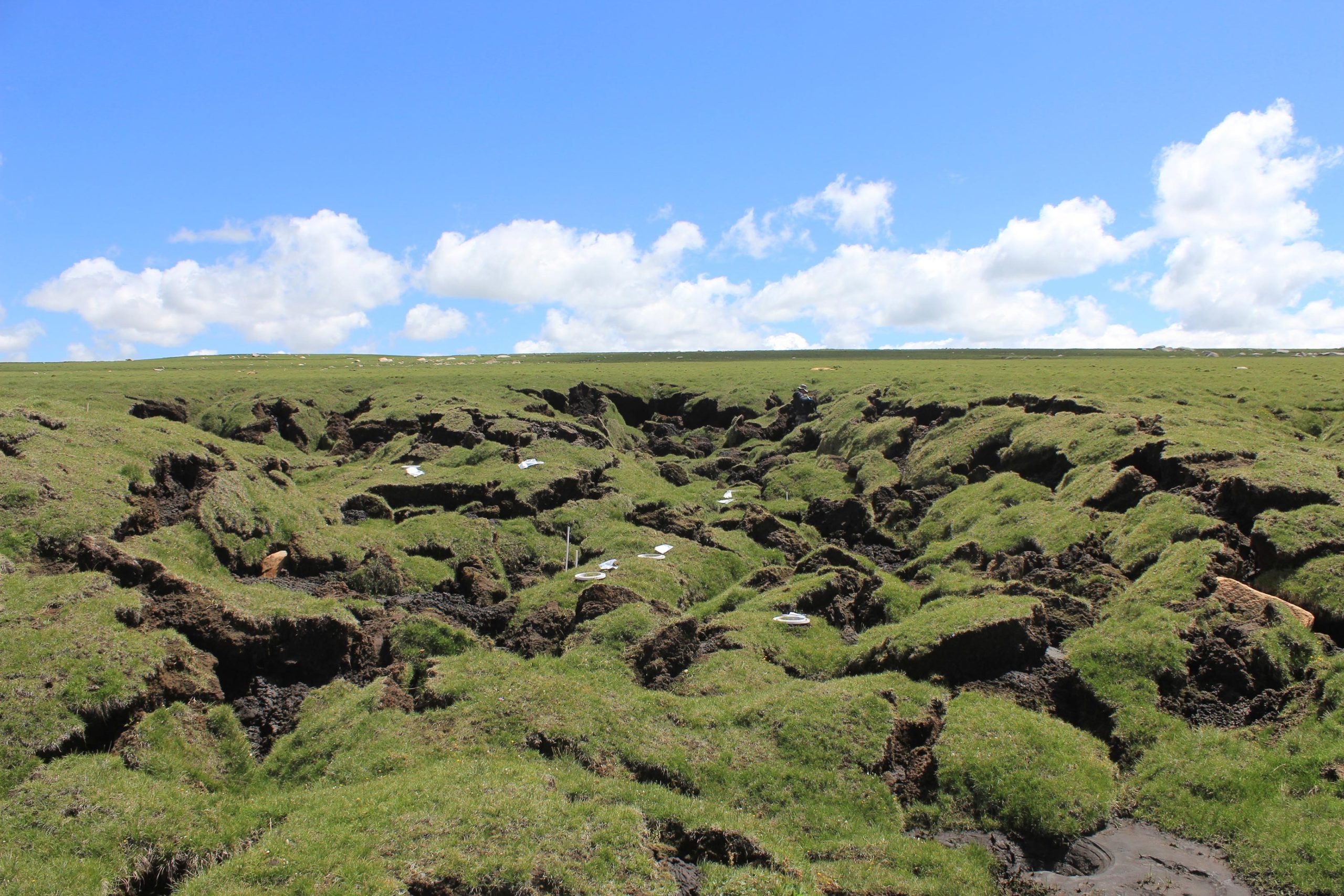
    Thermokarst Landscape
    Thermokarst landscape on the Tibetan Plateau. Credit: Guanqin Wang

    Study Details and Methodology

    Previous studies have failed to address whether the impacts of warming on soil CO2 flux differ between thermokarst and non-thermokarst areas. To fill this knowledge gap, Professor Yuanhe Yang and his team from the Institute of Botany of the Chinese Academy of Sciences have explored how the formation of thermokarst alters the soil’s response to climate warming.

    Their research used various methodologies, including a well-replicated warming experiment conducted in both thermokarst and non-thermokarst areas. They discovered that thermokarst areas exhibit a warming-induced CO2 release rate that is approximately 5.5 times higher than that in non-thermokarst areas.

    Findings on CO2 Flux Response to Warming

    The team analyzed over 30 potential factors that could affect the increased CO2 release due to warming. They concluded that the heightened response in thermokarst areas is primarily due to poorer soil substrate quality and a higher presence of microbial genes involved in decomposing organic carbon.

    Additional experiments incubating soils from six thermokarst-affected sites along a 550-km permafrost transect also confirmed that thermokarst formation significantly raises the temperature sensitivity of CO2 release, underscoring a robust response of these soils to climate warming.

    Global Implications and Future Projections

    Professor Yang emphasized the broad significance of their findings, stating, “As a preliminary exploration of its global importance, extrapolating the warming response of soil CO2 flux to all upland thermokarst regions in the Northern Hemisphere, there could be an additional 0.4 Pg C year-1 of soil carbon release, which is about a quarter of the projected permafrost soil carbon losses by the end of the 21st century.”

    This research not only sheds light on the dynamic responses of permafrost soils to warming but also aids in refining projections regarding future permafrost carbon-climate feedback mechanisms.

    Reference: “Enhanced response of soil respiration to experimental warming upon thermokarst formation” by Guanqin Wang, Yunfeng Peng, Leiyi Chen, Benjamin W. Abbott, Philippe Ciais, Luyao Kang, Yang Liu, Qinlu Li, Josep Peñuelas, Shuqi Qin, Pete Smith, Yutong Song, Jens Strauss, Jun Wang, Bin Wei, Jianchun Yu, Dianye Zhang and Yuanhe Yang, 30 April 2024, Nature Geoscience.
    DOI: 10.1038/s41561-024-01440-2

    Never miss a breakthrough: Join the SciTechDaily newsletter.
    Follow us on Google and Google News.

    Carbon Emissions Chinese Academy of Sciences Climatology Permafrost
    Share. Facebook Twitter Pinterest LinkedIn Email Reddit

    Related Articles

    Humanity’s Carbon Signature Is Now Embedded Deep in the Ocean

    Arctic Coastal Retreat Accelerates: Scientists Sound Alarm on “Triple Threat”

    3,775-Year-Old Log Sparks New Solution to Climate Change

    Tropical Methane Emissions Explain More Than 80% of Recent Changes in Global Atmospheric Methane Growth Rate

    Study Reports Air Pollution Causes Thousands of Premature Deaths Each Year

    Storing Carbon Emissions in Deep Saline Aquifers

    Fossil Fuel Emissions, Organic Carbon and Alaska’s Glaciers

    The Role of Climate Change in Chemical Weathering of Rocks

    National GHG 2010 Greenhouse Gas Emissions Data

    1 Comment

    1. Stefan Gradmann on May 11, 2024 2:17 am

      OK!

      Reply
    Leave A Reply Cancel Reply

    • Facebook
    • Twitter
    • Pinterest
    • YouTube

    Don't Miss a Discovery

    Subscribe for the Latest in Science & Tech!

    Trending News

    NASA’s Voyager 1 Is About to Become the First Spacecraft One Light-Day From Earth

    A Woman Who Lived 30,000 Years Ago Is Changing What We Know About Ice Age Europe

    A Rare Radioactive Element Reveals a Hidden Secret About the Heaviest Atoms

    Breakthrough Cancer Treatment Wipes Out Deadly Brain Tumors in Every Mouse Tested

    Something Remarkable Is Happening to Dogs Living Near Chernobyl’s Nuclear Plant

    Hubble Uncovers a Mysterious 93-Billion-Mile Structure Hiding in a Nearby Star System

    Earth’s Oceans Were Slowly Suffocating Millions of Years Before a Devastating Mass Extinction

    Why Are Men Twice As Likely To Develop Parkinson’s? Scientists Discover a Hidden Clue in the Brain

    Follow SciTechDaily
    • Facebook
    • Twitter
    • YouTube
    • Pinterest
    • Newsletter
    • RSS
    SciTech News
    • Biology News
    • Chemistry News
    • Earth News
    • Health News
    • Physics News
    • Science News
    • Space News
    • Technology News
    Recent Posts
    • Scientists Finally Crack a 1,600-Year-Old Roman Glass Mystery
    • Scientists Discover Something Unexpected 90 Kilometers Beneath Earth
    • Popular Dairy Alternatives Could Be Leaving You Short of Essential Nutrients
    • A Healthier Form of Salt Could Prevent Nearly 3 Million Deaths Every Year, Scientists Say
    • Scientists Engineer Rice That Fights Back Against a Devastating Crop Disease
    Copyright © 1998 - 2026 SciTechDaily. All Rights Reserved.
    • Science News
    • About
    • Contact
    • Editorial Board
    • Privacy Policy
    • Terms of Use

    Type above and press Enter to search. Press Esc to cancel.