
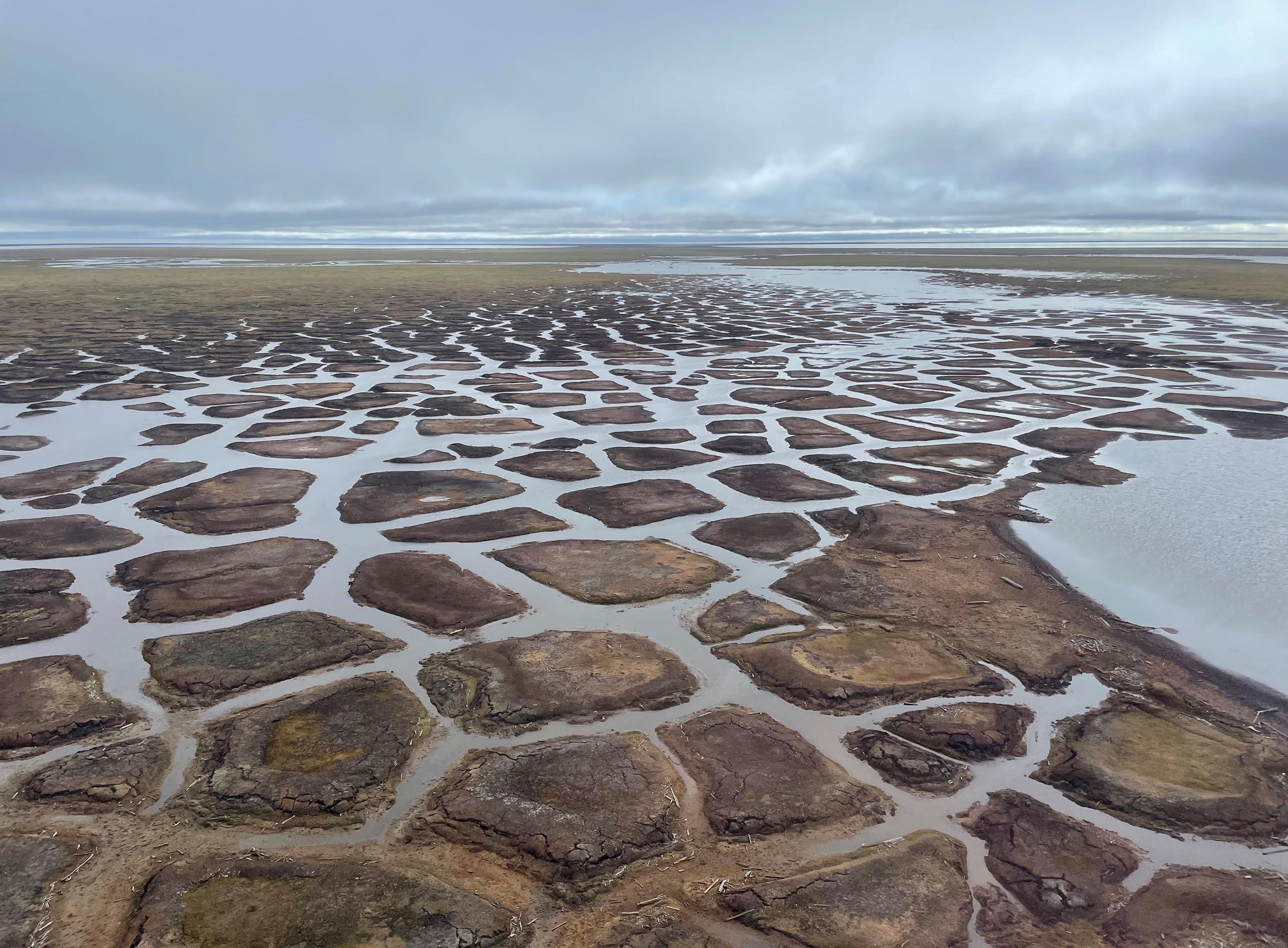
Arctic coastal land loss, driven by sea level rise, erosion, and permafrost thaw subsidence, is accelerating, with unprecedented impacts predicted by 2100. Permafrost thaw subsidence will dominate shoreline retreat, highlighting the urgent need for adaptive strategies to safeguard Arctic communities.
The combined effects of sea level rise, permafrost thaw subsidence, and erosion could result in land loss in Arctic coastal regions that far exceeds the impact of any one of these climate hazards alone, according to scientists.
Although 75 years of aerial and satellite data have documented coastal erosion as a growing threat in the Arctic, less attention has been given to other hazards, such as the cumulative effects of sea level rise and permafrost thaw subsidence. This gap in focus has hindered comprehensive assessments of how these processes compare to and interact with coastal erosion in driving land loss.
Study on Alaska’s Arctic Coastal Plain
A new study in Proceedings of the National Academy of Sciences by scientists with the Woods Hole Oceanographic Institution (WHOI) and other academic institutions focuses on Alaska’s Arctic Coastal Plain (ACP), a 60,000+ square kilometer, low-elevation, and low-relief landscape replete with ice-rich permafrost that has among the highest rates of sea-level rise and coastal erosion in the Arctic.
“Our findings highlight the risks that compounding climate hazards pose to coastal communities and underscore the need for adaptive planning for Arctic communities within zones of 21st-century land loss,” the study notes.

“Compound climate impacts accelerate coastal change,” said study lead author Roger Creel, a postdoctoral scholar in WHOI’s Department of Physical Oceanography. “There is this nonlinear acceleration in coastal impacts that we should be expecting will happen in places like Northern Alaska.”
“The findings from this study reveal an unprecedented transformation of Alaska’s Arctic coastlines. By 2100, the combined effects of coastal erosion, sea level rise, and permafrost thaw subsidence will likely push the North Slope shoreline inland to a location it hasn’t reached since the last interglacial period over 100,000 years ago,” said study co-author Benjamin Jones, research associate professor at the Institute of Northern Engineering, the University of Alaska Fairbanks. “These findings represent a paradigm shift in the 21st Century Arctic, highlighting the urgent need for adaptive strategies to protect vulnerable communities and infrastructure in the face of these cumulative climate hazards.”
Methodology and Key Findings
The study utilized 5-meter topography, satellite-derived coastal lake depth estimates, and empirical assessments of land subsidence due to permafrost thaw, along with projections of coastal erosion and sea level rise for medium and high emission scenarios from the IPCC’s 6th Assessment Report.
“This research highlights the value of working across disciplinary boundaries for more robust projections of coastal Arctic evolution in the coming century,” said co-author Julia Guimond, assistant scientist in WHOI’s Applied Ocean Physics and Engineering Department. “Our work shows that By 2100, total land loss will exceed erosional losses by up to eight times. Here we focus on processes affecting Alaska’s Arctic Coastal Plain, but a key takeaway is the compounding effects of multiple hazards and that applies to coastal resilience planning across the globe.”
“Along ice-rich permafrost coastlines, the land surface is falling faster than the sea levels are rising. Over the coming decades, permafrost thaw subsidence will move the coastline farther inland than coastal erosion or sea level rise alone will move it, and this subsidence will dominate Arctic coastal change over the long term,” said co-author Pier Paul Overduin, senior scientist at the Alfred Wegener Institute Helmholtz Centre for Polar and Marine Research in Potsdam, Germany.
A Call to Action
Creel said the impact of permafrost thaw subsidence is familiar to people who live in northern Alaska. However, he adds agencies such as the U.S. Army Corps of Engineers and the Federal Emergency Management Agency allocate many of their resources based on published literature. “These sorts of bodies with a lot of resources may have not been paying enough attention to permafrost thaw subsidence as an agent of coastal change. This study is a wake-up call to expand the conversation.”
An Arctic shoreline governed by inundation “will pose new challenges to communities whose homelands – including infrastructure, hunting grounds, subsistence access routes, cultural heritage sites, landscapes, and the soil itself – are disappearing,” the study states. “Future research on Arctic shoreline evolution should be motivated by the needs of these communities, who will need support to respond to the paradigm shift in 21st century Arctic coastal change that we project here.”
Reference: “Permafrost thaw subsidence, sea-level rise, and erosion are transforming Alaska’s Arctic coastal zone” by Roger Creel, Julia Guimond, Benjamin M. Jones, David M. Nielsen, Emily Bristol, Craig E. Tweedie and Pier Paul Overduin, 3 December 2024, Proceedings of the National Academy of Sciences.
DOI: 10.1073/pnas.2409411121
Funding for this study was provided by a Woods Hole Oceanographic Institution Postdoctoral Scholarship and the President’s Innovation Fund, U.S. National Science Foundation grants, and the Deutsche Forschungsgemeinschaft under Germany‘s Excellence Strategy, with additional support provided under a Broad Agency Announcement award from the U.S. Army Corps of Engineers’ Engineer Research and Development Center – Cold Regions Research and Engineering Laboratory.
Never miss a breakthrough: Join the SciTechDaily newsletter.
Follow us on Google and Google News.
2 Comments
My baloney had a first name…
Learn about real reasons of the global warming: https://youtu.be/5OGTOa_U7vM?si=dndzXQqjmyZscs5u