
Close Menu
    Facebook X (Twitter) Instagram
    SciTechDaily
    • Biology
    • Chemistry
    • Earth
    • Health
    • Physics
    • Science
    • Space
    • Technology
    Facebook X (Twitter) Pinterest YouTube RSS
    SciTechDaily
    Home»Physics»Physicists Spawn Rings of Exceptional Points Out of Dirac Cones
    Physics

    Physicists Spawn Rings of Exceptional Points Out of Dirac Cones

    By Jim Shelton, Yale UniversitySeptember 10, 2015No Comments2 Mins Read
    Facebook Twitter Pinterest Telegram LinkedIn WhatsApp Email Reddit
    Share
    Facebook Twitter LinkedIn Pinterest Telegram Email Reddit
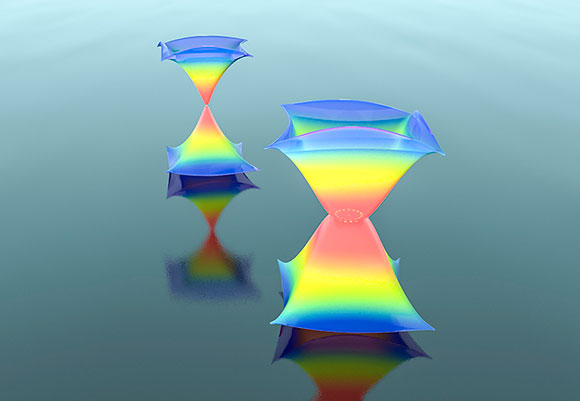
    Spawning Rings of Exceptional Points Out of Dirac Cones
    A schematic drawing of how a ring of exceptional points (shown in dashes) can be spawned from a Dirac point (a dot), and thus change the dispersion from a conical shape that is widely known into an exotic lantern-like shape. Credit: Yale University

    Physicists outline a new concept called the “exceptional ring.”

    Optics research just got a bit more exceptional, and the world may benefit.

    Physicists have long known about the existence of isolated “exceptional points” — unique points where two physical states coalesce into one. Exceptional points give rise to counterintuitive phenomena; a more opaque material can seem more transparent, and light may be allowed to propagate in one direction but not the other.

    Now, in a paper published in the journal Nature, scientists have outlined a new concept called the “exceptional ring.”

    An exceptional ring is a continuous ring of exceptional points, and its discovery opens new avenues of research for basic science and technology, note the researchers. In this case, the exceptional rings were found in a slab of nanostructured material called a photonic crystal. The researchers found that exceptional rings arise from Dirac cones, which commonly occur in a 2D material and have been the focus of many important physics discoveries in the past decade.

    “This finding may enable a number of exciting applications,” said co-lead author Chia Wei Hsu, a Yale postdoctoral researcher in applied physics. “Examples include more sensitive biological and chemical sensors, lasers with higher output power, and light-emitting devices with directional emission.”

    Reference: “Spawning rings of exceptional points out of Dirac cones” by Bo Zhen, Chia Wei Hsu, Yuichi Igarashi, Ling Lu, Ido Kaminer, Adi Pick, Song-Liang Chua, John D. Joannopoulos and Marin Soljačić, 9 September 2015, Nature.
    DOI: 10.1038/nature14889

    The other co-lead authors of the research are Bo Zhen of MIT and Yuichi Igarashi of Smart Energy Research Laboratories, in Japan.

    Never miss a breakthrough: Join the SciTechDaily newsletter.
    Follow us on Google and Google News.

    Nanoscience Nanotechnology Optics Yale University
    Share. Facebook Twitter Pinterest LinkedIn Email Reddit

    Related Articles

    Engineers Develop New Temperature Switchable Membrane to Regulate Flow

    Nanomaterials Give Immune Cells a Cancer-Fighting Boost

    Nanoparticle Temporarily Violates the Second Law of Thermodynamics

    PEPs Might Make Quantum Condensation Possible at Room Temperature

    New Carbon Films Pave the Way for the Next Generation of Solar Cells

    Cathodoluminescence Used to Probe Metamaterials

    Ultrashort Pulses of Infrared Light Trigger Changes in Magnetism

    Path to Magnetic Vortex RAM Might be More Difficult Than Previously Assumed

    Researchers Explain Mysterious Nanoscale Crop Circles

    Leave A Reply Cancel Reply

    • Facebook
    • Twitter
    • Pinterest
    • YouTube

    Don't Miss a Discovery

    Subscribe for the Latest in Science & Tech!

    Trending News

    Scientists Discover New Compound That Burns Fat Without Killing Your Appetite

    Mount Vesuvius Buried These Scrolls for 2,000 Years – Now Scientists May Read Them

    The Asteroid That Killed the Dinosaurs Was Stranger Than We Thought

    Scientists Rewrite the Atomic Structure of Glass While It Melts

    DNA Has a Four-Letter Alphabet. Scientists Just Expanded It to Eight

    A Little-Known Protein Could Point to a New Way To Treat Alzheimer’s

    Scientists Turn Plastic Waste Into Protein-Rich Cookies

    New Findings Could Help Build Computers That Think More Like Your Brain

    Follow SciTechDaily
    • Facebook
    • Twitter
    • YouTube
    • Pinterest
    • Newsletter
    • RSS
    SciTech News
    • Biology News
    • Chemistry News
    • Earth News
    • Health News
    • Physics News
    • Science News
    • Space News
    • Technology News
    Recent Posts
    • Astronomers Just Caught a Giant Planet in the Act of Forming
    • NASA Planned for 10 Years. The Roman Space Telescope May Keep Going for 22
    • Two Dead Stars Are Racing Around Each Other Every 6.2 Minutes
    • Scientists Reassess a Major Risk of Breast Cancer Screening
    • Every Breath Leaves a Unique Signature in Your Brain, Study Finds
    Copyright © 1998 - 2026 SciTechDaily. All Rights Reserved.
    • Science News
    • About
    • Contact
    • Editorial Board
    • Privacy Policy
    • Terms of Use

    Type above and press Enter to search. Press Esc to cancel.