
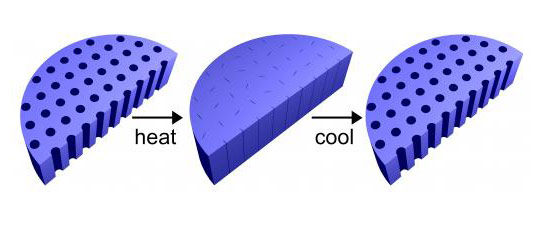
Researchers from the University of Connecticut and Yale University have developed a new membrane with highly aligned nanoscale pores that open and close in response to temperature; this highly porous, valve-like material has many potential filtration applications, including water purification and molecular separation.
The membrane was created from a block copolymer that self-assembles into alternating groups of two types of molecular segments with different properties, each capable of packing into domains of different shapes, depending on the overall size and composition of the polymer. In this case, they embedded cylindrical columns of one segment type in a matrix composed of the other segment type.
Notably, the Yale researchers used magnetic fields to ensure the aligned orientation of the cylindrical domains, then chemically removed the column-shaped segments, leaving behind an empty pore with nanoscale dimensions. The resulting material is a thin film membrane with parallel aligned pores that stretch from one side of the film to the other.
“In most conventional membranes, the pores are not aligned — they go in every which way, creating a highly tortuous path,” says Chinedum Osuji, associate professor of chemical & environmental engineering and principal investigator of the research, published in Advanced Materials. “We developed a scalable method for aligning the pores in thin film, which results in highly attractive transport properties.”
The aligned pores of the Yale team’s material are also significant for being responsive to temperature. For example, at 25 degrees Celsius, the pores are open. However, when the temperature is raised to 75 degrees Celsius, the pores collapse — a process that is reversible if the temperature is again lowered to 25 degrees Celsius. “The pore collapse is rapid and reversible, which very conveniently provides control over the permeability of the membrane and opens the door for unique industrial applications,” says Menachem Elimelech, Roberto C. Goizueta Professor of Chemical & Environmental Engineering and co-author of the research.
The membrane can in this way act like a valve, becoming alternately permeable and impermeable; additionally, the same behavior may enable the pore size to be modified gradually as a function of temperature, providing the material a temperature tunable porosity. This behavior could be particularly useful in industrial applications where high-value enzymes must be separated from byproducts, as the variable pore size could enable this single type of thin film to isolate chemical products with various molecular sizes.
The title of the study is “Thermally Switchable Aligned Nanopores by Magnetic-Field Directed Self-Assembly of Block Copolymers.”
In addition to Osuji and Elimelech, the authors of the study are associate research scientist Manesh Gopinadhan and doctoral students Youngwoo Choo and Pawel Majewski from Yale; associate professor Rajeswari M. Kasi and doctoral student Prashant Deshmukh from the University of Connecticut; and Olgica Bakajin from Porifera Inc.
Reference: “Thermally Switchable Aligned Nanopores by Magnetic-Field Directed Self-Assembly of Block Copolymers” by Manesh Gopinadhan, Prashant Deshmukh, Youngwoo Choo, Pawel W. Majewski, Olgica Bakajin, Menachem Elimelech, Rajeswari M. Kasi and Chinedum O. Osuji, 4 June 2014, Advanced Materials.
DOI: 10.1002/adma.201401569
Never miss a breakthrough: Join the SciTechDaily newsletter.
Follow us on Google and Google News.