
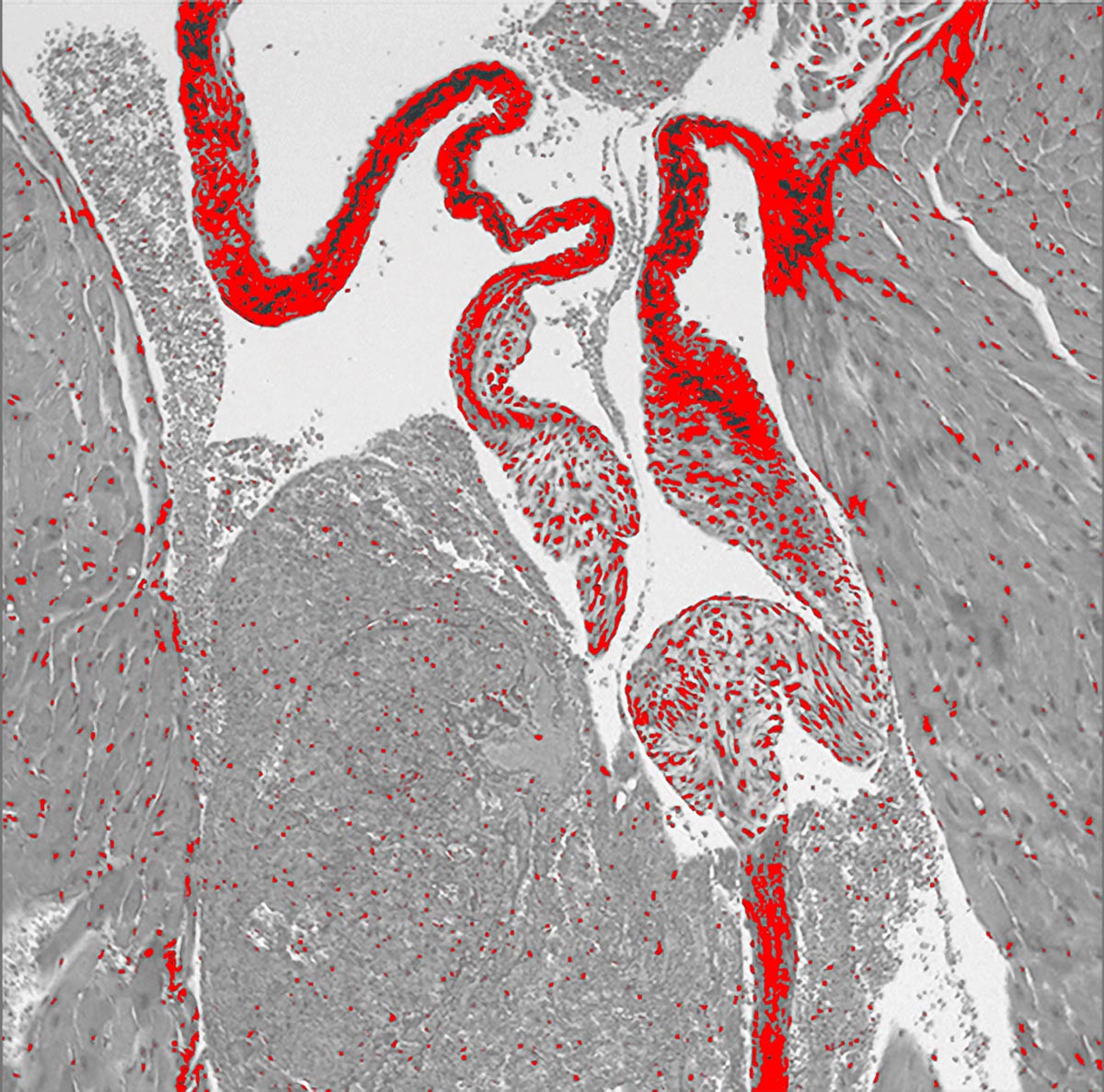
Serotonin can impact the mitral valve of the heart and potentially accelerate a cardiac condition known as degenerative mitral regurgitation, according to a new study led by researchers at Columbia University’s Department of Surgery in collaboration with the Pediatric Heart Valve Center at Children’s Hospital of Philadelphia (CHOP), the University of Pennsylvania, and the Valley Hospital Heart Institute.
The results of the multicenter study, which was supported by a grant from the National Heart, Lung, and Blood Institute and co-led by Columbia’s Giovanni Ferrari, PhD, and CHOP’s Robert J. Levy, MD, were published earlier this month in Science Translational Medicine.
Degenerative Mitral Regurgitation
Degenerative mitral regurgitation (DMR) is one of the most common types of heart valve disease. The mitral valve is located between the left atrium and left ventricle of the heart. It closes tightly when the heart contracts to prevent blood from leaking back into the left atrium.
In DMR, the shape of the mitral valve becomes distorted, preventing the valve from closing completely. This allows blood to leak back toward the lungs (regurgitation), limiting the amount of oxygen-rich blood moving through the heart to the rest of the body.
As a result, DMR can bring about symptoms like fatigue and shortness of breath. Because of the reduced efficiency in circulation, the heart has to work harder, which over time causes permanent damage. This can lead to a number of serious and life-threatening cardiac issues, including atrial fibrillation and heart failure.
Currently, there is no treatment for mitral valve degeneration. “Certain medications can ease the symptoms and prevent complications, but they do not treat the mitral valve,” says Ferrari, scientific director of the Cardiothoracic Research Program at Columbia. “If the degeneration of the mitral valve becomes severe, surgery to repair or replace the valve is needed.”
The Role of Serotonin
Serotonin plays a part in a wide range of body functions, including emotional state, digestion, sleep, memory, and blood clotting. Serotonin’s role as a neurotransmitter helps your brain regulate mood; lower levels of serotonin are associated with anxiety and depression.
Serotonin binds to specific receptors on the surface of a cell, sending a signal to the cell to act accordingly. A protein known as the serotonin transporter (SERT or 5-HTT) moves serotonin into the cell to be reabsorbed and recycled, a process known as serotonin reuptake.
Medications called selective serotonin reuptake inhibitors (SSRIs) bind to the SERT to reduce serotonin reuptake, allowing serotonin to remain available for longer periods. This increased serotonin availability can help improve symptoms of mood disorders. SSRIs are some of the most widely prescribed types of antidepressants and include well-known medications like fluoxetine (Prozac) and sertraline (Zoloft).
Study Design
The study examined clinical data from more than 9,000 patients who had undergone valve repair or replacement surgery for DMR and evaluated 100 mitral valve biopsies. “Studying the data of these patients, we found that taking SSRIs was associated with severe mitral regurgitation that needed to be treated with surgery at a younger age than for patients not taking SSRIs,” says Ferrari.
The researchers also studied in vivo mouse models using transgenic mice lacking the SERT gene and normal mice. They discovered that mice without a SERT gene developed thicker mitral valves and that normal mice treated with high doses of SSRIs also developed thickened mitral valves.
Using genetic analysis, the researchers identified genetic variants in the SERT gene region 5-HTTLPR that affect SERT activity. They found that a “long” variant of 5-HTTLPR makes SERT less active in the mitral valve cells, especially when there are two copies (one maternal and one paternal). DMR patients with the “long-long” variant needed mitral valve surgery more often than those with other variants.
Mitral valve cells from DMR patients with the “long-long” variant were more prone to react to serotonin by producing more collagen, changing the shape of the mitral valve. Additionally, mitral valve cells with the “long-long” variant of 5-HTTLPR were more sensitive to fluoxetine than those with other variants.
Implications for Patients with Mitral Valve Disease
The study indicates that for DMR patients with the “long-long” variant, taking SSRIs lowers SERT activity in the mitral valve. The researchers suggest testing DMR patients for potential low SERT activity by genotyping them for 5-HTTLPR, which can be determined easily from a DNA sample obtained from the blood or a mouth swab. “Assessing patients with DMR for low SERT activity may help identify patients who may need mitral valve surgery earlier,” says Ferrari. “Promptly fixing a mitral valve that is very leaky would protect the heart and could prevent congestive heart failure.”
The researchers did not find a negative effect with normal doses of SSRIs or the “long-long” variant in cells from healthy human mitral valves. “A healthy mitral valve can probably stand low SERT activity without deforming,” says Ferrari. “It is unlikely that low SERT can cause degeneration of the mitral valve by itself. SSRIs are generally safe for most patients. Once the mitral valve has started to degenerate, it may be more susceptible to serotonin and low SERT.”
Additional research may help determine if DMR patients who respond well to SSRIs should be regularly seen to assess progression of mitral degeneration, and whether DMR patients who are not responding well to SSRIs should consider switching to a non-SSRI antidepressant rather than raising the dose of the SSRI.
Reference: “Decreased serotonin transporter activity in the mitral valve contributes to progression of degenerative mitral regurgitation” by Estibaliz Castillero, Emmett Fitzpatrick, Samuel J. Keeney, Alex M. D’Angelo, Benjamin B. Pressly, Michael T. Simpson, Mangesh Kurade, W. Clinton Erwin, Vivian Moreno, Chiara Camillo, Halley J. Shukla, Vaishali V. Inamdar, Arbi Aghali, Juan B. Grau, Elisa Salvati, Itzhak Nissim, Lubica Rauova, Mark A. Oyama, Stanley J. Stachelek, Chase Brown, Abba M. Krieger, Robert J. Levy and Giovanni Ferrari, 4 January 2023, Science Translational Medicine.
DOI: 10.1126/scitranslmed.adc9606
Never miss a breakthrough: Join the SciTechDaily newsletter.
Follow us on Google and Google News.
2 Comments
Where can I get more info on DMR?
“Currently, there is no treatment for mitral valve degeneration. “Certain medications can ease the symptoms and prevent complications, but they do not treat the mitral valve,” says Ferrari, scientific director of the Cardiothoracic Research Program at Columbia. “If the degeneration of the mitral valve becomes severe, surgery to repair or replace the valve is needed.”
THIS STATEMENT IS INCORRECT. There is a treatment for DMR. The Mitraclip. Or is this treatment what is meant by SURGERY? I have one in my heart inserted through my vein with no cutting to my body. The cutting is what is usually thought of as surgery. I think it should have been mentioned in the article. Easy procedure (for me) and it is working wonderfully.
“The MitraClip is typically inserted from the right atrium into the left atrium through the fossa ovalis, so the standard access point is the right femoral vein. Jun 1, 2019”