
Close Menu
    Facebook X (Twitter) Instagram
    SciTechDaily
    • Biology
    • Chemistry
    • Earth
    • Health
    • Physics
    • Science
    • Space
    • Technology
    Facebook X (Twitter) Pinterest YouTube RSS
    SciTechDaily
    Home»Space»ALMA Views the Episodic Outflow of Protostar CARMA-7
    Space

    ALMA Views the Episodic Outflow of Protostar CARMA-7

    By Jim Shelton, Yale UniversityNovember 5, 20151 Comment3 Mins Read
    Facebook Twitter Pinterest Telegram LinkedIn WhatsApp Email Reddit
    Share
    Facebook Twitter LinkedIn Pinterest Telegram Email Reddit
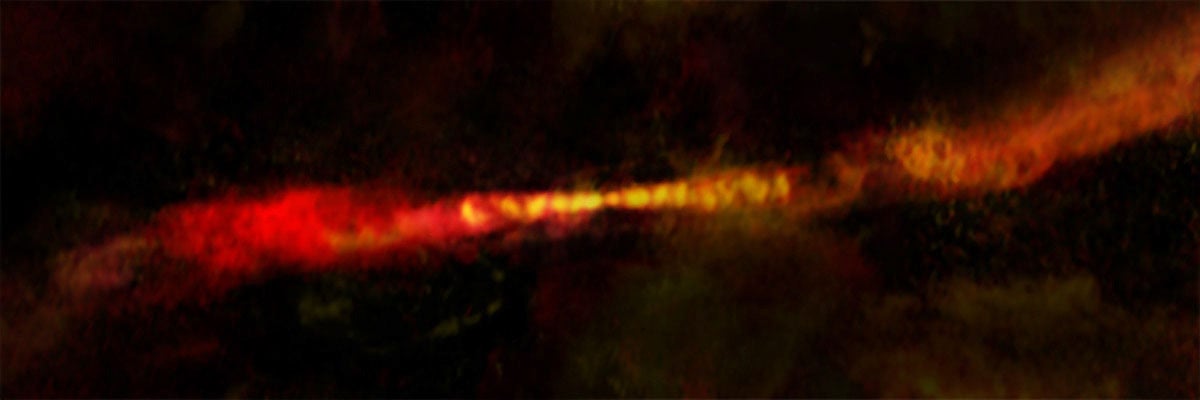
    Protostar CARMA-7
    Astronomers using the Atacama Large Millimeter/sub-millimeter Array (ALMA) have imaged the episodic outflow of a young protostar known as CARMA-7. The twin jets — each nearly 1.5 trillion kilometers long — have distinct gaps, revealing that the star is growing by fits and starts. (Image courtesy of B. Saxton, NRAO/AUI/NSF; A Plunkett et al.; ALMA, NRAO/ESO/NAOJ)

    A new study led by Yale University reveals a cluster of young stars that develop in distinct, episodic spurts.

    It is the first time astronomers have seen such a growth pattern within a star cluster — a chaotic, turbulent environment that is common for star formation. Previous observations have focused on stars forming in more isolated regions of space.

    In a study published this week in the journal Nature, astronomers described the cosmic convulsions within Serpens South, a star cluster 1,400 light years from Earth. The researchers focused in particular on a protostar called CARMA-7.

    The researchers recorded 22 “episodes” in which CARMA-7 experienced the gravitational push-pull that characterizes star formation. As protostars ingest raw material, they have counter-balancing emissions of material they don’t need. Such “outflow” is important to researchers because it can be measured more easily, unlike the hard-to-detect incoming matter.

    “Outflows are very common in astrophysics,” said co-author Héctor Arce, an astronomy professor at Yale whose research group focuses on outflow dynamics. “They are good indicators of protostars, evolved stars, and even supermassive black holes. They tell us that there is a central, massive object in the outflow origin, with a surrounding accretion disc.”

    The first author of the paper is Adele Plunkett, a recent Yale graduate student now working with the European Southern Observatory (ESO) in Santiago, Chile. Plunkett and her colleagues used data from the Atacama Large Millimeter/sub-millimeter Array (ALMA) in Chile to conduct the research.

    “This is the beginning of being able to understand cluster regions,” Plunkett said. “In the past, we only saw cumulative outflows. To be able to observe individual outflows, with distinct ejection events, was exciting — and something we could only do with ALMA.”

    Plunkett said the technology allows researchers to determine details about the star formation process, such as how often material is accreted or ejected, on time scales of a few hundred years. Further observation promises an even greater level of detail about protostars in their most common environment, said the researchers.

    “This result shows that when young stars grow they do so episodically, in little growth spurts, rather than steadily,” said co-author Pieter van Dokkum, the Sol Goldman Professor of Astronomy and chair of Yale’s Department of Astronomy. “They’ve learned to chew their food before they swallow.”

    The other co-authors of the paper are Diego Mardones of the Universidad de Chile, Michael Dunham of the Harvard-Smithsonian Center for Astrophysics, Manuel Fernández-López of Instituto Argentino de Radioastronomía, and José Gallardo and Stuartt Corder of the Joint ALMA Observatory.

    Reference: “Episodic molecular outflow in the very young protostellar cluster Serpens South” by Adele L. Plunkett, Héctor G. Arce, Diego Mardones, Pieter van Dokkum, Michael M. Dunham, Manuel Fernández-López, José Gallardo and Stuartt A. Corder, 5 November 2015, Nature.
    DOI: 10.1038/nature15702

    Never miss a breakthrough: Join the SciTechDaily newsletter.
    Follow us on Google and Google News.

    Astronomy Astrophysics Cosmology Protostar Star Formation Yale University
    Share. Facebook Twitter Pinterest LinkedIn Email Reddit

    Related Articles

    Evidence of Galaxy Star Birth Regulated by Black Holes

    Pebble-Size Particles May Represent a New Class of Interstellar Particles

    Early Quasars Got a “Super Boost” from Star Clusters

    Herschel Views Star Factory NGC 7538

    Astronomers Discover a Drastic Chemical Change Occurring in Birth of a Planetary System

    Simulations Shed Light on the Formation of Stars in the Earliest Galaxies

    New Research Boosts Binary-Star Formation Theory

    Study Reveals the Explosive Growth of a Newly Formed Star in the Milky Way

    ALMA Gets a Close-Up View of Starbirth

    1 Comment

    1. Lynn Romine on November 6, 2015 7:15 pm

      This sounds more like the birth of a Black Hole than a protostar.

      Reply
    Leave A Reply Cancel Reply

    • Facebook
    • Twitter
    • Pinterest
    • YouTube

    Don't Miss a Discovery

    Subscribe for the Latest in Science & Tech!

    Trending News

    Magnetic Fields May Solve a Longstanding Binary Star Mystery

    The Probiotic Breakthrough for Natural Anxiety Relief and Better Mental Health

    Animal vs. Plant Protein: Scientists Found a Surprising Nutritional Difference

    According to Scientists, This Simple Dietary Change Is Linked to Lower Depression Scores

    Researchers Discover a Hidden Vitamin D Problem That Persists Year-Round

    Interstellar Comet 3I/ATLAS Reveals Strange Chemistry Beyond Our Solar System

    A Newly Found Cellular Shift May Explain Why Aging Leads to Disease

    Scientists Discover Gut Signal That Turns Off Sugar Cravings

    Follow SciTechDaily
    • Facebook
    • Twitter
    • YouTube
    • Pinterest
    • Newsletter
    • RSS
    SciTech News
    • Biology News
    • Chemistry News
    • Earth News
    • Health News
    • Physics News
    • Science News
    • Space News
    • Technology News
    Recent Posts
    • Breakthrough for 800 Million Patients? Kidney Disease Drug Shows Powerful New Benefits
    • A Surprising Discovery Suggests Autism Is Not One Condition
    • New Alzheimer’s Discovery Could Change How Scientists Fight the Disease
    • This Quantum Detector Boosts Terahertz Sensitivity by 20 Times
    • A Universe Without Dark Energy? Mathematicians Challenge Standard Cosmology
    Copyright © 1998 - 2026 SciTechDaily. All Rights Reserved.
    • Science News
    • About
    • Contact
    • Editorial Board
    • Privacy Policy
    • Terms of Use

    Type above and press Enter to search. Press Esc to cancel.