
Close Menu
    Facebook X (Twitter) Instagram
    SciTechDaily
    • Biology
    • Chemistry
    • Earth
    • Health
    • Physics
    • Science
    • Space
    • Technology
    Facebook X (Twitter) Pinterest YouTube RSS
    SciTechDaily
    Home»Space»Herschel Views Star Factory NGC 7538
    Space

    Herschel Views Star Factory NGC 7538

    By European Space AgencyMarch 4, 2014No Comments3 Mins Read
    Facebook Twitter Pinterest Telegram LinkedIn WhatsApp Email Reddit
    Share
    Facebook Twitter LinkedIn Pinterest Telegram Email Reddit


    Herschel Views Star Factory NGC 7538
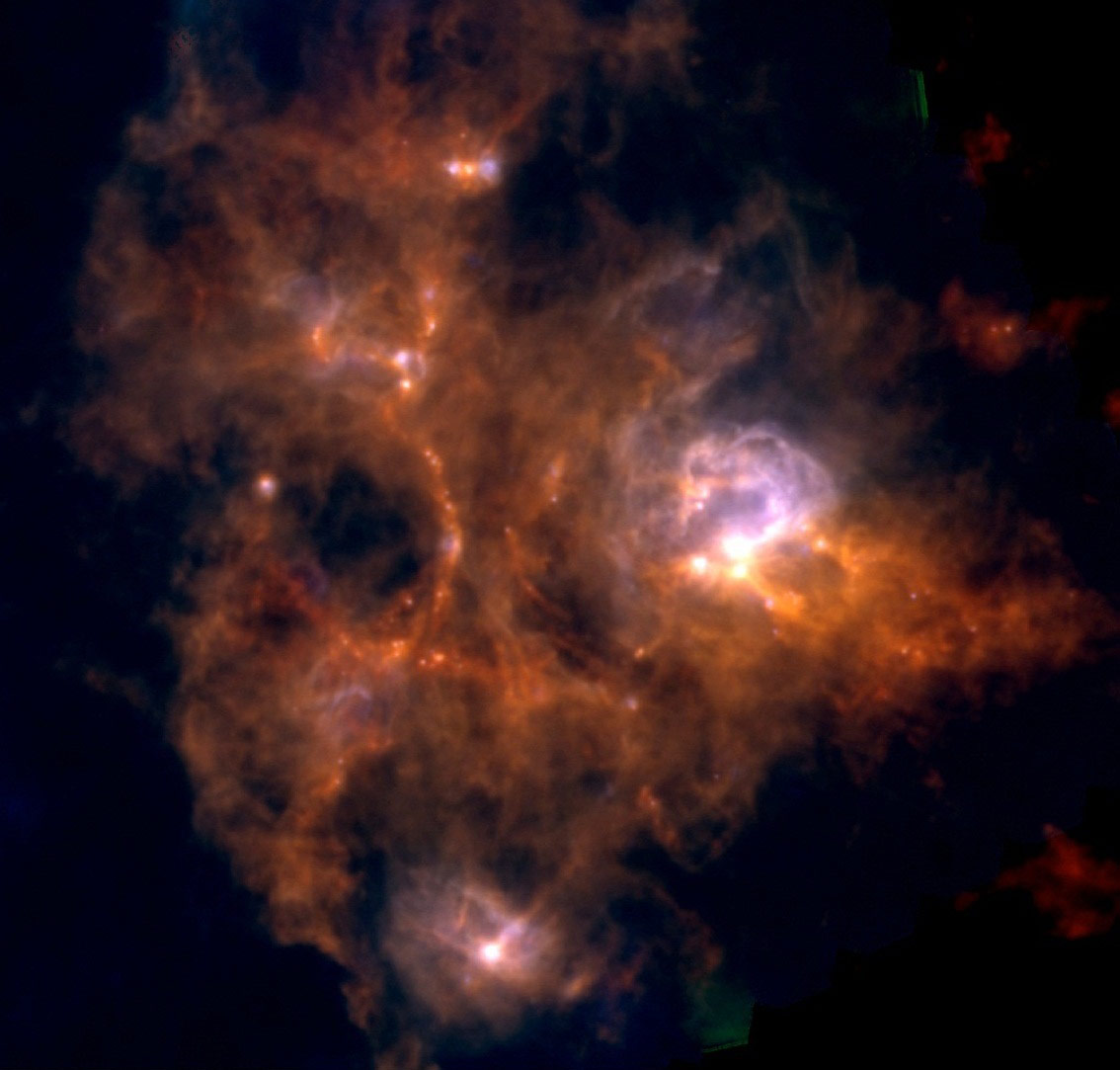
    NGC 7538 is a stellar nursery for massive stars. Situated approximately 9,000 light-years away, this region stands as one of the few places of massive star formation within relative proximity. This proximity offers astronomers an exceptional opportunity to scrutinize this process with remarkable detail. Credit: ESA/Herschel/PACS/SPIRE. Acknowledgments: Cassie Fallscheer (University of Victoria), Mike Reid (University of Toronto), and the Herschel HOBYS team

    This new composite image shows NGC 7538, a stellar nursery for massive stars located roughly 9,000 light-years away.

    The billowing clouds portrayed in this image from ESA’s Herschel observatory are part of NGC 7538, a stellar nursery for massive stars. Located around 9,000 light-years away, this is one of the few regions of massive star formation that are relatively close to us, allowing astronomers to investigate this process in great detail.

    Star factories like NGC 7538 consist mainly of hydrogen gas, but they also contain small amounts of cosmic dust. It was through this minor – but crucial – component that Herschel could image these star-forming regions, because dust shines brightly at the far-infrared wavelengths that were probed by the observatory.

    With a total mass of almost 400,000 Suns, NGC 7538 is an active factory where stars come to life – especially huge ones that are over eight times more massive than the Sun. Hundreds of seeds of future stellar generations nestle in the mixture of surrounding gas and dust scattered across the image. Once they reach a critical mass, they will ignite as stars. Thirteen of these proto-stars have masses greater than 40 Suns, and are also extremely cold, less than –250ºC (-418ºF).

    One group of stellar seeds seem to trace a ring-like structure, visible in the left part of the image. The ring may be the edge of a bubble carved by previous stellar explosions – as stars reach the end of their lives and explode as dramatic supernovas – but astronomers are still investigating the origin of this peculiar arrangement.

    The image is a composite of the wavelengths of 70 microns (blue), 160 microns (green), and 250 microns (red) and spans about 50 x 50 arc minutes. North is up and east is to the left.

    Reference: “Herschel Reveals Massive Cold Clumps in NGC 7538” by C. Fallscheer, M. A. Reid, J. Di Francesco, P. G. Martin, M. Hennemann, T. Hill, Q. Nguyen-Luong, F. Motte, A. Men’shchikov, Ph. Andre, D. Ward-Thompson, M. Griffin, J. Kirk, V. Konyves, K. L. J. Rygl, M. Sauvage, N. Schneider, L. D. Anderson, M. Benedettini, J.-P. Bernard, S. Bontemps, A. Ginsburg, S. Molinari, D. Polychroni, A. Rivera-Ingraham, H. Roussel, L. Testi, G. White, J. P. Williams, C. D. Wilson, M. Wong and A. Zavagno, 30 July 2013, The Astrophysical Journal.
    DOI: 10.1088/0004-637X/773/2/102
    arXiv:1307.0022


    Never miss a breakthrough: Join the SciTechDaily newsletter.
    Follow us on Google and Google News.

    Astronomy Astrophysics European Space Agency Herschel Space Observatory Protostar Star Formation
    Share. Facebook Twitter Pinterest LinkedIn Email Reddit

    Related Articles

    Astronomers Find the First Evidence of a Noble-Gas Based Molecule in Space

    Study Reveals the Explosive Growth of a Newly Formed Star in the Milky Way

    Astronomers Detect Subtle Twist in the Relic Radiation from the Big Bang

    Herschel Discovers a Newfound Reservoir of Stellar Fuel

    APEX Reveals Interstellar Dust in the Cosmic Clouds of Orion

    Herschel Makes Detailed Observations of a Hot Molecular Gas at the Center of the Milky Way

    Herschel Data Reveals Clues About High-Mass Star Formation

    Astronomers Discover Some of the Youngest Stars Ever Seen

    Herschel Discovers Water Vapor in a Molecular Cloud on the Verge of Star Formation

    Leave A Reply Cancel Reply

    • Facebook
    • Twitter
    • Pinterest
    • YouTube

    Don't Miss a Discovery

    Subscribe for the Latest in Science & Tech!

    Trending News

    The Universe Is Expanding Too Fast and Scientists Can’t Explain Why

    “Like Liquid Metal”: Scientists Create Strange Shape-Shifting Material

    Early Warning Signals of Esophageal Cancer May Be Hiding in Plain Sight

    Common Blood Pressure Drug Shows Surprising Power Against Deadly Antibiotic-Resistant Superbug

    Scientists Uncover Dangerous Connection Between Serotonin and Heart Valve Disease

    Scientists Discover a “Protector” Protein That Could Help Reverse Hair Loss

    Bone-Strengthening Discovery Could Reverse Osteoporosis

    Scientists Uncover Hidden Trigger Behind Stem Cell Aging

    Follow SciTechDaily
    • Facebook
    • Twitter
    • YouTube
    • Pinterest
    • Newsletter
    • RSS
    SciTech News
    • Biology News
    • Chemistry News
    • Earth News
    • Health News
    • Physics News
    • Science News
    • Space News
    • Technology News
    Recent Posts
    • Quantum Physics’ Strangest Problem May Hold the Key to Time Itself
    • Scientists Create “Liquid Gears” That Spin Without Touching
    • The Simple Habit That Could Help Prevent Cancer
    • Forgotten Medicinal Plant Shows Promise in Fighting Dangerous Superbugs
    • Millions Take These IBS Drugs, But a New Study Finds Serious Risks
    Copyright © 1998 - 2026 SciTechDaily. All Rights Reserved.
    • Science News
    • About
    • Contact
    • Editorial Board
    • Privacy Policy
    • Terms of Use

    Type above and press Enter to search. Press Esc to cancel.