
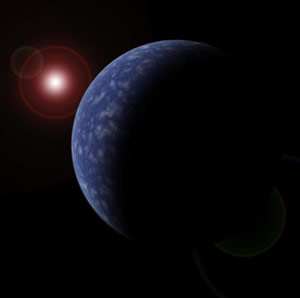
An international team of astronomers has discovered eight new planets orbiting nearby red dwarf stars, three of which are classified as habitable-zone super-Earths.
The study identifies that virtually all red dwarfs, which make up at least three quarters of the stars in the Universe, have planets orbiting them. The research also suggests that habitable-zone super-Earth planets (where liquid water could exist and making them possible candidates to support life) orbit around at least a quarter of the red dwarfs in the Sun’s own neighborhood.
These new results have been obtained from analyzing data from two high-precision planet surveys – the HARPS (High Accuracy Radial Velocity Planet Searcher) and UVES (Ultraviolet and Visual Echelle Spectrograph) – both operated by the European Southern Observatory in Chile. By combining the data, the team was able to detect signals that were not strong enough to be seen clearly in the data from either instrument alone.
Dr. Mikko Tuomi, from the University of Hertfordshire’s Center for Astrophysics Research and lead author of the study, said: “We were looking at the data from UVES alone, and noticed some variability that could not be explained by random noise. By combining those with data from HARPS, we managed to spot this spectacular haul of planet candidates.”
“We are clearly probing a highly abundant population of low-mass planets, and can readily expect to find many more in the near future – even around the very closest stars to the Sun.”
To find evidence for the existence of these planets, the astronomers measured how much a star “wobbles” in space as it is affected by a planet’s gravity. As an unseen planet orbits a distant star, the gravitational pull causes the star to move back and forth in space. This periodic wobble is detected in the star’s light.
The team used novel analysis techniques in squeezing the planetary signals out of the data. In particular, they applied the Bayes’ rule of conditional probabilities that enables answering the question “What is the probability that a given star has planets orbiting it based on the available data?” This approach, together with a technique enabling the researchers to filter out excess noise in the measurements, made the detections possible.
Professor Hugh Jones, also from the University of Hertfordshire, commented: “This result is somewhat expected in the sense that studies of distant red dwarfs with the Kepler mission indicate a significant population of small radius planets. So it is pleasing to be able to confirm this result with a sample of stars that are among the brightest in their class.”
The new planets have been discovered around stars between 15 and 80 light-years away and they have orbital periods between two weeks and nine years. This means they orbit their stars at distances ranging from about 0.05 to 4 times the Earth-Sun distance – 149 million kilometers (93 million miles).
These discoveries add eight new exoplanets signals to the previous total of 17 already known around such low-mass dwarfs. The paper also presents ten weaker signals for which further follow-up is necessary.
Reference: “Bayesian search for low-mass planets around nearby M dwarfs. Estimates for occurrence rate based on global detectability statistics” by Mikko Tuomi, Hugh R. A. Jones, John R. Barnes, Guillem Anglada-Escudé and James S. Jenkins, 8 May 2014, MNRAS.
DOI: 10.1093/mnras/stu358
arXiv:1403.0430
Never miss a breakthrough: Join the SciTechDaily newsletter.
Follow us on Google and Google News.