
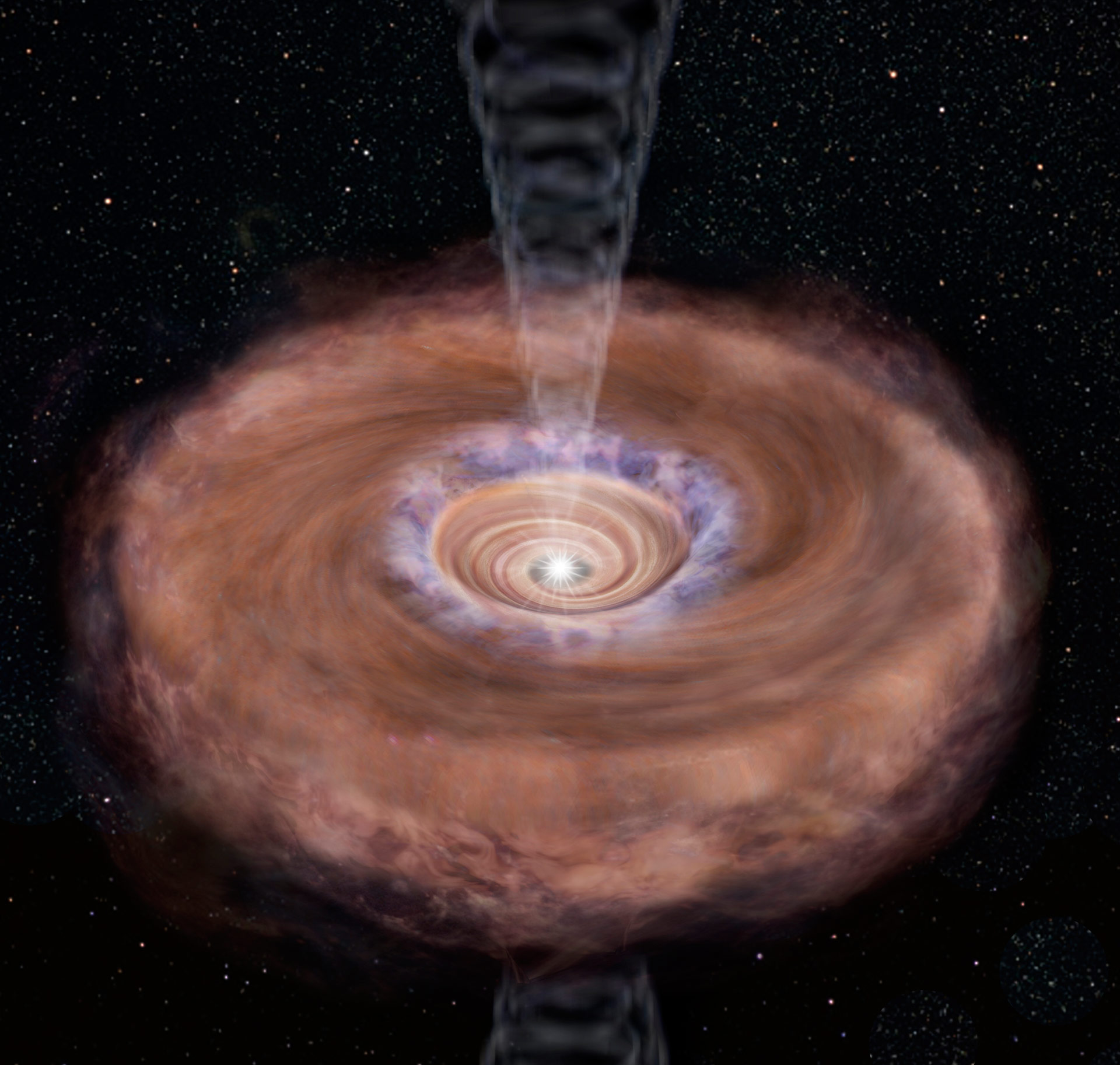
Astronomers have discovered an unexpected chemical change in the transition zone between the infalling envelope and the gas disk around young protostar L1527.
The international research team observed the young protostar L1527 in the Taurus molecular cloud at a high spatial resolution with ALMA, and discovered an unexpected chemical change in the transition zone between the infalling envelope and the gas disk. So far, it has been believed that interstellar matter is smoothly delivered to the gas disk around the protostar without any significant chemical changes. However, it is now found to be oversimplified. The infalling gas is jammed up due to centrifugal force at the outer edge of the gas disk, where local heating causes a drastic chemical change. This chemical change highlights the outer edge of the gas disk which is still growing.
This research highlights “chemistry in the formation of protoplanetary disks” which is not anticipated before. It is still unknown whether this sharp transition is seen around many protostars or not, and it will be uncovered by future observational studies. This is also important for understanding of the formation process of our own solar system.
Stars are formed by the contraction of interstellar gas and dust. Around a protostar, gas, and dust form a disk in which planets are eventually formed. Then, are the chemical compositions of the interstellar cloud and the disk identical? The new ALMA observations show that the answer is ‘no.’ This finding has a large impact on the understanding of the formation process of planets and protoplanetary disks.
The international research team, led by Dr. Nami Sakai, an assistant professor at the Department of Physics, The University of Tokyo, observed a baby star L1527 in the constellation Taurus with ALMA. The team observed radio emission from cyclic-C3H2 and sulfur monoxide (SO) molecules to analyze the motion and temperature of the gas around the baby star.
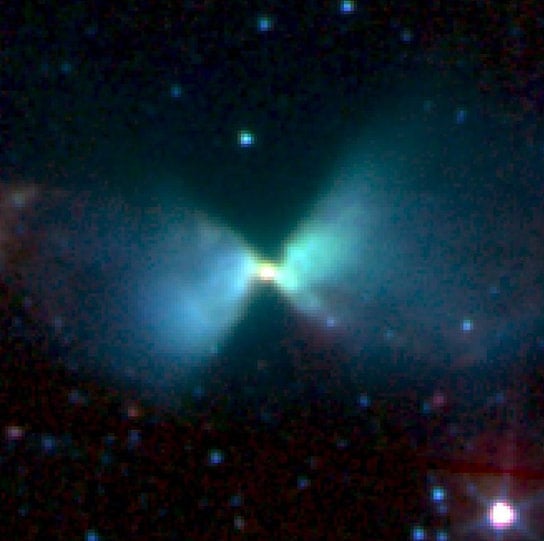
L1527 is a well-known protostar (baby star) and many astronomers have pointed telescopes at it. For example, NASA’s Spitzer Space Telescope took infrared images of the star. The stellar light escapes through a cavity excavated by a powerful bipolar gas flow from the star and illuminates the surrounding gas, which makes a butterfly-shaped nebula extending in the east-west direction (Figure 1). Past radio observations revealed that gas is circling around the star to form a disk and we see the disk edge-on.
Radio observations by ALMA have the advantage of being able to see the gas directly, which is invisible in infrared light. Various molecules in the gas emit characteristic radiation as radio waves under characteristic conditions (temperature, density, chemical compositions). Therefore astronomers can investigate the nature of the gas by observing various molecules. Also, astronomers measure the motion of the gas with the Doppler Effect. ALMA’s unprecedented sensitivity enables us to detect weak radio emissions which are undetectable by other telescopes. In fact, because of their low abundances, cyclic-C3H2, and SO emissions are much weaker than, for example, the CO emission observed in detail around L1527 in earlier studies.
Observations of cyclic-C3H2 with ALMA show that the gas forms a disk with a radius of 500 AU (1 AU corresponds to the distance between the Sun and Earth. The distance from the Sun to Neptune is 30 AU) circling around the protostar. Beyond 100 AU, as gas rotates around the protostar it is also infalling towards the star. Inside 100 AU, the emission from cyclic-C3H2 is very weak, which indicates chemical differentiation between the inner and outer disk. The team estimated the gas temperature at -240 to -250 degrees Celsius (-400 to -418 degrees Fahrenheit) from the emission strength. On the other hand, SO has a completely different distribution: a ring-like structure with a radius of 100 AU. The temperature of the SO molecules is estimated to be -210 degrees Celsius (-346 degrees Fahrenheit), which is clearly higher than that of cyclic-C3H2.
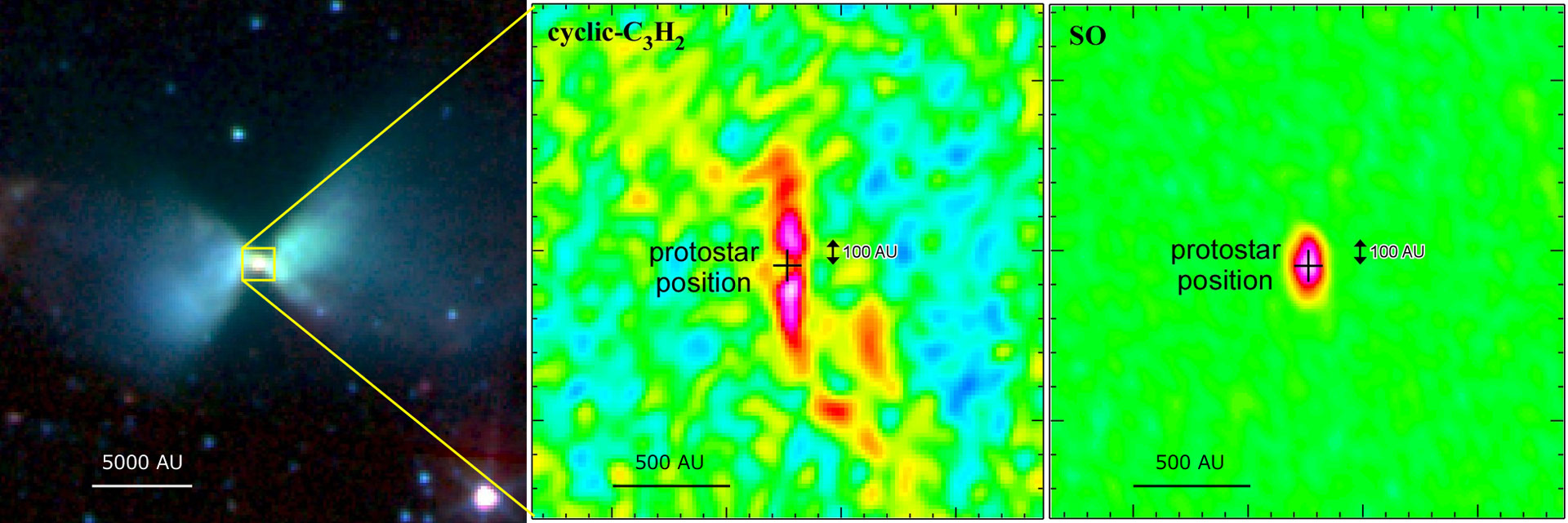
What causes the drastic chemical composition change at 100 AU from the star? Simple simulations show that the infalling gas is inhibited due to the centrifugal force and piles up. This boundary is called the “centrifugal barrier”. The infalling gas collides with the barrier and is warmed up. SO molecules frozen on the surface of cold dust grains are liberated into the gas phase. The temperature decreases inside the barrier and the SO molecules are frozen again. This is the formation process of the SO ring at 100 AU.
Rotating motion dominates inside the centrifugal barrier. Hence, the barrier is the edge of the disk formation region in which eventually a planetary system will be formed. There has been little consideration of the chemical differences between the interstellar clouds and the protoplanetary disks. This is the first evidence of a drastic change in the chemical composition during the formation of a protoplanetary disk.
This research highlights “chemistry in the formation of protoplanetary disks” which was not anticipated before. It is still unknown whether this sharp transition is seen around many protostars or not, and that will be uncovered by future observational studies. This is also important for understanding the formation process of our own Solar System.
Reference: “Change in the chemical composition of infalling gas forming a disk around a protostar” by Nami Sakai, Takeshi Sakai, Tomoya Hirota, Yoshimasa Watanabe, Cecilia Ceccarelli, Claudine Kahane, Sandrine Bottinelli, Emmanuel Caux, Karine Demyk, Charlotte Vastel, Audrey Coutens, Vianney Taquet, Nagayoshi Ohashi, Shigehisa Takakuwa, Hsi-Wei Yen, Yuri Aikawa and Satoshi Yamamoto, 12 February 2014, Nature.
DOI: 10.1038/nature13000
Never miss a breakthrough: Join the SciTechDaily newsletter.
Follow us on Google and Google News.