
Close Menu
    Facebook X (Twitter) Instagram
    SciTechDaily
    • Biology
    • Chemistry
    • Earth
    • Health
    • Physics
    • Science
    • Space
    • Technology
    Facebook X (Twitter) Pinterest YouTube RSS
    SciTechDaily
    Home»Space»Cassini Measures Titan Surface Temperatures During Northern Winter and Spring
    Space

    Cassini Measures Titan Surface Temperatures During Northern Winter and Spring

    By SciTechDailyFebruary 23, 2016No Comments3 Mins Read
    Facebook Twitter Pinterest Telegram LinkedIn WhatsApp Email Reddit
    Share
    Facebook Twitter LinkedIn Pinterest Telegram Email Reddit
    Maps Show Varying Surface Temperatures on Titan
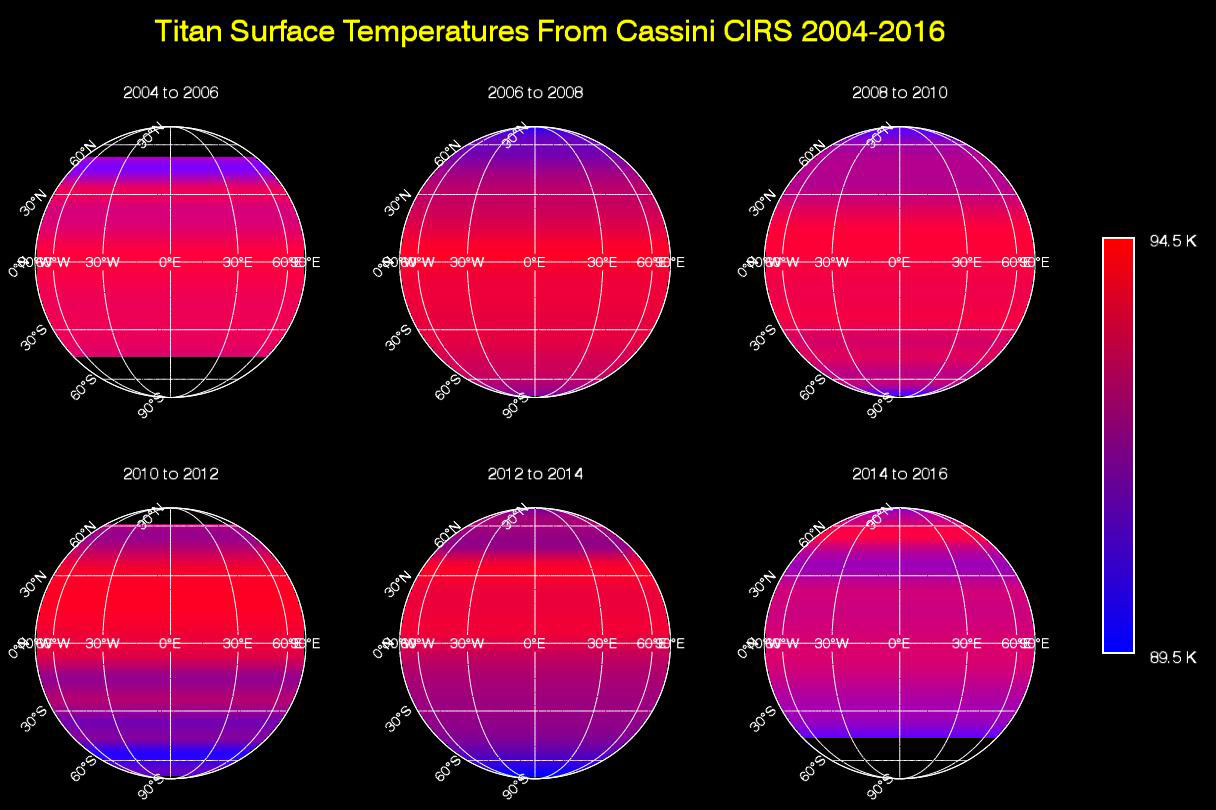
    New maps show varying surface temperatures on Titan. Credit: NASA/JPL-Caltech/GSFC

    Newly published research details the varying surface temperatures on Saturn’s moon Titan at two-year intervals, from 2004 to 2016. The measurements were made by the Composite Infrared Spectrometer (CIRS) instrument on NASA’s Cassini spacecraft.

    The maps show thermal infrared radiation (heat) coming from Titan’s surface at a wavelength of 19 microns, a spectral window at which the moon’s otherwise opaque atmosphere is mostly transparent. Temperatures have been averaged around the globe from east to west (longitudinally) to emphasize the seasonal variation across latitudes (from north to south). Black regions in the maps are areas for which there was no data.

    Titan’s surface temperature changes slowly over the course of the Saturn system’s long seasons, which each last seven and a half years. As on Earth, the amount of sunlight received at each latitude varies as the sun’s illumination moves northward or southward over the course of the 30-year-long Saturnian year.
    New Titan Temperature Lag Maps & Animation
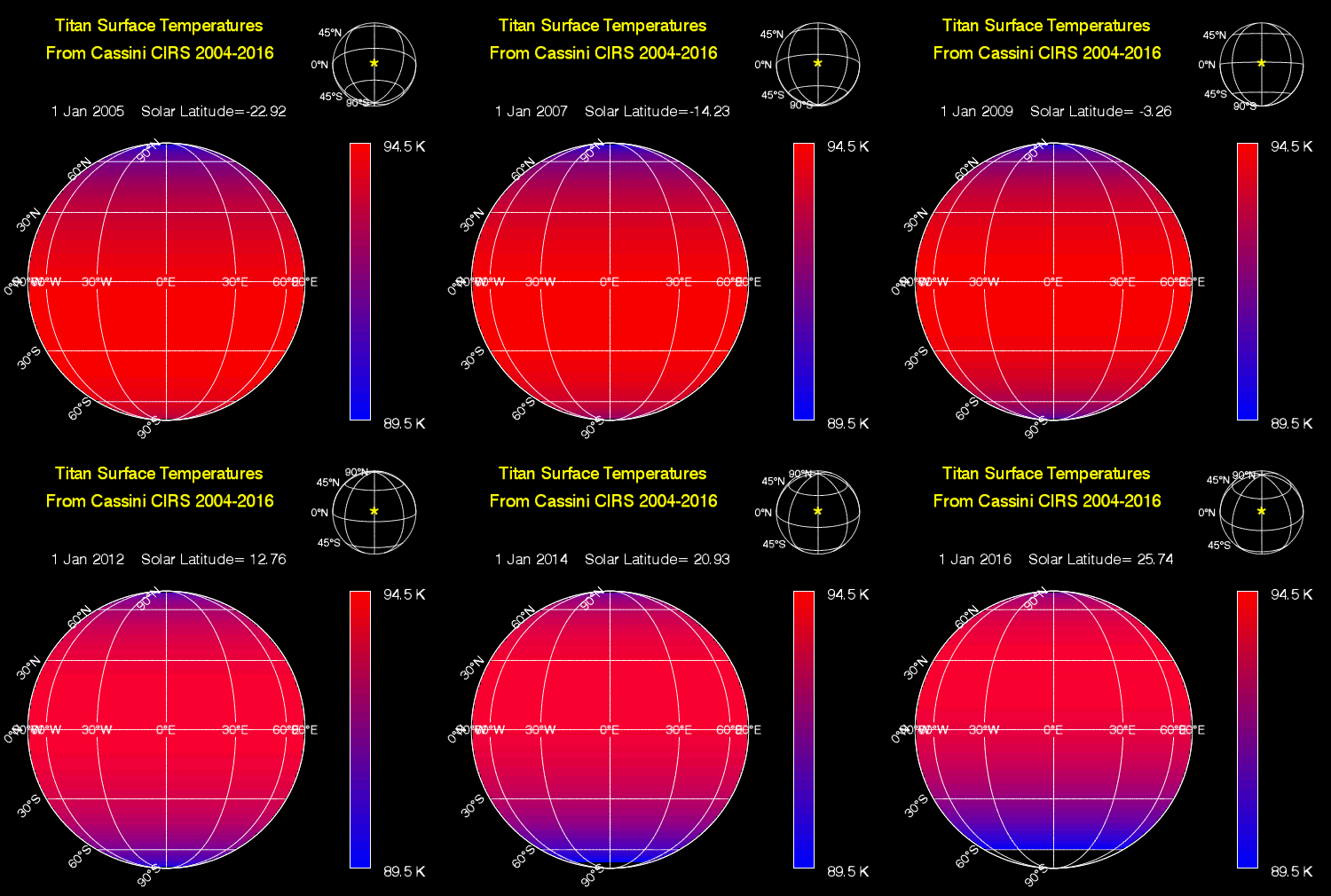
    New Titan temperature lag maps & animation. Credit: NASA/JPL-Caltech/GSFC

    When Cassini arrived at Saturn in 2004, Titan’s southern hemisphere was in late summer and was therefore the warmest region. Shortly after the 2009 equinox, in 2010, temperatures were symmetrical across the northern and southern hemispheres, mimicking the distribution observed by Voyager 1 in 1980 (one Titan year earlier). Temperatures subsequently cooled in the south and rose in the north, as southern winter approached.

    While the overall trend in the temperature shift is clearly evident in these maps, there is narrow banding in several places that is an artifact of making the observations through Titan’s atmosphere. The moon’s dense, hazy envelope adds noise to the difficult measurement.

    The animation above shows a simplified model of the varying temperature data at yearly intervals. The latitude banding has been smoothed to more clearly show how Titan’s peak temperature moved from 19 degrees south to 16 degrees north latitude between 2004 and 2016. The small globe in the upper right corner shows the view of Titan as seen from the direction of the sun. The latitude on Titan where the sun is directly overhead (the subsolar latitude) is indicated by a yellow star.

    Although it moves in latitude, the maximum measured temperature on Titan remains around -292 degrees Fahrenheit (-179.6 degrees Celsius, 93.6 Kelvin), with a minimum temperature at the winter pole only 6 degrees Fahrenheit (3.5 degrees Celsius or Kelvin) colder. This is a much smaller contrast than exists between Earth’s warmest and coldest temperatures, which can vary by more than 200 degrees Fahrenheit, or more than 100 degrees Celsius.

    These Titan surface temperature maps are a visualization of measurements that appeared in publication as: D. E. Jennings et al., Astrophysical Journal Letters, 816, L17, 2016.

    Reference: “Surface Temperatures on Titan During Northern Winter and Spring” by D. E. Jennings, V. Cottini, C. A. Nixon, R. K. Achterberg, F. M. Flasar, V. G. Kunde, P. N. Romani, R. E. Samuelson, A. Mamoutkine, N. J. P. Gorius, A. Coustenis and T. Tokano, 4 January 2016, The Astrophysical Journal.
    DOI: 10.3847/2041-8205/816/1/L17

    Never miss a breakthrough: Join the SciTechDaily newsletter.
    Follow us on Google and Google News.

    Astronomy Cassini-Huygens Mission NASA Planetary Science Titan
    Share. Facebook Twitter Pinterest LinkedIn Email Reddit

    Related Articles

    NASA’s Cassini Spacecraft Views a Cloudy Saturn and Titan

    NASA Experiments Reveal Previously Unidentified Material in Titan’s Atmosphere

    Cassini Views the Lakes of Saturn’s Moon Titan

    NASA’s Cassini to Conduct Its 100th Flyby of the Saturn Moon Titan

    Cassini Reveals Clues about Saturn’s Moon Titan

    New Cassini Images of Titan’s Hydrocarbon Seas and Lakes

    Cassini Helps Explain the Mystery of the Missing Waves on Titan

    Cassini Data Confirms PAHs Play Major Role in Production of Lower Haze on Titan

    Titan’s Methane May Run Out

    Leave A Reply Cancel Reply

    • Facebook
    • Twitter
    • Pinterest
    • YouTube

    Don't Miss a Discovery

    Subscribe for the Latest in Science & Tech!

    Trending News

    Scientists May Have Found the Key to Jupiter and Saturn’s Moon Mystery

    Scientists Uncover Brain Changes That Link Pain to Depression

    Saunas May Do More Than Raise Body Temperature – They Activate Your Immune System

    Exercise in a Pill? Metformin Shows Surprising Effects in Cancer Patients

    Hidden Oceans of Magma Could Be Protecting Alien Life

    New Study Challenges Alzheimer’s Theories: It’s Not Just About Plaques

    Artificial Sweeteners May Harm Future Generations, Study Suggests

    Splashdown! NASA Artemis II Returns From Record-Breaking Moon Mission

    Follow SciTechDaily
    • Facebook
    • Twitter
    • YouTube
    • Pinterest
    • Newsletter
    • RSS
    SciTech News
    • Biology News
    • Chemistry News
    • Earth News
    • Health News
    • Physics News
    • Science News
    • Space News
    • Technology News
    Recent Posts
    • As Cities Invade the Amazon, Yellow Fever Makes a Dangerous Comeback
    • “Asian Flush” May Be a Hidden Trigger for Deadly Heart Damage
    • AI Could Detect Early Signs of Alzheimer’s in Under a Minute – Far Before Traditional Tests
    • What if Dark Matter Has Two Forms? Bold New Hypothesis Could Explain a Cosmic Mystery
    • Researchers Expose Hidden Chemistry of “Ore-Forming” Elements in Biology
    Copyright © 1998 - 2026 SciTechDaily. All Rights Reserved.
    • Science News
    • About
    • Contact
    • Editorial Board
    • Privacy Policy
    • Terms of Use

    Type above and press Enter to search. Press Esc to cancel.