
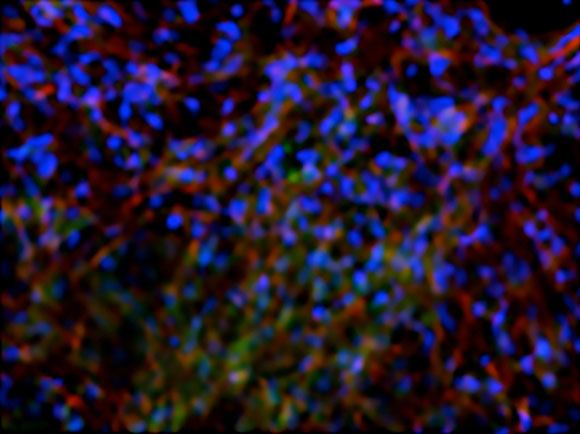
A team of scientists from UC San Diego have discovered an easy and efficient way to coax human pluripotent stem cells to regenerate bone tissue — by feeding them adenosine, a naturally occurring molecule in the body. The stem-cell-derived bone tissue helped repair cranial bone defects in mice without developing tumors or causing infection.
The work could lead to regenerative treatments for patients with critical bone defects and soldiers who have suffered traumatic bone injuries. The findings, published in the journal Science Advances, could also lead to a simple, scalable, and inexpensive way to manufacture a pure population of bone-building cells.
“One of the broader goals of our research is to make regenerative treatments more accessible and clinically relevant by developing easy, efficient, and cost-effective ways to engineer human cells and tissues,” said Shyni Varghese, a bioengineering professor at UC San Diego and senior author of the study.
Pluripotent stem cells are capable of becoming any type of cell in the body, such as muscle, heart, skin, or bone — a process called differentiation. Because of this ability, pluripotent stem cells have promising therapeutic uses to repair or regenerate various tissues and organs.
But getting pluripotent stem cells to differentiate into a particular type of cell that can function inside the body is not simple. Directing stem cell differentiation is like following a complex recipe, involving a long list of ingredients and steps that make the process costly and inefficient.
Another challenge is producing stem-cell-derived tissues or organs that don’t develop teratomas—tumors that contain a variety of tissues found in different organs — when transplanted. Teratomas are what can happen when some of the pluripotent stem cells go rogue and differentiate uncontrollably.
Varghese and her team showed that they could control the differentiation of human pluripotent stem cells into functional osteoblasts — bone-building cells — simply by adding the molecule adenosine to their growth medium. Like living bone cells in the body, the resulting osteoblasts built bone tissues with blood vessels. When transplanted into mice with bone defects, the osteoblasts formed new bone tissues in vivo without any signs of teratoma formation.
“It’s amazing that a single molecule can direct stem cell fate. We don’t need to use a cocktail of small molecules, growth factors or other supplements to create a population of bone cells from human pluripotent stem cells like induced pluripotent stem cells,” Varghese said.
This work stems from a previous study by Varghese’s group to understand how calcium phosphate minerals found in bone tissue induce stem cells to differentiate into osteoblasts. Her team discovered that stem cells take up calcium phosphate to produce ATP, a metabolic molecule, which then breaks down into adenosine and signals the stem cells to become osteoblasts.
“We wondered what would happen if we bypassed the steps and just supplemented the medium with adenosine. That’s what inspired this current study,” Varghese said.
Varghese’s team is now investigating exactly how adenosine signaling promotes bone formation. So far, they’ve attributed the signaling to a receptor on the stem cells’ surface, called the A2bR receptor, which binds to adenosine. But this mechanism still requires further study, she said.
Full paper: “Small molecule-driven direct conversion of human pluripotent stem cells into functional osteoblasts.” Authors of the study are Heemin Kang, Yu-Ru V. Shih, Manando Nakasaki, Harsha Kabra, and Shyni Varghese, all from UC San Diego.
This work was supported by the National Institutes of Health (grant 1 R01 AR063184-01A1).
Reference: “Small molecule–driven direct conversion of human pluripotent stem cells into functional osteoblasts” by Heemin Kang, Yu-Ru V. Shih, Manando Nakasaki, Harsha Kabra and Shyni Varghese, 31 August 2016, Science Advances.
DOI: 10.1126/sciadv.1600691
Never miss a breakthrough: Join the SciTechDaily newsletter.
Follow us on Google and Google News.