
Close Menu
    Facebook X (Twitter) Instagram
    SciTechDaily
    • Biology
    • Chemistry
    • Earth
    • Health
    • Physics
    • Science
    • Space
    • Technology
    Facebook X (Twitter) Pinterest YouTube RSS
    SciTechDaily
    Home»Space»Astronomers Study a Star’s Environment from Light Curves
    Space

    Astronomers Study a Star’s Environment from Light Curves

    By Harvard-Smithsonian Center for AstrophysicsOctober 17, 2016No Comments3 Mins Read
    Facebook Twitter Pinterest Telegram LinkedIn WhatsApp Email Reddit
    Share
    Facebook Twitter LinkedIn Pinterest Telegram Email Reddit
    Studying a Star's Environment from Light Curves
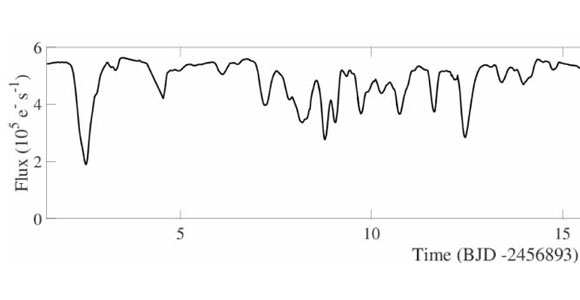
    A plot of the light intensity versus time (the light curve) for the star EPIC 204278916. The star was observed for over 78.8 days with a 29.4-minute cadence. The first 15 days are plotted here, and show the light changing in intensity by over a factor of two.

    Using the ALMA telescopes, astronomers discovered a circumstellar disk around the star EPIC 204278916 and offer several explanations for the dips including that they are caused by clumps of material in the warped inner portion of the disk.

    There are now about 2700 confirmed exoplanets discovered by transiting techniques including those used with the Kepler satellite. The transit method observes the stellar light curve (the flux versus time), and spots the slight dimming of starlight when an exoplanet crosses the face of the star as seen from Earth. The orbital period of the exoplanet can be determined from multiple transits, with the duration and details of the transit dip providing a measure of the planet’s size. Light curves actually monitor a number of physical processes including some at the stellar surface (like sunspots) as well as in their surroundings. Periodic variability of the observed stellar flux has long been used to measure stellar rotation periods, for example; transiting exoplanets produce a characteristic shape in the light curve.

    Variability in young stellar objects (YSOs) is also related to the presence of a protoplanetary disc. The material in the disc can intermittently obscure the central star, while the highly variable accretion onto the central star can also modify the emission from the system. The variability of YSOs is known to show different kinds of periodicities and symmetries that are possibly related to different environmental processes, from comets orbiting around the stars to variations in circumstellar material with occulting material located at the inner edges of a disc viewed edge-on.

    CfA astronomer Luca Ricci and his colleagues serendipitously noticed such an effect in the light curves of the star EPIC204278916 seen with the extended Kepler mission (“K2”). Its irregular light dimming appears to be due to one of these environmental possibilities. For about twenty-five days the light from the star, a young, low-mass “M” dwarf star, underwent unusual and large irregular fluctuations, dimming by as much as sixty-five percent. The astronomers then used the ALMA radio array to spot evidence of a tilted disk around the star, confirming their original suspicions.

    Their careful analysis of the light curve concludes that it is consistent with a warped inner disk, inclined to the line-of-sight by about fifty-seven degrees and containing dark clumps of material in circular orbits; an alternative possibility is a collection of cometary debris in an eccentric orbit. Future observations will further constrain these choices, but the results emphasize the wealth of information about stellar systems (not only the stars themselves) that can be extracted from light curves.

    Reference: “The Peculiar Dipping Events in the Disk-Bearing Young-Stellar Object EPIC 204278916” by S. Scaringi, C. F. Manara, S. A. Barenfeld, P. J. Groot, A. Isella, M. A. Kenworthy, C. Knigge, T. J. Maccarone, L. Ricci and M. Ansdell, 26 August 2016, MNRAS.
    DOI: 10.1093/mnras/stw2155

    Never miss a breakthrough: Join the SciTechDaily newsletter.
    Follow us on Google and Google News.

    Astronomy Astrophysics Cosmology Harvard-Smithsonian Center for Astrophysics
    Share. Facebook Twitter Pinterest LinkedIn Email Reddit

    Related Articles

    Webb’s Mysterious “Little Red Dots” May Be the Cradle of the First Black Holes

    Mysterious Radio Signals Reveal What’s Hiding Between Galaxies

    Cosmic Mystery Solved: Astronomers Have Discovered the Universe’s “Missing” Matter

    Invisible Storm Lights Up Galaxy Cluster With Record-Breaking Radio Glow

    Astronomers Search for Trigger of Nearby Supernova

    Herschel Observations Help Identify the Physical Processes Underway in Cold, Dense Clouds

    CfA Scientists Measure the Rate of Expansion of the Universe

    New Study Challenges Planck Results

    Calculations Show the Ideal Time to Study the Cosmos

    Leave A Reply Cancel Reply

    • Facebook
    • Twitter
    • Pinterest
    • YouTube

    Don't Miss a Discovery

    Subscribe for the Latest in Science & Tech!

    Trending News

    Scientists Discover How Coffee Impacts Memory, Mood, and Gut Health

    Why Did the Neanderthals Disappear? Scientists Reveal Humans Had a Hidden Advantage

    Physicists Propose Strange Experiment Where Time Goes Quantum

    Magnesium Magic: New Drug Melts Fat Even on a High-Fat, High-Sugar Diet

    Weight-Loss Drugs Like Ozempic May Come With an Unexpected Cost

    Mezcal “Worm” in a Bottle Mystery: DNA Testing Reveals a Surprise

    New Research Reveals That Your Morning Coffee Activates an Ancient Longevity Switch

    This Is What Makes You Irresistible to Mosquitoes

    Follow SciTechDaily
    • Facebook
    • Twitter
    • YouTube
    • Pinterest
    • Newsletter
    • RSS
    SciTech News
    • Biology News
    • Chemistry News
    • Earth News
    • Health News
    • Physics News
    • Science News
    • Space News
    • Technology News
    Recent Posts
    • Harvard Scientists Reveal Secret Structure Behind How You Smell
    • Scientists Just Discovered the Hidden Trick That Keeps Your Cells Alive
    • This Simple Movement Could Be Secretly Cleaning Your Brain
    • Male Birth Control Breakthrough: Scientists Find Way To Turn Sperm Production Off and Back On
    • A Common Vitamin Could Hold the Key to Treating Fatty Liver Disease
    Copyright © 1998 - 2026 SciTechDaily. All Rights Reserved.
    • Science News
    • About
    • Contact
    • Editorial Board
    • Privacy Policy
    • Terms of Use

    Type above and press Enter to search. Press Esc to cancel.