
Close Menu
    Facebook X (Twitter) Instagram
    SciTechDaily
    • Biology
    • Chemistry
    • Earth
    • Health
    • Physics
    • Science
    • Space
    • Technology
    Facebook X (Twitter) Pinterest YouTube RSS
    SciTechDaily
    Home»Physics»Yale Engineers Advance Quantum Technology With Photon Control
    Physics

    Yale Engineers Advance Quantum Technology With Photon Control

    By School of Engineering & Applied Science, Yale UniversityNovember 1, 2016No Comments2 Mins Read
    Facebook Twitter Pinterest Telegram LinkedIn WhatsApp Email Reddit
    Share
    Facebook Twitter LinkedIn Pinterest Telegram Email Reddit
    Advancing Quantum Technology With Photon Control
    Controlling the frequency of individual photons is a critical aspect of quantum communications and computing.

    Engineers from Yale University have developed a new technique to control the frequency of single photons.

    The ability to control the frequency of single photons is crucial to realizing the potential of quantum communications and quantum computing. The current methods for changing photon frequency, however, bring with them significant drawbacks.

    Researchers in the lab of Hong Tang, the Llewellyn West Jones, Jr. Professor of Electrical Engineering & Physics, have developed a technique that avoids these obstacles. The results of their work are published today in Nature Photonics. Linran Fan, a Ph.D. student in Tang’s lab, is the lead author.

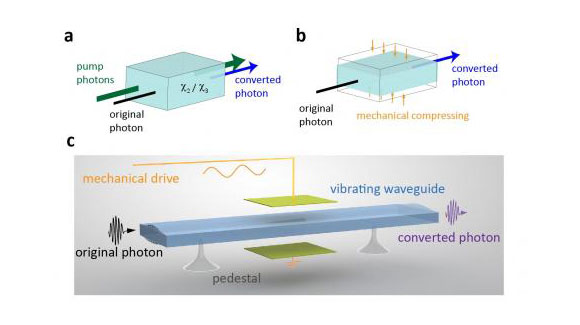
    Currently, the most common technique for manipulating photon frequency is with what’s known as nonlinear optical effects, in which a laser essentially acts as a pump, changing the photon frequency by providing extra photons to mix with the original one. The effect is weak and probabilistic, though, so the process requires a very strong laser, which creates “noise” – the loss of certain quantum properties.

    Using a completely different technique, the Tang lab demonstrated a capability to change photon frequency by up to 300 GHz without creating any noise. Instead of using nonlinear optical effects, the researchers change the frequency of the photon by changing the photon’s propagating medium – the material in which the light travels. The structure that guides the light, known as a waveguide, is rapidly modified while the photon is in it. This allows the researchers to stretch or compress the photon and change its frequency. It’s a difficult process, Fan said, because the researchers need to change the structure enough within a very small time scale, and the change must happen exactly as the photon enters the waveguide.

    “We utilize microwave and the piezo-electric effect, which turns microwave energy into mechanical stress, to change the waveguide structure,” Fan said. “We don’t need the optical pump, so we don’t create any noise photon.”

    Reference: “Integrated optomechanical single-photon frequency shifter” by Linran Fan, Chang-Ling Zou, Menno Poot, Risheng Cheng, Xiang Guo, Xu Han and Hong X. Tang, 31 October 2016, Nature Photonics.
    DOI: 10.1038/nphoton.2016.206

    Never miss a breakthrough: Join the SciTechDaily newsletter.
    Follow us on Google and Google News.

    Engineering Photonics Quantum Computing Quantum Physics Yale School of Engineering & Applied Science Yale University
    Share. Facebook Twitter Pinterest LinkedIn Email Reddit

    Related Articles

    MIT Physicists Create a New Form of Light Where Photons Interact

    New Research Provides Clearest Evidence Yet of Majorana Particle

    Yale Engineers Develop A New Chip That Could Advance Quantum Technology

    Yale Researchers Cross the “Break Even” Point in Preserving a Bit of Quantum Information

    Schrödinger’s Cat Gets a Second Box

    Chip-Scale Device Enables Yale Engineers to ‘See Without Looking’

    Yale Engineers Develop Hybrid System for Quantum Communication

    Physicists Track Quantum Errors in Real Time

    Physicists Create and Control a Large Quantum Mechanical System Built on Photons

    Leave A Reply Cancel Reply

    • Facebook
    • Twitter
    • Pinterest
    • YouTube

    Don't Miss a Discovery

    Subscribe for the Latest in Science & Tech!

    Trending News

    Popular Supplement Ingredient Linked to Shorter Lifespan in Men

    Scientists May Have Found a Way To Repair Nerve Damage in Multiple Sclerosis

    “Totally Unexpected” – Scientists Discover Pancreatic Cancer’s Fatal Addiction

    A Strange Quantum Effect May Explain One of Biology’s Greatest Mysteries

    James Webb Telescope Reveals the Universe’s Hidden Cosmic Web in Stunning Detail

    Scientists Identify Simple Supplement That Greatly Reduces Alzheimer’s Damage

    You May Have a Dangerous Type of Cholesterol Even if Your Tests Look Normal

    Your Blood Pressure Reading Could Be Wrong Because of One Simple Mistake

    Follow SciTechDaily
    • Facebook
    • Twitter
    • YouTube
    • Pinterest
    • Newsletter
    • RSS
    SciTech News
    • Biology News
    • Chemistry News
    • Earth News
    • Health News
    • Physics News
    • Science News
    • Space News
    • Technology News
    Recent Posts
    • Scientists Say a 40-Year-Old Childhood Obesity Warning May Be Completely Wrong
    • Marijuana Use May Raise Lung Cancer Risk, Researchers Warn
    • This Common Type of Food May Be Raising Your Risk of Heart Disease
    • Fur Seals’ Hearts Suddenly Spike Hours After Returning to Land
    • Scientists Say Cognitive Decline Isn’t Inevitable — Your Brain Can Improve at Any Age
    Copyright © 1998 - 2026 SciTechDaily. All Rights Reserved.
    • Science News
    • About
    • Contact
    • Editorial Board
    • Privacy Policy
    • Terms of Use

    Type above and press Enter to search. Press Esc to cancel.