
Close Menu
    Facebook X (Twitter) Instagram
    SciTechDaily
    • Biology
    • Chemistry
    • Earth
    • Health
    • Physics
    • Science
    • Space
    • Technology
    Facebook X (Twitter) Pinterest YouTube RSS
    SciTechDaily
    Home»Technology»Yale Engineers Develop A New Chip That Could Advance Quantum Technology
    Technology

    Yale Engineers Develop A New Chip That Could Advance Quantum Technology

    By Yale UniversityOctober 5, 2016No Comments3 Mins Read
    Facebook Twitter Pinterest Telegram LinkedIn WhatsApp Email Reddit
    Share
    Facebook Twitter LinkedIn Pinterest Telegram Email Reddit
    New Chip Could Advance Quantum Technology
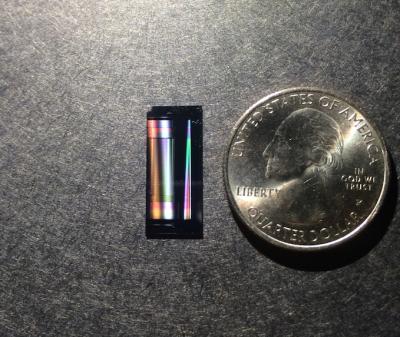
    Photo of chip from Hong Tang’s lab, compared in size to a quarter (colors in chip are photographic artifacts). Picture courtesy of Xiang Guo.

    Yale engineers have developed a new device that converts visible light to infrared light suitable for fiber-optic transmission without destroying the light’s quantum state.

    The lab of Hong Tang, Llewellyn West Jones, Jr. Professor of Electrical Engineering & Physics, has developed a device that converts visible light to infrared light, a crucial step in building practical quantum information technology. The results of their work were published recently in Physical Review Letters.

    Built on a chip, the wavelength converter would allow for the manipulation of quantum bits and the transmission of that same information over long distances. The device has the potential to be built on a scale required for quantum computers as the technology advances.

    “People want to use short wavelength photons – like 700 to 800 nanometers – to do quantum computation,” said Xiang Guo, a graduate student in Tang’s lab and lead author of the article. But if they want to transmit that information over a long distance through optics fibers with low loss, they need to convert the photons to longer wavelengths of about 1,500 nanometers. When it reaches its destination, the photon needs to be converted back to the shorter wavelength.

    When lasers send two wavelengths of light into the device, the converter generates a third frequency that acts as a kind of middle ground between the two. The device is made from aluminum nitride, which is key to the device’s success.

    “We managed to make it very low loss, while retaining the nonlinearity,” Guo said. Their lab had started using the material five or six years ago, but found that it was very lossy – that is, quantum information was lost in the transmission. The team improved the material quality, which made it more transparent to light and reduced the loss of photons scattering at the boundary of the device.

    Guo said the device has achieved a 14% conversion rate. He said the research team’s next step is to work more on the device and improve its conversion rates. “We want to increase it all the way to 70%, or even 90% or 100%,” he said.

    Reference: “On-Chip Strong Coupling and Efficient Frequency Conversion between Telecom and Visible Optical Modes” Xiang Guo, Chang-Ling Zou, Hojoong Jung, and Hong X. Tang, 16 September 2016, Physical Review Letters.
    DOI: 10.1103/PhysRevLett.117.123902

    Never miss a breakthrough: Join the SciTechDaily newsletter.
    Follow us on Google and Google News.

    Computer Chips Engineering Nanotechnology Quantum Computing Quantum Physics Yale University
    Share. Facebook Twitter Pinterest LinkedIn Email Reddit

    Related Articles

    TrueNorth Computer Chip Emulates Human Cognition

    New Research Provides Clearest Evidence Yet of Majorana Particle

    Yale Engineers Advance Quantum Technology With Photon Control

    Yale Engineers Devise Quantum Technology On A Chip

    New Technique Allows Particles to Switch the Quantum State of Each Other

    USC Study Validates Large-Scale Quantum Chip

    New Spin Technique Moves Quantum Computers a Step Closer

    Yale Physicists Observe Quantum Information While Preserving Its Integrity

    Electronic Read-Out of the Quantum State of an Atom

    Leave A Reply Cancel Reply

    • Facebook
    • Twitter
    • Pinterest
    • YouTube

    Don't Miss a Discovery

    Subscribe for the Latest in Science & Tech!

    Trending News

    Millions Take These IBS Drugs, But a New Study Finds Serious Risks

    Scientists Unlock Hidden Secrets of 2,300-Year-Old Mummies Using Cutting-Edge CT Scanner

    Bread Might Be Making You Gain Weight Even Without Eating More Calories

    Scientists Discover Massive Magma Reservoir Beneath Tuscany

    Europe’s Most Active Volcano Just Got Stranger – Here’s Why Scientists Are Rethinking It

    Alzheimer’s Symptoms May Start Outside the Brain, Study Finds

    Millions Take This Popular Supplement – Scientists Discover a Concerning Link to Heart Failure

    The Universe Is Expanding Too Fast and Scientists Can’t Explain Why

    Follow SciTechDaily
    • Facebook
    • Twitter
    • YouTube
    • Pinterest
    • Newsletter
    • RSS
    SciTech News
    • Biology News
    • Chemistry News
    • Earth News
    • Health News
    • Physics News
    • Science News
    • Space News
    • Technology News
    Recent Posts
    • Doctors Surprised by the Power of a Simple Drug Against Colon Cancer
    • Why Popular Diabetes Drugs Like Ozempic Don’t Work for Everyone: The “Genetic Glitch”
    • Scientists Create Improved Insulin Cells That Reverse Diabetes in Mice
    • Scientists Stunned After Finding Plant Thought Extinct for 60 Years
    • A Common Diabetes Drug May Hold the Key to Stopping HIV From Coming Back
    Copyright © 1998 - 2026 SciTechDaily. All Rights Reserved.
    • Science News
    • About
    • Contact
    • Editorial Board
    • Privacy Policy
    • Terms of Use

    Type above and press Enter to search. Press Esc to cancel.