
Close Menu
    Facebook X (Twitter) Instagram
    SciTechDaily
    • Biology
    • Chemistry
    • Earth
    • Health
    • Physics
    • Science
    • Space
    • Technology
    Facebook X (Twitter) Pinterest YouTube RSS
    SciTechDaily
    Home»Space»New Cassini Image Shows a Tiny Mimas, Huge Saturn Rings
    Space

    New Cassini Image Shows a Tiny Mimas, Huge Saturn Rings

    By SciTechDailyNovember 28, 2016No Comments2 Mins Read
    Facebook Twitter Pinterest Telegram LinkedIn WhatsApp Email Reddit
    Share
    Facebook Twitter LinkedIn Pinterest Telegram Email Reddit
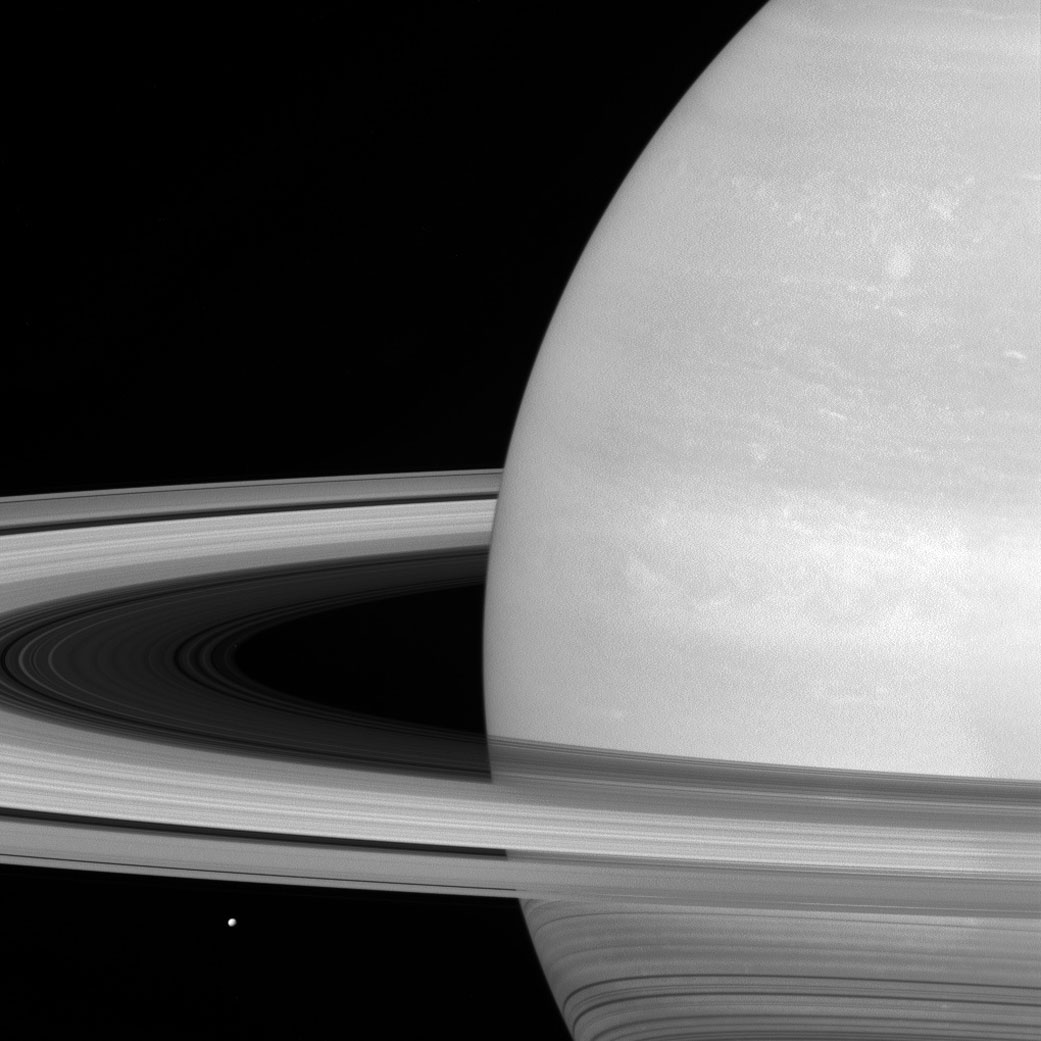
    New Cassini Image of Tiny Mimas Huge Rings
    In comparison to Saturn’s colossal rings, the icy moon Mimas (located near the lower left) seems diminutive.  Credit: NASA/JPL-Caltech/Space Science Institute

    In this new image from the Cassini Spacecraft, Saturn’s icy moon Mimas is dwarfed by the planet’s enormous rings.

    Because Mimas (near lower left) appears tiny by comparison, it might seem that the rings would be far more massive, but this is not the case. Scientists think the rings are no more than a few times as massive as Mimas, or perhaps just a fraction of Mimas’ mass. Cassini is expected to determine the mass of Saturn’s rings to within just a few hundredths of Mimas’ mass as the mission winds down by tracking radio signals from the spacecraft as it flies close to the rings.

    The rings, which are made of small, icy particles spread over a vast area, are extremely thin – generally no thicker than the height of a house. Thus, despite their giant proportions, the rings contain a surprisingly small amount of material.

    Mimas is 246 miles (396 kilometers) wide.

    This view looks toward the sunlit side of the rings from about 6 degrees above the ring plane. The image was taken in red light with the Cassini spacecraft wide-angle camera on July 21, 2016.

    The view was obtained at a distance of approximately 564,000 miles (907,000 kilometers) from Saturn and at a Sun-Saturn-spacecraft, or phase, angle of 31 degrees. The image scale is 34 miles (54 kilometers) per pixel.

    Never miss a breakthrough: Join the SciTechDaily newsletter.
    Follow us on Google and Google News.

    Astronomy Cassini-Huygens Mission Mimas Planetary Science Popular Saturn
    Share. Facebook Twitter Pinterest LinkedIn Email Reddit

    Related Articles

    New Cassini Image Shows Tethys Dwarfed by Saturn and Its Rings

    Cassini Views Water Jets from Enceladus

    Cassini Reveals a Gored Clump in Saturn’s F Ring

    Cassini Spacecraft to Begin Flyby of Saturn’s Moon Enceladus

    Cassini Reveals Global Ocean in Saturn’s Moon Enceladus

    Cassini Reveals Incomplete Cooling Down of Saturn’s A Ring at Solar Equinox

    Activity on Enceladus Could Be ‘Curtain Eruptions’

    Scientists Pinpoint the Position of Saturn

    Storm Spawns the Largest Tropospheric Vortex Ever Seen on Saturn

    Leave A Reply Cancel Reply

    • Facebook
    • Twitter
    • Pinterest
    • YouTube

    Don't Miss a Discovery

    Subscribe for the Latest in Science & Tech!

    Trending News

    Study Finds Natural Dairy Trans Fats Behave Very Differently From Industrial Fats

    Your Voice May Reveal How Fast Your Brain Is Aging

    These Fingernail-Sized Animals Are Moving Astonishing Amounts of California Beach Sand

    NASA’s Perseverance Rover Finds Mars Had a Far More Complicated Water History Than Expected

    Why Do Muscles Weaken With Age? Scientists May Have Found an Important Missing Piece

    Cancer’s “Obesity Paradox” May Have a Surprising Explanation

    Engineers Have Created the World’s First Floating Titanium

    More Than 1 in 3 Adults Had High Blood Pressure – Most Didn’t Know It

    Follow SciTechDaily
    • Facebook
    • Twitter
    • YouTube
    • Pinterest
    • Newsletter
    • RSS
    SciTech News
    • Biology News
    • Chemistry News
    • Earth News
    • Health News
    • Physics News
    • Science News
    • Space News
    • Technology News
    Recent Posts
    • Engineers Create Revolutionary New Sound Effect Technology
    • MIT Study Reveals Why a Neutrino Laser May Be Impossible
    • This Strange New Magnetism Could Change How Computers Work
    • 2 Billion-Year-Old Rocks Reveal How Life Helped Stabilize Earth’s Atmosphere
    • Switzerland’s Glaciers Lost More Than 5% of Their Ice in Just One Year
    Copyright © 1998 - 2026 SciTechDaily. All Rights Reserved.
    • Science News
    • About
    • Contact
    • Editorial Board
    • Privacy Policy
    • Terms of Use

    Type above and press Enter to search. Press Esc to cancel.