
Close Menu
    Facebook X (Twitter) Instagram
    SciTechDaily
    • Biology
    • Chemistry
    • Earth
    • Health
    • Physics
    • Science
    • Space
    • Technology
    Facebook X (Twitter) Pinterest YouTube RSS
    SciTechDaily
    Home»Space»Sun’s Rage: Massive X2.3 Solar Flare Spotted by NASA
    Space

    Sun’s Rage: Massive X2.3 Solar Flare Spotted by NASA

    By SciTechDaily.comNovember 7, 20249 Comments3 Mins Read
    Facebook Twitter Pinterest Telegram LinkedIn WhatsApp Email Reddit
    Share
    Facebook Twitter LinkedIn Pinterest Telegram Email Reddit
    X2.3 Solar Flare November 2024
    NASA’s Solar Dynamics Observatory captured this striking image of a solar flare—a bright flash at the Sun’s center—on November 6, 2024. The image shows extreme ultraviolet light, highlighting the superheated material in the flare, which has been colorized in red. Credit: NASA/SDO

    On November 6, 2024, NASA’s Solar Dynamics Observatory recorded a powerful solar flare, peaking at 8:40 a.m. ET. This flare, classified as an X2.3, is intense enough to potentially disrupt radio signals, navigation systems, and power grids on Earth. It also poses significant risks to astronauts and spacecraft operating in orbit.

    X2.3 Solar Flare November 2024
    On November 6, 2024, NASA’s Solar Dynamics Observatory captured a solar flare, visible as an intense flash near the Sun’s center. The image uses extreme ultraviolet light to reveal the flare’s hot material, colorized in red. Credit: NASA/SDO

    Solar flares are sudden bursts of energy and light that erupt from the Sun’s surface. They occur when powerful magnetic fields within the Sun become twisted and release their energy, sending out intense radiation across space. This radiation spans a wide spectrum, including visible light, X-rays, and ultraviolet light, and can travel across the solar system at nearly the speed of light. Solar flares are often associated with sunspots, which are cooler, dark regions on the Sun’s surface where magnetic fields are particularly strong.

    Solar flares are classified by their intensity, with the most intense types being X-class flares, followed by M-class, C-class, and B-class flares. X-class flares are the strongest and can have significant effects on Earth. When an X-class flare is directed toward Earth, it can interfere with our planet’s upper atmosphere, creating disruptions to radio communications, GPS signals, and even power grids. High-energy solar particles can also pose dangers to astronauts and satellites in orbit, potentially damaging sensitive electronics.

    Solar flares are part of the broader phenomenon of space weather, which includes solar wind and coronal mass ejections (CMEs)—huge clouds of charged particles ejected from the Sun that often accompany strong solar flares. Scientists closely monitor solar activity to predict solar flares and mitigate their effects on Earth and in space. NASA’s Solar Dynamics Observatory and other solar telescopes around the world help track these eruptions, providing crucial data for understanding and responding to solar activity that could impact modern technology and space exploration.
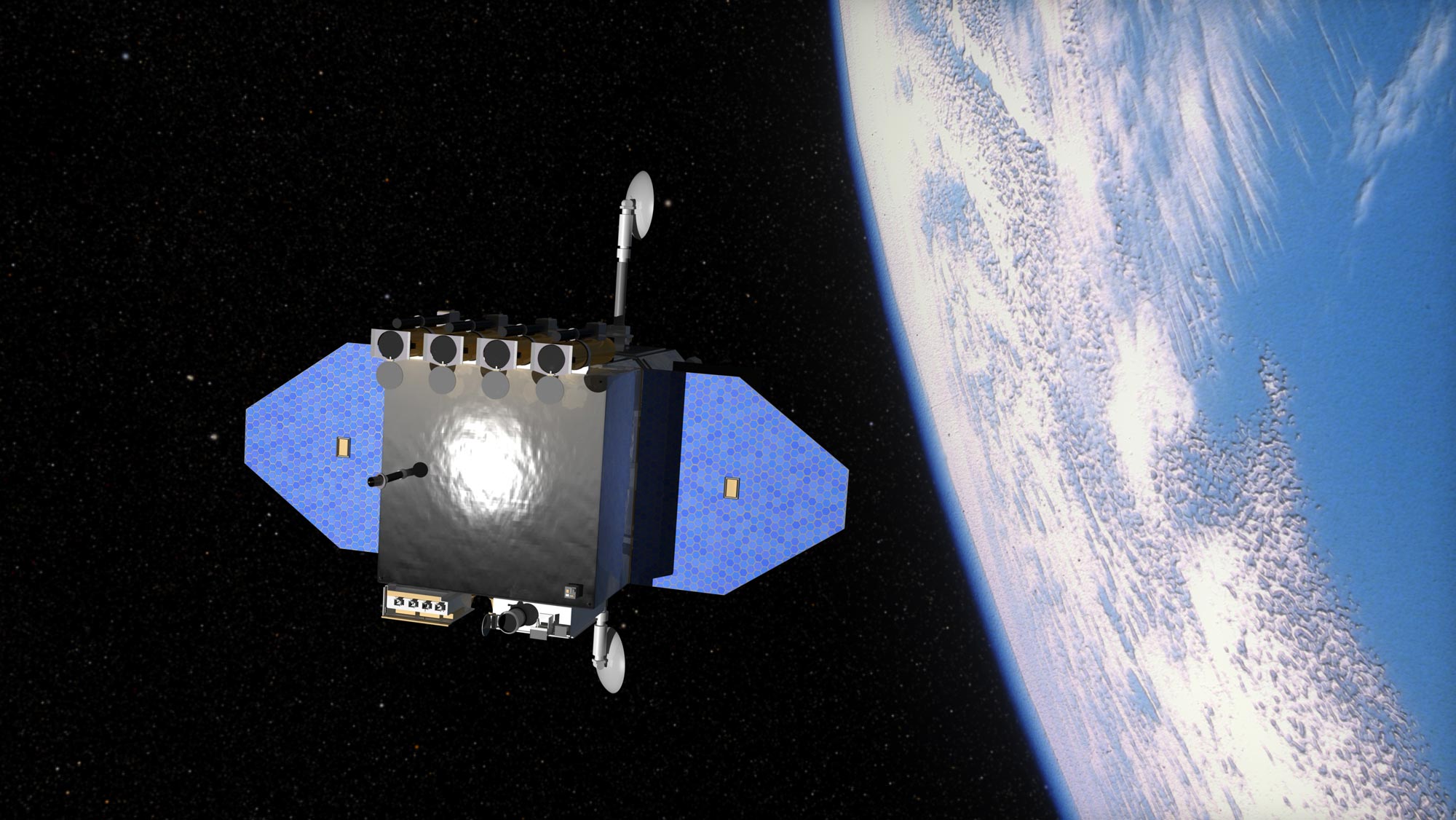
    NASA Solar Dynamics Observatory Orbiting Earth
    Artist’s concept image of the SDO satellite orbiting Earth. Credit: NASA

    NASA’s Solar Dynamics Observatory (SDO) is a spacecraft dedicated to studying the Sun’s atmosphere and magnetic activity. Launched in 2010, SDO provides high-resolution images and data, capturing solar activity in unprecedented detail. This mission plays a vital role in NASA’s efforts to understand space weather, specifically focusing on solar phenomena like solar flares, sunspots, and coronal mass ejections (CMEs), which can affect Earth’s communication systems, satellites, and power grids.

    Equipped with three main instruments—the Atmospheric Imaging Assembly (AIA), the Helioseismic and Magnetic Imager (HMI), and the Extreme Ultraviolet Variability Experiment (EVE)—SDO measures the Sun’s magnetic field, images the Sun’s atmosphere in various wavelengths, and monitors its energy output. This combination of tools allows SDO to track changes in the Sun’s magnetic fields, temperature, and atmospheric composition, revealing how these factors drive solar activity.

    SDO orbits Earth at a vantage point that gives it a continuous view of the Sun, transmitting real-time data 24/7. The information it collects helps scientists make accurate forecasts of space weather events, which are crucial for protecting Earth’s technology and astronauts in space.

    Never miss a breakthrough: Join the SciTechDaily newsletter.
    Follow us on Google and Google News.

    NASA Solar Dynamics Observatory Solar Flares
    Share. Facebook Twitter Pinterest LinkedIn Email Reddit

    Related Articles

    Powerful X-class Solar Flare Erupts From Sun

    NASA’s Solar Dynamics Observatory Spots Burst of Light and Energy on the Sun: A B-Class Flare

    M7.9-Class Solar Flare Seen by Solar Dynamics Observatory

    NASA’s Solar Dynamics Observatory Views M-Class Solar Flare

    New SDO Image of X-Class Solar Flare

    NASA’s SDO Reveals Images of X4.9-Class Solar Flare

    NASA’s Solar Dynamics Observatory Views Two New Solar Flares

    New Light Shed on the Origins of Extreme Space Storms

    Solar Flare Causes Powerful Solar Radiation Storm

    9 Comments

    1. Ernie K on November 7, 2024 9:02 am

      Would appear the Sun is also celebrating Trump’s election victory.

      Reply
      • Bob on November 7, 2024 9:18 am

        The Sun is lashing at and how stupid all those who voted for him are.

        Reply
      • RevC on November 7, 2024 9:55 pm

        . . . or raging.

        Reply
      • RevC on November 7, 2024 9:56 pm

        . . . or raging at our reckless foolishness.

        Reply
      • John atenson on November 8, 2024 11:48 am

        When the grids go down,you will know how God,the sun God Aten feels about the election,perhaps an awakening of Yellowstone will make it more clear,may God also bring wind,fire and water as well to enlighten the fascist.

        Reply
    2. Jim on November 7, 2024 9:09 am

      There used to be a live sun image we could watch the sun ..Is that still available?

      Reply
    3. Sheriff Longmire on November 8, 2024 6:49 am

      Save your TDS and politics for mainstream media. It’s not relevant to solar flares and science.

      Reply
      • Tristram Carlyon on November 8, 2024 12:23 pm

        Agreed, Sherrif.

        Reply
    4. Rob on November 8, 2024 3:21 pm

      How odd. Solar flares emit assorted wavelengths of electromagnetic radiation that includes assorted wavelengths of light that “can travel across the solar system at nearly the speed of light”. And here is me thinking that light travels in vaccuo at the speed of light. Maybe the invisible dark matter in the Solar System slows it down, which would have implications for Erwin Hubble’s idea? Hmmmmmmm……….

      Reply
    Leave A Reply Cancel Reply

    • Facebook
    • Twitter
    • Pinterest
    • YouTube

    Don't Miss a Discovery

    Subscribe for the Latest in Science & Tech!

    Trending News

    Scientists Warn That This Common Pet Fish Can Wreck Entire Ecosystems

    Scientists Make Breakthrough in Turning Plastic Trash Into Clean Fuel Using Sunlight

    This Popular Supplement May Interfere With Cancer Treatment, Scientists Warn

    Scientists Finally Solved One of Water’s Biggest Mysteries

    Could This New Weight-Loss Pill Disrupt the Entire Market? Here’s What You Should Know About Orforglipron

    Earth’s Crust Is Tearing Open in Africa, and It Could Form a New Ocean

    Breakthrough Bowel Cancer Trial Leaves Patients Cancer-Free for Nearly 3 Years

    Natural Compound Shows Powerful Potential Against Rheumatoid Arthritis

    Follow SciTechDaily
    • Facebook
    • Twitter
    • YouTube
    • Pinterest
    • Newsletter
    • RSS
    SciTech News
    • Biology News
    • Chemistry News
    • Earth News
    • Health News
    • Physics News
    • Science News
    • Space News
    • Technology News
    Recent Posts
    • The Most Effective Knee Arthritis Treatments Aren’t What You Expect
    • Scientists Develop Bioengineered Chewing Gum That Could Help Fight Oral Cancer
    • Popular Weight-Loss Drugs Found To Cut Heart Attack and Stroke Risk
    • After 37 Years, the World’s Longest-Running Soil Warming Experiment Uncovers a Startling Climate Secret
    • NASA Satellite Captures First-Ever High-Res View of Massive Pacific Tsunami
    Copyright © 1998 - 2026 SciTechDaily. All Rights Reserved.
    • Science News
    • About
    • Contact
    • Editorial Board
    • Privacy Policy
    • Terms of Use

    Type above and press Enter to search. Press Esc to cancel.