
Close Menu
    Facebook X (Twitter) Instagram
    SciTechDaily
    • Biology
    • Chemistry
    • Earth
    • Health
    • Physics
    • Science
    • Space
    • Technology
    Facebook X (Twitter) Pinterest YouTube RSS
    SciTechDaily
    Home»Space»NASA’s Solar Dynamics Observatory Views M-Class Solar Flare
    Space

    NASA’s Solar Dynamics Observatory Views M-Class Solar Flare

    By Karen C. Fox, NASA's Goddard Space Flight Center,January 14, 2015No Comments1 Min Read
    Facebook Twitter Pinterest Telegram LinkedIn WhatsApp Email Reddit
    Share
    Facebook Twitter LinkedIn Pinterest Telegram Email Reddit
    First Notable Solar Flare of 2015
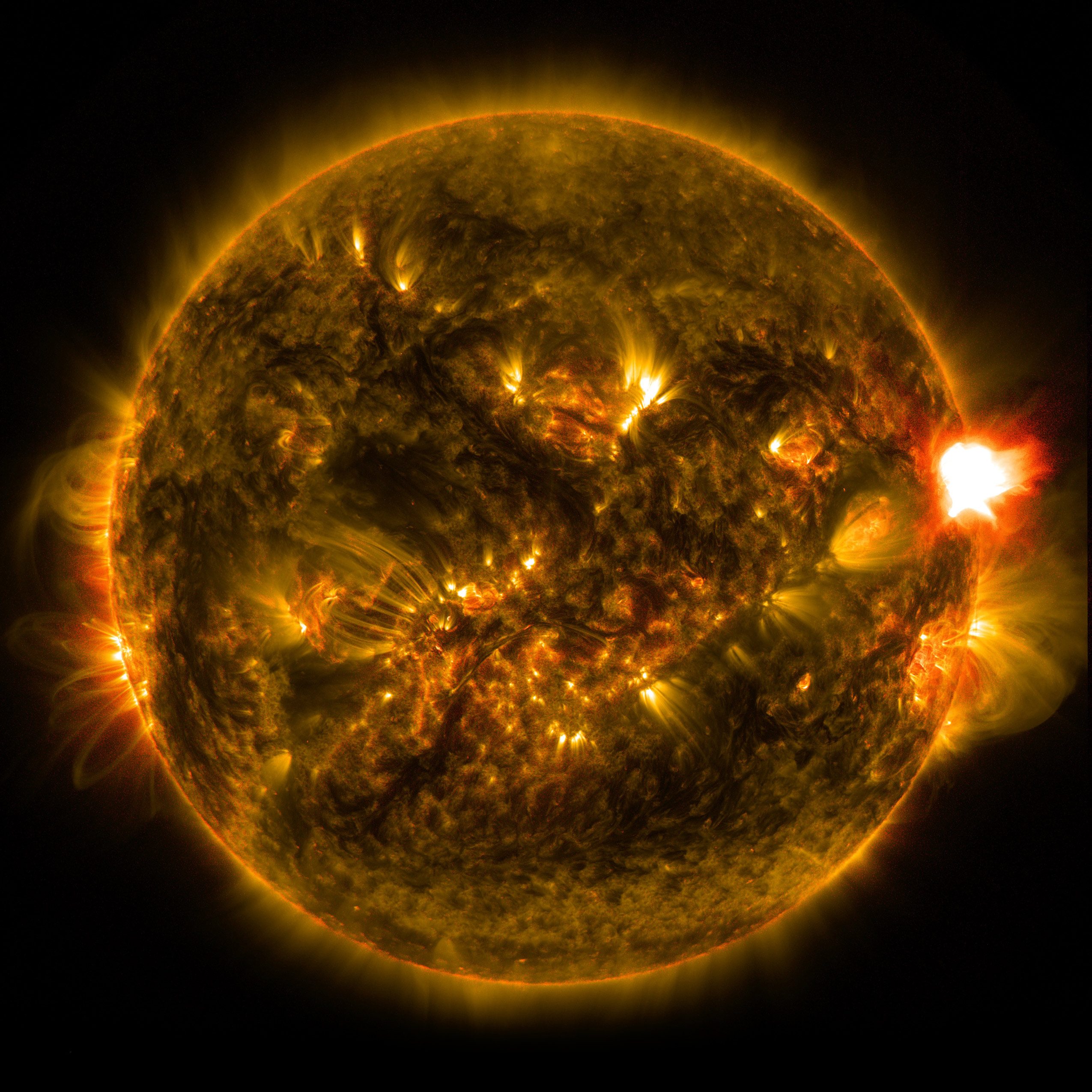
    An M-class solar flare erupts from the right side of the sun in this image from shortly before midnight EST on January 12, 2015. The image blends two wavelengths of light –  171 and 304 angstroms – as captured by NASA’s Solar Dynamics Observatory. Credit: NASA/SDO

    The first significant solar flare of 2015 was spotted by NASA’s Solar Dynamics Observatory.

    The sun emitted a mid-level solar flare, peaking at 11:24 p.m. EST on January 12, 2015. NASA’s Solar Dynamics Observatory, which watches the sun constantly, captured an image of the event. Solar flares are powerful bursts of radiation. Harmful radiation from a flare cannot pass through Earth’s atmosphere to physically affect humans on the ground, however – when intense enough –  they can disturb the atmosphere in the layer where GPS and communications signals travel.

    SDO Views Solar Flare
    Giant magnetic loops dance on the sun’s horizon in concert with the eruption of a solar flare – seen as a bright flash of light –  in this imagery from NASA’s Solar Dynamics Observatory, captured January 12-13, 2015. Credit: NASA/SDO

    Never miss a breakthrough: Join the SciTechDaily newsletter.
    Follow us on Google and Google News.

    Astronomy NASA Solar Dynamics Observatory Solar Flares Sun
    Share. Facebook Twitter Pinterest LinkedIn Email Reddit

    Related Articles

    Solar Fury Erupts: Sun Rings In the New Year With X1.8 Flare

    X1.8 Flare Unleashed: NASA Captures Powerful Solar Eruption

    Sun Unleashes Monumental X9.0 Solar Flare – Most Intense in 7 Years – Captured by NASA Observatory

    Monster X7.1 Solar Flare Unleashed: Intense Blast Captured by NASA’s Solar Dynamics Observatory

    Sun Ignites: Unleashing a Powerful X4.5 Solar Flare

    NASA’s Solar Dynamics Observatory Captures Mid-Level Flare Erupting From the Sun

    NASA’s Solar Dynamics Observatory Spots Burst of Light and Energy on the Sun: A B-Class Flare

    NASA’s SDO Reveals Images of X4.9-Class Solar Flare

    NASA’s Solar Dynamics Observatory Views Two New Solar Flares

    Leave A Reply Cancel Reply

    • Facebook
    • Twitter
    • Pinterest
    • YouTube

    Don't Miss a Discovery

    Subscribe for the Latest in Science & Tech!

    Trending News

    Scientists Discover Crows Make Decisions Twice As Fast as Humans

    Animal vs. Plant Protein: New Study Reveals Unexpected Testosterone Differences

    A Black Hole Could Split in Two, According to a Surprising New Theory

    Scientists Sound the Alarm As Colorectal Cancer Reverses a 20-Year Decline

    A Devastating Disease Is Threatening the World’s Chocolate Supply – but Scientists May Have Found the Answer

    NASA’s Voyager 1 Is About to Become the First Spacecraft One Light-Day From Earth

    A Woman Who Lived 30,000 Years Ago Is Changing What We Know About Ice Age Europe

    A Rare Radioactive Element Reveals a Hidden Secret About the Heaviest Atoms

    Follow SciTechDaily
    • Facebook
    • Twitter
    • YouTube
    • Pinterest
    • Newsletter
    • RSS
    SciTech News
    • Biology News
    • Chemistry News
    • Earth News
    • Health News
    • Physics News
    • Science News
    • Space News
    • Technology News
    Recent Posts
    • Scientists Discover Greenland’s Ice Sheet Once Retreated 60 Miles
    • Researchers Recover DNA from 7,000-Year-Old Leather, Revealing a Link to Goats Alive Today
    • Scientists Discover Climate Change May Have Stopped Earth’s Next Ice Age
    • Strange Materials Make Waves Behave in Ways That Defy Expectations
    • Quantum Discovery Reveals Why More Powerful Lasers Can Actually Slow Atoms Down
    Copyright © 1998 - 2026 SciTechDaily. All Rights Reserved.
    • Science News
    • About
    • Contact
    • Editorial Board
    • Privacy Policy
    • Terms of Use

    Type above and press Enter to search. Press Esc to cancel.