
Close Menu
    Facebook X (Twitter) Instagram
    SciTechDaily
    • Biology
    • Chemistry
    • Earth
    • Health
    • Physics
    • Science
    • Space
    • Technology
    Facebook X (Twitter) Pinterest YouTube RSS
    SciTechDaily
    Home»Space»Monster X7.1 Solar Flare Unleashed: Intense Blast Captured by NASA’s Solar Dynamics Observatory
    Space

    Monster X7.1 Solar Flare Unleashed: Intense Blast Captured by NASA’s Solar Dynamics Observatory

    By SciTechDaily.comOctober 2, 2024No Comments4 Mins Read
    Facebook Twitter Pinterest Telegram LinkedIn WhatsApp Email Reddit
    Share
    Facebook Twitter LinkedIn Pinterest Telegram Email Reddit
    X7.1 Flare October 2024
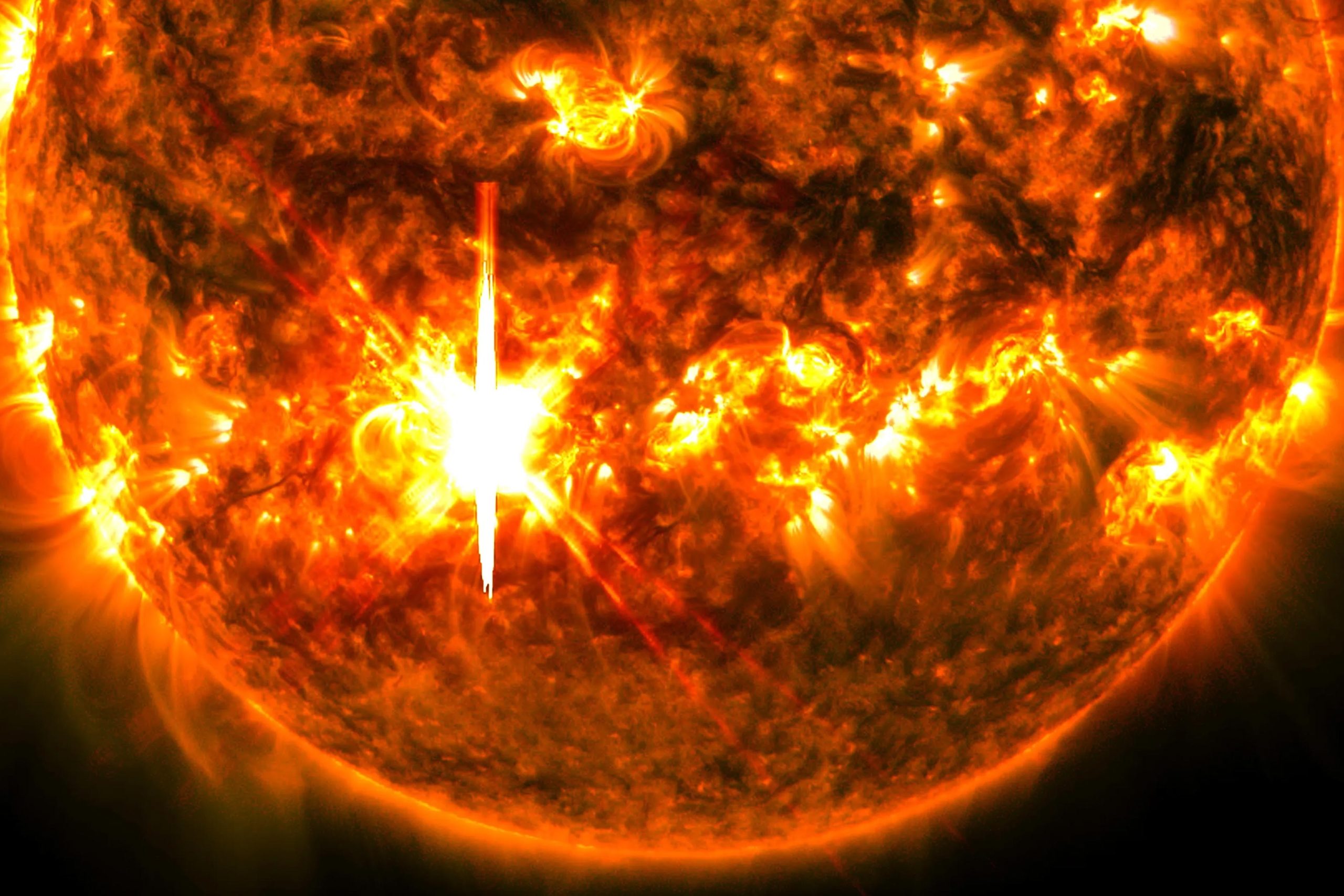
    NASA’s Solar Dynamics Observatory captured this image of a solar flare – seen as the bright flash in the lower left – on October 1, 2024. The image shows a subset of extreme ultraviolet light that highlights the extremely hot material in flares and which is colorized in red and orange. Credit: NASA/SDO

    On October 1, 2024, a powerful X7.1 solar flare was captured by NASA’s Solar Dynamics Observatory, hitting its peak at 6:20 p.m. ET. This significant solar event ranks as the second most powerful flare of the current Solar Cycle 25, which started in December 2019 and was previously topped only by an X8.7 flare in May 2024.

    Solar flares are intense bursts of radiation emanating from the release of magnetic energy associated with sunspots. They are classified based on their brightness in the X-ray wavelengths observed by satellites, with classes ranging from A, B, C, M, to X, with each class representing a tenfold increase in energy output. A-class flares are the smallest, having little effect on Earth, while X-class flares are the largest and can cause planet-wide radio blackouts and long-lasting radiation storms.
    X7.1 Flare October 2024
    Closer view of the intense X7.1 solar flare on October 1, 2024, as captured by NASA’s Solar Dynamics Observatory. Credit: NASA/SDO

    The classification system not only labels flares by their X-ray brightness but also includes a numerical suffix that provides more information about their strength. For instance, an X2 flare is twice as intense as an X1 flare, and an X3 is three times as intense. This granular classification helps researchers and space weather forecasters assess potential impacts on Earth and technological systems. During periods of heightened solar activity, typically at the peak of the Sun’s 11-year solar cycle, the frequency and intensity of flares increase, making monitoring and classification even more critical.

    Agencies like NASA and NOAA keep a constant watch on the Sun’s activity through various space-based observatories. This vigilant monitoring is crucial to forecast and mitigate the effects of solar flares on space-borne and ground-based technological systems, ensuring safety and continuity in our increasingly technology-dependent world.
    NASA Solar Dynamics Observatory
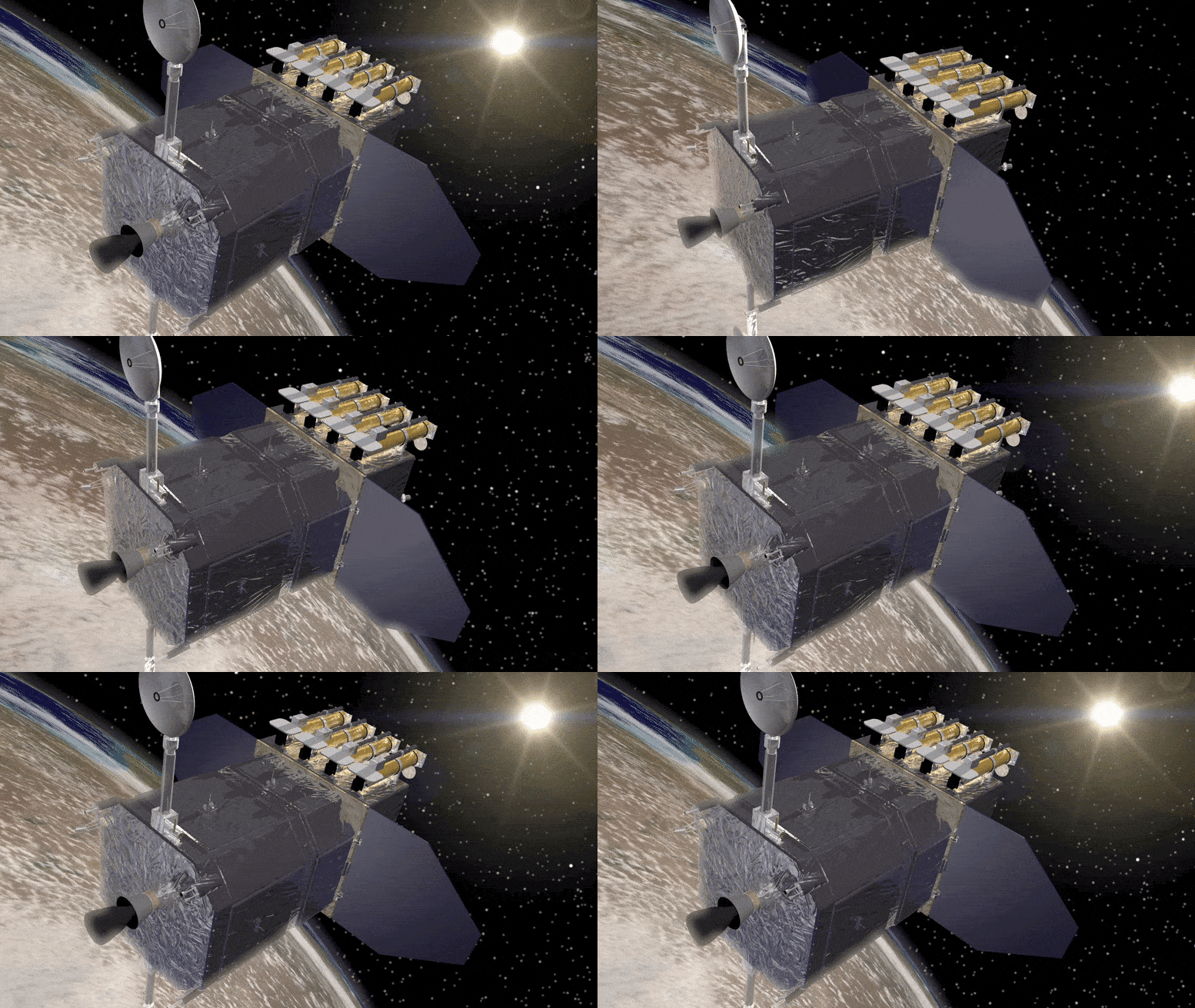
    This animation of the Solar Dynamics Observatory shows it above the earth as it faces toward the Sun. SDO is designed to help us understand the Sun’s influence on Earth and Near-Earth space by studying the solar atmosphere on small scales of space and time and in many wavelengths simultaneously. Credit: NASA/Goddard Space Flight Center Conceptual Image Lab

    NASA’s Solar Dynamics Observatory (SDO) is a mission dedicated to observing the Sun and its behavior continuously. Launched on February 11, 2010, as part of the Living With a Star (LWS) program, the SDO aims to provide a deeper understanding of the Sun’s influence on Earth and Near-Earth space by studying the solar atmosphere across multiple wavelengths. The primary goal is to learn more about the Sun’s magnetic field and how it generates the solar wind, solar flares, and other space weather phenomena that can impact life and technology on Earth.

    The SDO spacecraft is equipped with a suite of instruments that capture high-resolution images of the Sun in 13 different wavelengths every 12 seconds, offering unprecedented insights into solar activities. Key instruments include the Helioseismic and Magnetic Imager (HMI), which maps the solar magnetic field and studies the photonic forces at work in the solar interior; the Atmospheric Imaging Assembly (AIA), which photographs the solar atmosphere in multiple wavelengths to better understand the connectivity between the Sun’s surface and atmosphere; and the Extreme Ultraviolet Variability Experiment (EVE), which measures the Sun’s ultraviolet output and provides crucial data on how it affects Earth’s atmosphere. Through these advanced tools, SDO plays a vital role in our understanding of the Sun’s complex system and helps improve our ability to forecast space weather events.

    Never miss a breakthrough: Join the SciTechDaily newsletter.
    Follow us on Google and Google News.

    Astronomy NASA Solar Dynamics Observatory Solar Flares Sun
    Share. Facebook Twitter Pinterest LinkedIn Email Reddit

    Related Articles

    Solar Fury Erupts: Sun Rings In the New Year With X1.8 Flare

    X1.8 Flare Unleashed: NASA Captures Powerful Solar Eruption

    Sun Unleashes Monumental X9.0 Solar Flare – Most Intense in 7 Years – Captured by NASA Observatory

    Sun Ignites: Unleashing a Powerful X4.5 Solar Flare

    NASA’s Solar Dynamics Observatory Captures Mid-Level Flare Erupting From the Sun

    NASA’s Solar Dynamics Observatory Spots Burst of Light and Energy on the Sun: A B-Class Flare

    NASA’s Solar Dynamics Observatory Views M-Class Solar Flare

    NASA’s SDO Reveals Images of X4.9-Class Solar Flare

    NASA’s Solar Dynamics Observatory Views Two New Solar Flares

    Leave A Reply Cancel Reply

    • Facebook
    • Twitter
    • Pinterest
    • YouTube

    Don't Miss a Discovery

    Subscribe for the Latest in Science & Tech!

    Trending News

    Your Blood Pressure Reading Could Be Wrong Because of One Simple Mistake

    Astronomers Stunned by Ancient Galaxy With No Spin

    Physicists May Be on the Verge of Discovering “New Physics” at CERN

    Scientists Solve 320-Million-Year Mystery of Reptile Skin Armor

    Scientists Say This Daily Walking Habit May Be the Secret to Keeping Weight Off After Dieting

    New Therapy Rewires the Brain To Restore Joy in Depression Patients

    Giant Squid Detected off Western Australia in Stunning Deep-Sea Discovery

    Popular Sugar-Free Sweetener Linked to Liver Disease, Study Warns

    Follow SciTechDaily
    • Facebook
    • Twitter
    • YouTube
    • Pinterest
    • Newsletter
    • RSS
    SciTech News
    • Biology News
    • Chemistry News
    • Earth News
    • Health News
    • Physics News
    • Science News
    • Space News
    • Technology News
    Recent Posts
    • The Hidden Types of Dementia Most People Have Never Heard Of
    • Scientists Discover Why Alcohol Prevents the Liver From Healing, Even After You Quit
    • Scientists Solve a 60-Year-Old Fat Cell Mystery — and It Changes What We Know About Obesity
    • A Crucial Atlantic Current Is Weakening and Weather Could Change Worldwide
    • Scientists Stunned As Volcano Removes Methane From the Air
    Copyright © 1998 - 2026 SciTechDaily. All Rights Reserved.
    • Science News
    • About
    • Contact
    • Editorial Board
    • Privacy Policy
    • Terms of Use

    Type above and press Enter to search. Press Esc to cancel.