
Close Menu
    Facebook X (Twitter) Instagram
    SciTechDaily
    • Biology
    • Chemistry
    • Earth
    • Health
    • Physics
    • Science
    • Space
    • Technology
    Facebook X (Twitter) Pinterest YouTube RSS
    SciTechDaily
    Home»Space»Solar Fury Erupts: Sun Rings In the New Year With X1.8 Flare
    Space

    Solar Fury Erupts: Sun Rings In the New Year With X1.8 Flare

    By NASAJanuary 7, 20252 Comments2 Mins Read
    Facebook Twitter Pinterest Telegram LinkedIn WhatsApp Email Reddit
    Share
    Facebook Twitter LinkedIn Pinterest Telegram Email Reddit
    X1.8 Solar Flare January 2025
    The National Oceanic and Atmospheric Administration’s Solar Ultraviolet Imager captured this image of a solar flare — seen as the bright flash on the left – on January 4, 2025. The image shows a subset of extreme ultraviolet light that highlights the extremely hot material in flares and which is colorized in orange. Credit: NOAA

    A powerful X1.8 solar flare erupted on January 4, 2025, and was recorded at its peak—7:48 a.m. ET—by NOAA’s Solar Ultraviolet Imager (SUVI). Such intense flares have the potential to disrupt Earth’s radio communications, navigation systems, and power grids, while also endangering astronauts and spacecraft in orbit.

    NASA’s Solar Dynamics Observatory data is currently inaccessible due to flooding at its data center. Fortunately, SUVI onboard NOAA’s GOES-East satellite provided critical observations of the event.

    Solar flares are sudden, powerful bursts of energy originating from the Sun’s surface. They occur when magnetic energy stored in the Sun’s atmosphere is released, emitting radiation across the electromagnetic spectrum, from radio waves to X-rays and gamma rays.

    Solar flares are classified into five categories based on their intensity: A, B, C, M, and X, with each letter representing a tenfold increase in strength. X-class flares are the most intense, and a numerical value (e.g., X1.8) specifies their magnitude within that class.
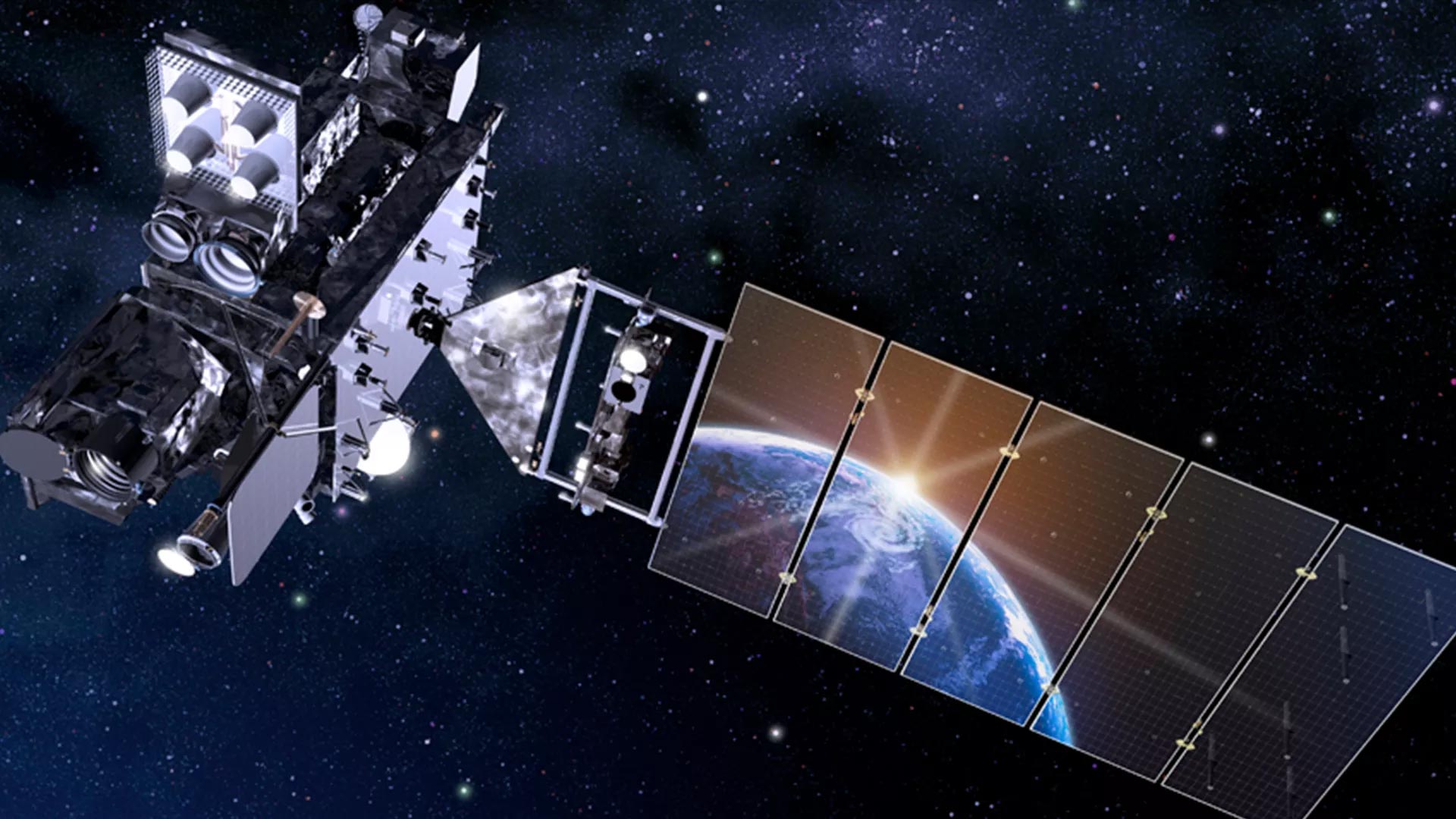
    NOAA GOES-T Satellite
    The Solar Ultraviolet Imager (SUVI) is a specialized instrument aboard NOAA’s GOES satellites. It observes the Sun in ultraviolet wavelengths, providing critical data on solar activity like flares and eruptions, which can affect communication systems and satellites. Credit: NOAA

    The Solar Ultraviolet Imager (SUVI) is a cutting-edge instrument onboard NOAA’s GOES (Geostationary Operational Environmental Satellites) series, specifically designed to monitor the Sun’s activity. SUVI observes the Sun in the extreme ultraviolet (EUV) spectrum, capturing images of solar phenomena like flares, coronal mass ejections (CMEs), and active regions.

    These high-resolution images help scientists study and predict space weather events that can affect Earth. By analyzing solar activity, SUVI supports NOAA’s Space Weather Prediction Center in forecasting disruptions to communication systems, navigation signals, power grids, and spacecraft operations. Its constant vigilance plays a critical role in safeguarding technology and infrastructure from the impacts of solar storms.

    Never miss a breakthrough: Join the SciTechDaily newsletter.
    Follow us on Google and Google News.

    Astronomy NASA NOAA Solar Dynamics Observatory Solar Flares Sun
    Share. Facebook Twitter Pinterest LinkedIn Email Reddit

    Related Articles

    X1.8 Flare Unleashed: NASA Captures Powerful Solar Eruption

    Sun Unleashes Monumental X9.0 Solar Flare – Most Intense in 7 Years – Captured by NASA Observatory

    Monster X7.1 Solar Flare Unleashed: Intense Blast Captured by NASA’s Solar Dynamics Observatory

    Sun Ignites: Unleashing a Powerful X4.5 Solar Flare

    NASA’s Solar Dynamics Observatory Captures Mid-Level Flare Erupting From the Sun

    NASA’s Solar Dynamics Observatory Spots Burst of Light and Energy on the Sun: A B-Class Flare

    NASA’s Solar Dynamics Observatory Views M-Class Solar Flare

    NASA’s SDO Reveals Images of X4.9-Class Solar Flare

    NASA’s Solar Dynamics Observatory Views Two New Solar Flares

    2 Comments

    1. AMBREEKHAN KHAN help me please sir help me please sir help me please sir help me please sir help me please sir help me please sir help me please sir help me please sir help me please sir help me please sir help me on January 9, 2025 6:29 am

      Please help me please sir help me please sir help me please sir help me please sir help me please sir help me please sir help me please sir help me please sir help me please sir help me please sir help me please sir help me please sir help me please sir help me please sir help me please sir help me please sir help me please sir help me please sir help me please sir help me please sir help me please sir help me please sir help me please sir help me please sir help me please sir help me please sir help me please sir help me please sir help me please sir help me

      Reply
    2. AMBREEKHAN KHAN help me please sir help me please sir help me please sir help me please sir help me please sir help me please sir help me please sir help me on January 9, 2025 6:33 am

      Photo of i have done it please sir help me please sir help me please sir help me please sir help me please sir help me please sir help me please sir help me please sir help me please sir help me please sir help me please sir help me please sir help me please sir help me please sir help me please sir help me please sir help me please sir help me please sir help me please sir help me please sir help me please sir help me please sir help me please sir help me please sir help me please sir help me please sir help me please

      Reply
    Leave A Reply Cancel Reply

    • Facebook
    • Twitter
    • Pinterest
    • YouTube

    Don't Miss a Discovery

    Subscribe for the Latest in Science & Tech!

    Trending News

    Even Occasional Binge Drinking May Triple Liver Damage Risk

    Liftoff! NASA’s Artemis II Launch Sends Astronauts Around the Moon for First Time in 50 Years

    Scientists Discover New Way To Eliminate “Zombie Cells” Driving Aging

    This New Quantum Theory Could Change Everything We Know About the Big Bang

    This One Vitamin May Help Protect Your Brain From Dementia Years Later

    Stopping Weight-Loss Drugs Like Ozempic Can Quickly Erase Heart Benefits

    A 500-Million-Year-Old Surprise Is Forcing Scientists to Rethink Spider Evolution

    Coffee and Blood Pressure: What You Need To Know Before Your Next Cup

    Follow SciTechDaily
    • Facebook
    • Twitter
    • YouTube
    • Pinterest
    • Newsletter
    • RSS
    SciTech News
    • Biology News
    • Chemistry News
    • Earth News
    • Health News
    • Physics News
    • Science News
    • Space News
    • Technology News
    Recent Posts
    • Longevity Isn’t Equal: Why Life-Extending Treatments May Be a “Biological Lottery”
    • AI May Soon Detect Cancer Just by Listening to You Speak
    • Your Child’s Clothes Could Contain Toxic Lead, Study Finds
    • Atomic Chains Turn Electric Fields into Measurable Quantum Signals
    • 12,000-Year-Old Native American Dice Rewrite the History of Gambling
    Copyright © 1998 - 2026 SciTechDaily. All Rights Reserved.
    • Science News
    • About
    • Contact
    • Editorial Board
    • Privacy Policy
    • Terms of Use

    Type above and press Enter to search. Press Esc to cancel.