
Close Menu
    Facebook X (Twitter) Instagram
    SciTechDaily
    • Biology
    • Chemistry
    • Earth
    • Health
    • Physics
    • Science
    • Space
    • Technology
    Facebook X (Twitter) Pinterest YouTube RSS
    SciTechDaily
    Home»Space»X1.8 Flare Unleashed: NASA Captures Powerful Solar Eruption
    Space

    X1.8 Flare Unleashed: NASA Captures Powerful Solar Eruption

    By SciTechDaily.comOctober 29, 2024No Comments2 Mins Read
    Facebook Twitter Pinterest Telegram LinkedIn WhatsApp Email Reddit
    Share
    Facebook Twitter LinkedIn Pinterest Telegram Email Reddit
     X1.8 Class Flare October 2024
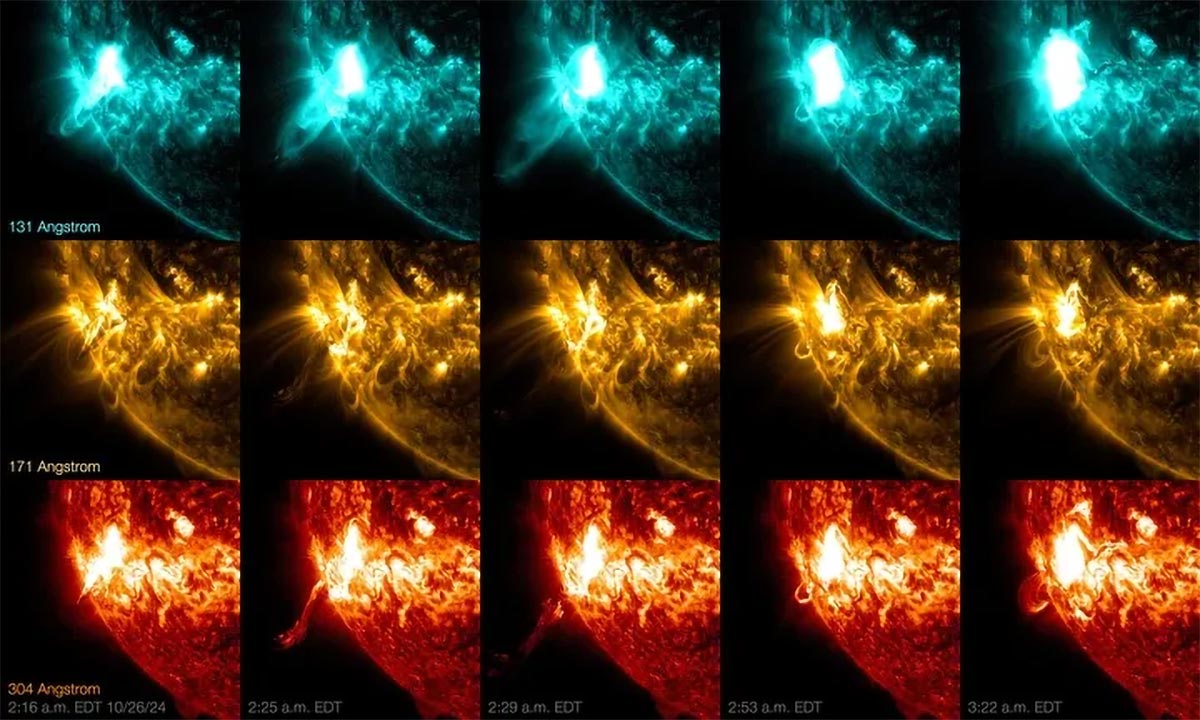
    NASA’s Solar Dynamics Observatory captured these images of a solar flare — seen as the bright flash in each of the three image panes — on October 26, 2024. The images show three different subsets of extreme ultraviolet light that highlight the extremely hot material in flares and which are colorized in teal, gold, and red. Credit: NASA/SDO

    On October 26, 2024, NASA’s Solar Dynamics Observatory recorded a powerful solar flare that peaked at 3:19 a.m. ET. Classified as an X1.8 flare, this intense event has the potential to disrupt radio signals, navigation systems, and power grids on Earth, while also posing risks to astronauts and spacecraft in orbit.

    Solar flares are sudden, intense bursts of energy originating from the Sun’s surface, typically near sunspots where magnetic fields are highly concentrated and unstable. These powerful eruptions release massive amounts of electromagnetic radiation across the spectrum, from radio waves to X-rays and gamma rays.

    Flares are classified by their intensity, with “X-class” representing the strongest flares, capable of disrupting communications, GPS, and power grids on Earth. Flares also pose radiation risks to astronauts and spacecraft. Solar flares are part of the Sun’s natural activity cycle and often occur alongside coronal mass ejections (CMEs), which send charged particles into space and amplify potential impacts on Earth’s technology and infrastructure.

    NASA’s Solar Dynamics Observatory (SDO) is a satellite dedicated to studying the Sun’s activity and its influence on Earth. Launched in 2010, the SDO provides continuous, high-resolution images and data on the Sun’s magnetic field, atmosphere, and solar emissions.

    This observatory monitors solar phenomena such as sunspots, solar flares, and coronal mass ejections (CMEs), capturing details across multiple wavelengths to help scientists understand the Sun’s dynamics and predict space weather. SDO’s insights are crucial for protecting technology and infrastructure on Earth, as well as ensuring the safety of astronauts in space.

    Never miss a breakthrough: Join the SciTechDaily newsletter.
    Follow us on Google and Google News.

    Astronomy NASA Solar Dynamics Observatory Solar Flares Sun
    Share. Facebook Twitter Pinterest LinkedIn Email Reddit

    Related Articles

    Solar Fury Erupts: Sun Rings In the New Year With X1.8 Flare

    Sun Unleashes Monumental X9.0 Solar Flare – Most Intense in 7 Years – Captured by NASA Observatory

    Monster X7.1 Solar Flare Unleashed: Intense Blast Captured by NASA’s Solar Dynamics Observatory

    Sun Ignites: Unleashing a Powerful X4.5 Solar Flare

    NASA’s Solar Dynamics Observatory Captures Mid-Level Flare Erupting From the Sun

    NASA’s Solar Dynamics Observatory Spots Burst of Light and Energy on the Sun: A B-Class Flare

    NASA’s Solar Dynamics Observatory Views M-Class Solar Flare

    NASA’s SDO Reveals Images of X4.9-Class Solar Flare

    NASA’s Solar Dynamics Observatory Views Two New Solar Flares

    Leave A Reply Cancel Reply

    • Facebook
    • Twitter
    • Pinterest
    • YouTube

    Don't Miss a Discovery

    Subscribe for the Latest in Science & Tech!

    Trending News

    Scientists Discover Game-Changing New Way To Treat High Cholesterol

    This Small Change to Your Exercise Routine Could Be the Secret to Living Longer

    Scientists Discover 430,000-Year-Old Wooden Tools, Rewriting Human History

    AI Could Detect Early Signs of Alzheimer’s in Under a Minute – Far Before Traditional Tests

    What if Dark Matter Has Two Forms? Bold New Hypothesis Could Explain a Cosmic Mystery

    This Metal Melts in Your Hand – and Scientists Just Discovered Something Strange

    Beef vs. Chicken: Surprising Results From New Prediabetes Study

    Alzheimer’s Breakthrough: Scientists Discover Key Protein May Prevent Toxic Protein Clumps in the Brain

    Follow SciTechDaily
    • Facebook
    • Twitter
    • YouTube
    • Pinterest
    • Newsletter
    • RSS
    SciTech News
    • Biology News
    • Chemistry News
    • Earth News
    • Health News
    • Physics News
    • Science News
    • Space News
    • Technology News
    Recent Posts
    • Milk Nanoparticles Could Revolutionize Treatment for Deadly Bile Duct Cancer
    • Largest-Ever Study Finds Medicinal Cannabis Ineffective for Anxiety, Depression, PTSD
    • Scientists Reveal Why a Common Drug Causes Birth Defects and Autism
    • A Medieval Japanese Diary Just Helped Scientists Detect a Dangerous Solar Event
    • Humans Returned to Britain 500 Years Earlier Than Scientists Thought
    Copyright © 1998 - 2026 SciTechDaily. All Rights Reserved.
    • Science News
    • About
    • Contact
    • Editorial Board
    • Privacy Policy
    • Terms of Use

    Type above and press Enter to search. Press Esc to cancel.