
Close Menu
    Facebook X (Twitter) Instagram
    SciTechDaily
    • Biology
    • Chemistry
    • Earth
    • Health
    • Physics
    • Science
    • Space
    • Technology
    Facebook X (Twitter) Pinterest YouTube RSS
    SciTechDaily
    Home»Space»Astronomy & Astrophysics 101: Structure of a Comet
    Space

    Astronomy & Astrophysics 101: Structure of a Comet

    By European Space Agency (ESA)December 12, 2024No Comments2 Mins Read
    Facebook Twitter Pinterest Telegram LinkedIn WhatsApp Email Reddit
    Share
    Facebook Twitter LinkedIn Pinterest Telegram Email Reddit
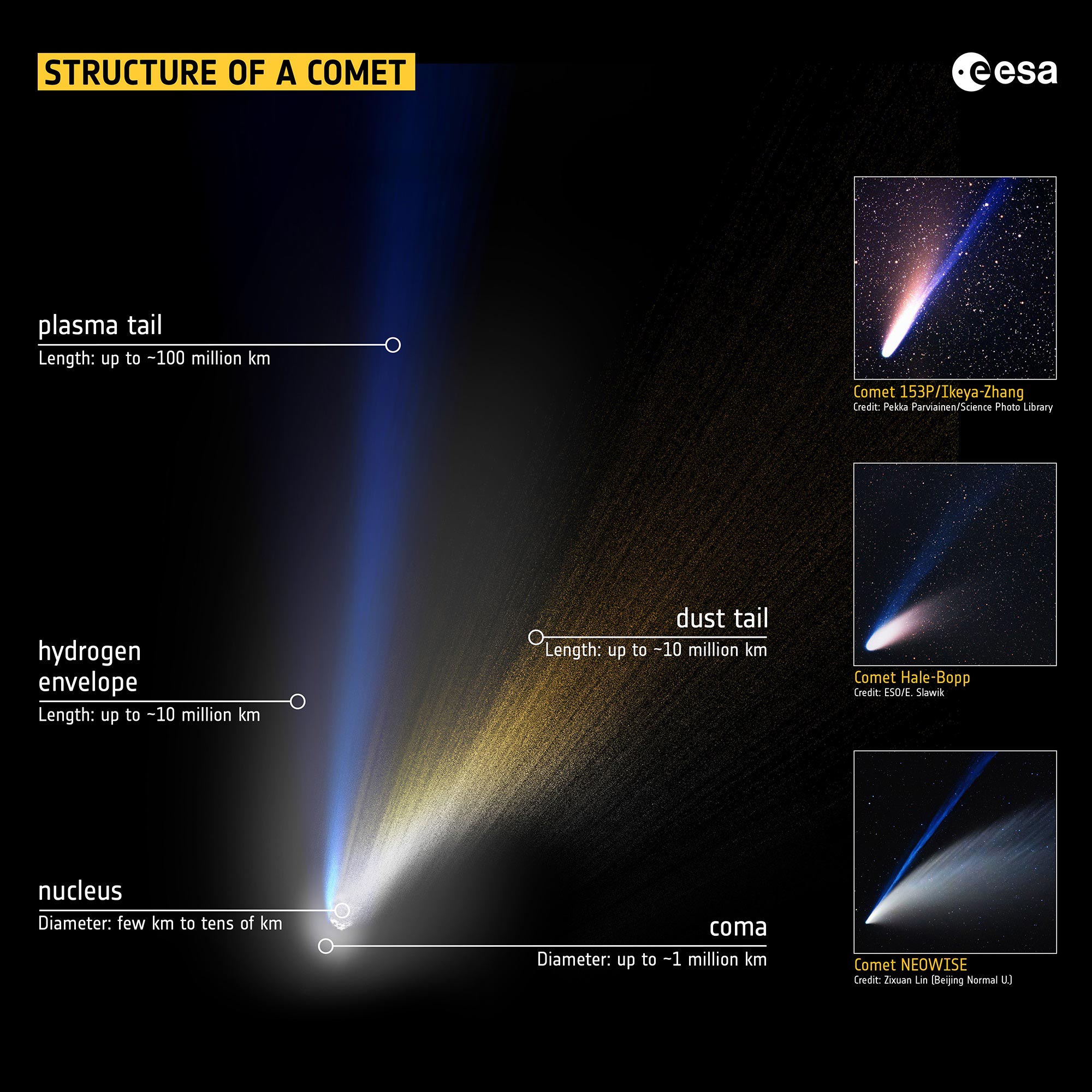
    Structure of Comet
    Comets, icy bodies formed alongside planets, come alive when returning to the inner Solar System due to the Sun’s heat. They release gases and dust, forming a coma and two tails—a yellowish dust tail and a blue-glowing plasma tail, both extending millions of kilometers and aligned with the solar wind. Credit: ESA

    Comets are icy bodies that formed alongside the planets in the early Solar System before being flung into its distant outer regions. When they return to the inner Solar System, the Sun’s heat and radiation activate them, causing them to release gases and dust. This material forms a glowing cloud around the comet’s solid nucleus, known as a coma.

    As the comet approaches the Sun, material from the coma is pushed outward, creating two distinct tails that can stretch millions of kilometers into space. The dust tail consists of tiny particles about the size of smoke particles, reflecting sunlight with a yellowish-white glow. The plasma tail, also called the ion tail, is made of electrically charged gases, often glowing blue due to carbon monoxide ions. Both tails point away from the Sun, shaped by the force of the solar wind, with the dust tail curving slightly along the comet’s path.

    Surrounding the coma and part of the tails is an invisible, irregular cloud called the hydrogen envelope. The envelope is made up of neutral hydrogen atoms which most likely come from water vapor molecules that are split up by radiation from the Sun. It is only visible in ultraviolet light, which cannot pass through Earth’s atmosphere.

    The right-hand side of the image shows photographs of three real comets streaking across the dark sky.

    Learn More: What Is a Comet?

    Never miss a breakthrough: Join the SciTechDaily newsletter.
    Follow us on Google and Google News.

    Astronomy Comet European Space Agency
    Share. Facebook Twitter Pinterest LinkedIn Email Reddit

    Related Articles

    Rare Comet Older Than the Sun Seen by Mars Orbiters

    SOHO Tracks Comet C/2023 A3’s Spectacular Flight Through Space With Rare Anti-Tail [Video]

    Rare Glimpse of “Doomed” SOHO Comet During Solar Eclipse

    Infographic: Anatomy of a Comet

    ESA’s Comet Interceptor Approved for Construction

    Astronomy & Astrophysics 101: Comet

    Solar Orbiter Spacecraft Catches a Second Comet by the Tail

    A Christmas Comet for Solar Orbiter: Heliospheric Imager Captures Comet Leonard

    Don’t Miss: Comet Leonard May Be Visible to the Naked Eye Today

    Leave A Reply Cancel Reply

    • Facebook
    • Twitter
    • Pinterest
    • YouTube

    Don't Miss a Discovery

    Subscribe for the Latest in Science & Tech!

    Trending News

    This Copper Drug Clears Alzheimer’s Brain Toxins and Boosts Memory

    Adults Over 65 Lost Massive Amounts of Weight With Ozempic

    How Flocking Birds “Defy” One of Physics’ Most Fundamental Laws

    Physicists Create a New Kind of Schrödinger’s Cat State From Exotic Quantum Building Blocks

    Your Diet Could Be Missing the Key Ingredient for Heart Protection

    Researchers Warn Widely Prescribed Blood Pressure Drugs Could Be Harming Diabetic Kidneys

    James Webb Spots Something Strange Between Day and Night on an Alien Planet

    How Ancient People Moved a 6-Ton Stone 700 Kilometers to Stonehenge

    Follow SciTechDaily
    • Facebook
    • Twitter
    • YouTube
    • Pinterest
    • Newsletter
    • RSS
    SciTech News
    • Biology News
    • Chemistry News
    • Earth News
    • Health News
    • Physics News
    • Science News
    • Space News
    • Technology News
    Recent Posts
    • Scientists Uncover Cause of Inflammatory Bowel Disease Solving Decades-Old Mystery
    • The Surprising Reason Swimming Could Be Better for Your Heart Than Running
    • Could Vitamin C Be the Secret to Keeping Your Brain Younger?
    • The Surprising Fix for Robot Traffic Jams
    • Near Absolute Zero, This Transistor Starts Acting Like a Brain Cell
    Copyright © 1998 - 2026 SciTechDaily. All Rights Reserved.
    • Science News
    • About
    • Contact
    • Editorial Board
    • Privacy Policy
    • Terms of Use

    Type above and press Enter to search. Press Esc to cancel.