

ESA’s Mars orbiters captured images of the interstellar comet 3I/ATLAS as it passed close to Mars, revealing its bright, hazy coma. Researchers are studying the data to learn more about this rare visitor from beyond our Solar System.
ESA’s Mars Orbiters Catch a Rare Interstellar Visitor
Between October 1 and 7, ESA’s ExoMars Trace Gas Orbiter (TGO) and Mars Express spacecraft focused their instruments on interstellar comet 3I/ATLAS as it made a close pass by Mars.
Among all ESA spacecraft, these two orbiters had the best vantage point to observe the comet. When 3I/ATLAS made its nearest approach to the Red Planet on October 3, it was about 30 million km away.
Both orbiters used their specialized cameras to track the comet’s movement. These cameras are normally built to photograph Mars’s bright surface from just a few hundred to a few thousand kilometers above it, so aiming at a faint, distant target presented a real challenge for scientists.
Spotting 3I/ATLAS: A Cosmic Speck in Motion
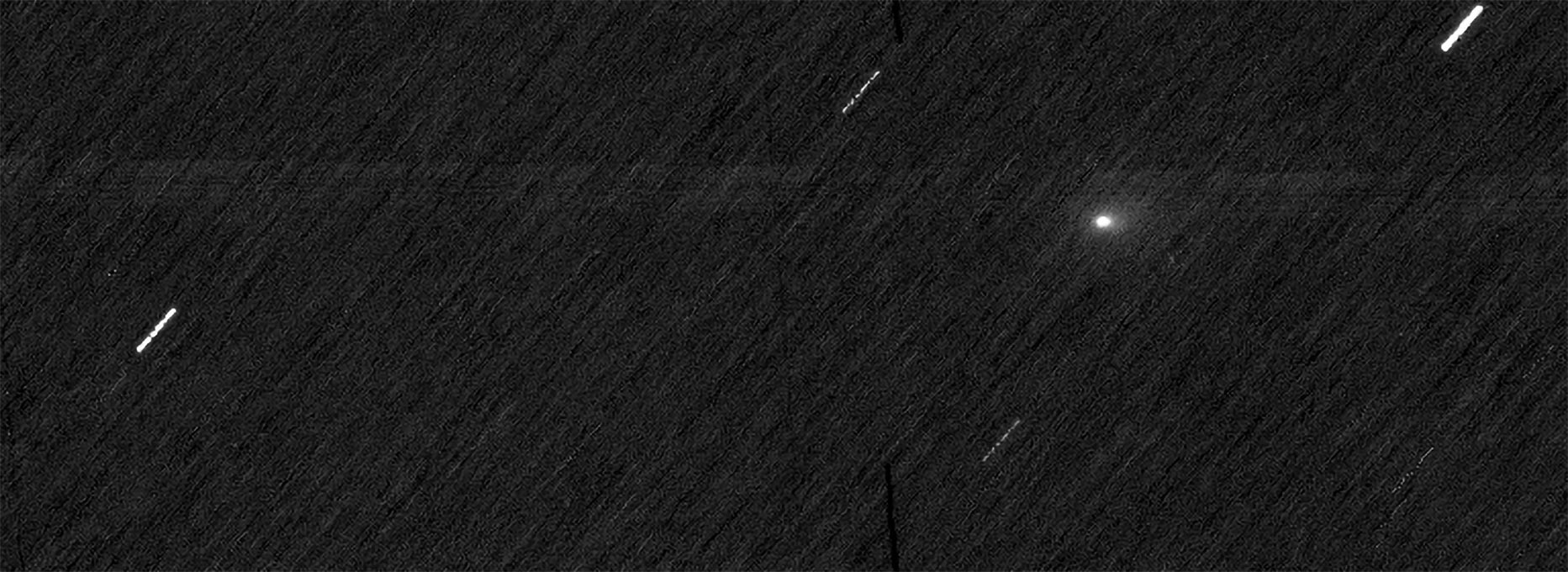
ExoMars TGO captured a series of images using its Colour and Stereo Surface Imaging System (CaSSIS). In the animation below, comet 3I/ATLAS appears as a slightly blurred white dot drifting downward near the center of the frame. That dot marks the comet’s core region, which contains both its solid icy-rocky nucleus and the hazy envelope of gas and dust that surrounds it, known as the coma.
Because the comet was so far away, CaSSIS was unable to distinguish between the nucleus and the coma. Detecting the tiny nucleus, which is only about a kilometer across, would have been as difficult as trying to see a mobile phone on the Moon from Earth.
The Coma Awakens: Heat, Dust, and Solar Fire
The coma, which spans several thousand kilometers, is clearly visible in the images. It forms as sunlight warms the comet while it moves closer to the Sun, causing frozen gases and dust to escape from the nucleus and form a glowing halo around it.
CaSSIS could not measure the coma’s full size because the brightness of the material fades rapidly with distance from the nucleus, eventually blending into background noise.
Usually, particles from the coma are carried away by solar radiation, forming a long tail that can stretch for millions of kilometers as the comet nears the Sun. The tail is far dimmer than the coma, which is why it does not appear in these images, but it could become more visible in future observations as 3I/ATLAS warms and releases more material.
Nick Thomas, Principal Investigator of the CaSSIS camera, said, “This was a very challenging observation for the instrument. The comet is around 10,000 to 100,000 times fainter than our usual target.”
Searching the Data for Clues
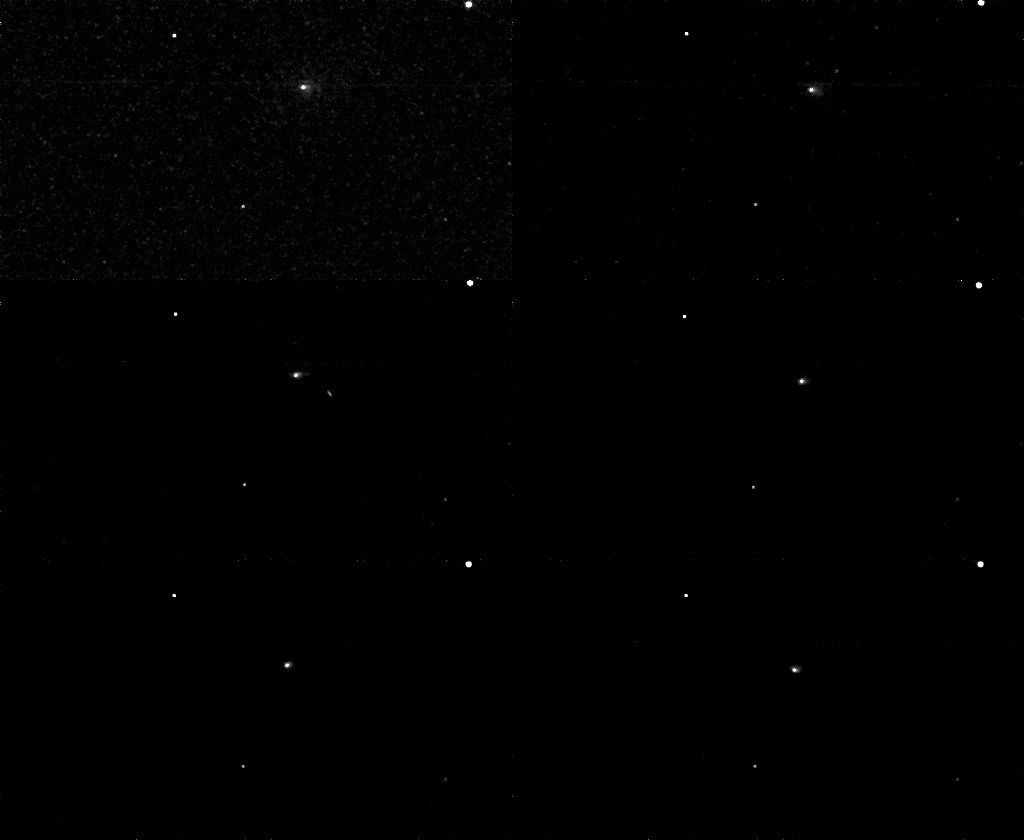
3I/ATLAS has not yet revealed itself in the Mars Express images, partly because these were taken with an exposure time of just 0.5 seconds (the maximum limit for Mars Express) compared to five seconds for ExoMars TGO.
Scientists will continue to analyse the data from both orbiters, including adding together several images from Mars Express to see if they can spot the faint comet.
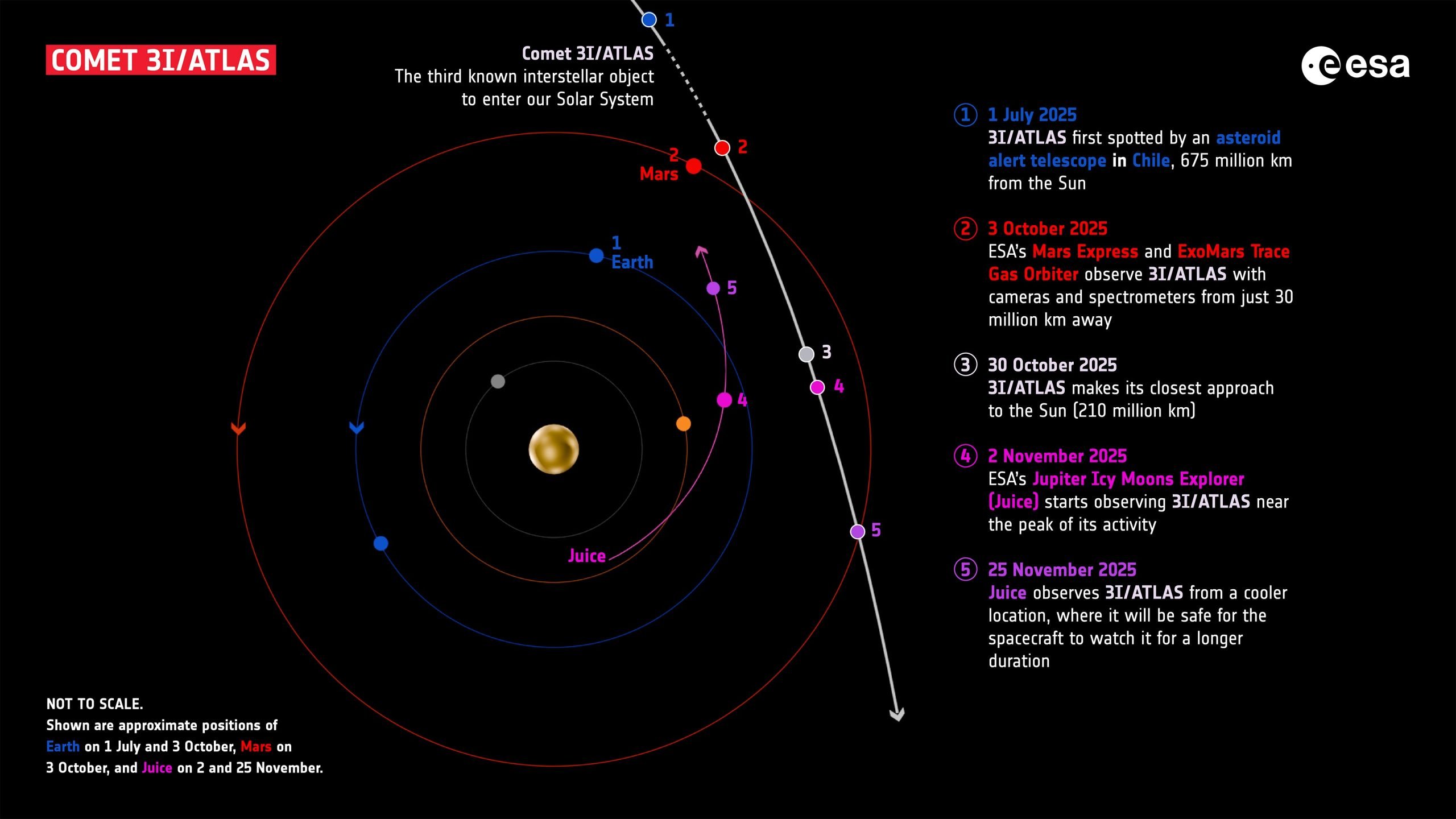
Since then, Earth has been moving away from 3I/ATLAS as it approaches the Sun. The comet is now on the other side of the Sun, making it impossible to observe from Earth.
ESA is making the most of its interplanetary missions to observe the comet from much better vantage points.
Between October 1 and 7, ESA’s Mars orbiters Mars Express and ExoMars Trace Gas Orbiter observed the comet as it passed close to Mars, with the closest distance between the spacecraft and the comet being 30 million km on October 3.
Then, between November 2 and 25, ESA’s Jupiter Icy Moons Explorer (Juice) will observe the comet with various instruments. As Juice looks towards 3I/ATLAS so soon after its closest approach to the Sun, it is likely to have the best view of the comet in a very active state, with a bright halo around its nucleus and a long tail stretching out behind it.
Credit: ESA, Acknowledgment: ATG Europe
Spectral Mysteries and the Quest for Composition
They also tried to measure the spectrum of light from comet 3I/ATLAS using Mars Express’s OMEGA and SPICAM spectrometers, and ExoMars TGO’s NOMAD spectrometer. At this point, it is uncertain whether the coma and tail were bright enough for a spectral characterisation.
Scientists will keep analysing the data over the next weeks and months to try to figure out more about what 3I/ATLAS is made of and how it is behaving as it approaches the Sun.
Colin Wilson, Mars Express and ExoMars project scientist at ESA, says: “Though our Mars orbiters continue to make impressive contributions to Mars science, it’s always extra exciting to see them responding to unexpected situations like this one. I look forward to seeing what the data reveals following further analysis.”
A Rare Visitor From Beyond the Solar System
Originating from outside our Solar System, comet 3I/ATLAS is only the third interstellar comet ever seen, following 1I/ʻOumuamua in 2017 and 2I/Borisov in 2019.
These comets are absolutely foreign. Every planet, moon, asteroid, comet, and lifeform in our Solar System shares a common origin. But interstellar comets are true outsiders, carrying clues about the formation of worlds far beyond our own.
Comet 3I/ATLAS was first spotted on July 1, 2025, by the Asteroid Terrestrial-impact Last Alert System (ATLAS) telescope in Río Hurtado, Chile. Since then, astronomers have used ground-based and space telescopes to monitor its progress and discover more about it.
Based on its trajectory, astronomers suspect that 3I/ATLAS could be the oldest comet ever observed. It may be three billion years older than the Solar System, which is itself already 4.6 billion years old.
What’s Next: Eyes Turn to Juice and the Future
Next month, we will observe the comet with our Jupiter Icy Moons Explorer (Juice). Though Juice will be further from 3I/ATLAS than our Mars orbiters were last week, it will see the comet just after its closest approach to the Sun, meaning that it will be in a more active state. We don’t expect to receive data from Juice’s observations until February 2026 – find out why in ESA’s Comet 3I/ATLAS FAQs.
Icy wanderers such as 3I/ATLAS offer a rare, tangible connection to the broader galaxy. To actually visit one would connect humankind with the Universe on a far greater scale. To this end, ESA is preparing the Comet Interceptor mission.
Comet Interceptor is due to launch in 2029 into a parking orbit, from where it will lie in wait for a suitable target – a pristine comet from the distant Oort Cloud that surrounds our Solar System, or, unlikely but highly appealing, an interstellar object like 3I/ATLAS.
Michael Kueppers, Comet Interceptor project scientist, expands: “When Comet Interceptor was selected in 2019, we only knew of one interstellar object – 1I/ʻOumuamua, discovered in 2017. Since then, two more such objects have been discovered, showing large diversity in their appearance. Visiting one could provide a breakthrough in understanding their nature.”
The Promise of Future Encounters
While it remains improbable that we will discover an interstellar object that is reachable for Comet Interceptor, as a first demonstration of a rapid response mission that waits in space for its target, it will be a pathfinder for possible future missions to intercept these mysterious visitors.
Never miss a breakthrough: Join the SciTechDaily newsletter.
Follow us on Google and Google News.
3 Comments
Yet to wait till binary mode
-Throttle commands to develope
Art & Dye
NASA,SPACE-X,TESLA
Busy in Retry, Retry, Retry.
Beyond. This. Place. Of. Rath. And. Tears. There Looms. Existence. Of. More. Universes. Abominable Hurdles. Will. Still. Have. To. Be. Conquered to. Achieve. Eternal. Love.
Uh? Do you not know God created all heavenly bodies on the 4th day? The text indicates it was a 24 hrs day, not eons of years? Genesis 14 –17 “And God said, “Let there be lights in the expanse of the sky to distinguish between the day and the night, and let them be signs to mark the seasons and days and years. And let them serve as lights in the expanse of the sky to shine upon the earth.” And it was so. God made two great lights: the greater light to rule the day and the lesser light to rule the night. And He made the stars as well. God set these lights in the expanse of the sky to shine upon the earth, to preside over the day and the night, and to separate the light from the darkness. And God saw that it was good. And there was evening, and there was morning—the fourth day.”