
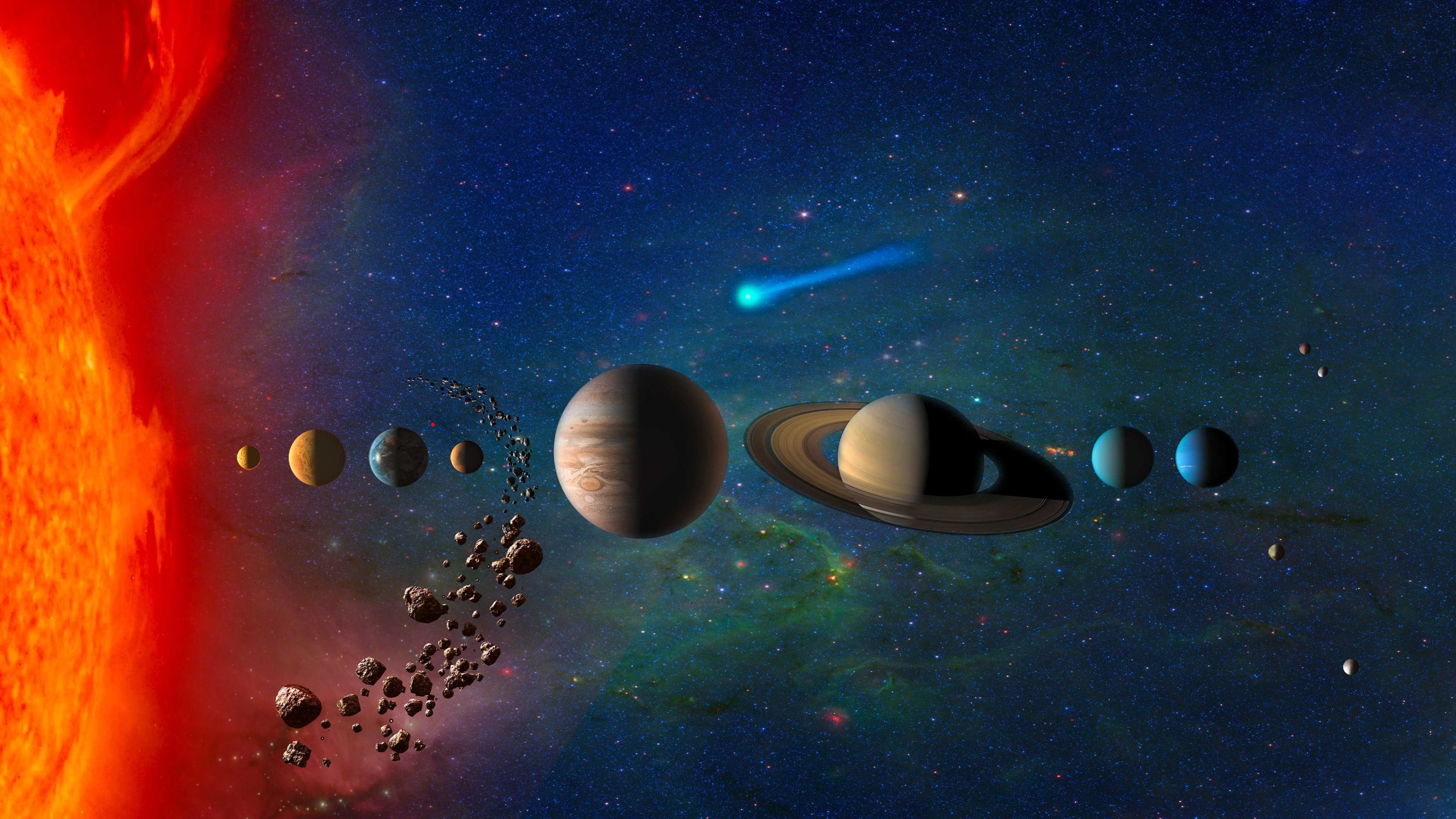
U-M astronomers are helping study a fast-moving, ancient, and massive comet that formed beyond our galaxy.
A group of astronomers from around the world, including a doctoral student from the University of Michigan, were the first to report the discovery of the third confirmed interstellar object to enter our solar system. The announcement was made on July 3.
Following the discovery, Aster Taylor from the University of Michigan’s Department of Astronomy and Darryl Seligman of Michigan State University co-authored a new study that begins to explore the properties of this newly identified object, named 3I/ATLAS.
Unlike objects that originate within our solar system, interstellar objects form elsewhere in the galaxy and pass through without becoming gravitationally bound to the sun. The arrival of 3I/ATLAS, along with the two previous interstellar visitors, has provided scientists with rare and valuable chances to investigate distant galactic environments.
Public interest and future discoveries
“This is what we’re here for—finding objects like this, making the public aware of them and generating excitement,” said Aster Taylor, a Fannie and John Hertz Fellow in the U-M Department of Astronomy.
Public enthusiasm plays a vital role in sustaining support for funding and the development of advanced technologies that make future discoveries possible. One example is the Vera C. Rubin Observatory, which began operations this summer with backing from the U.S. National Science Foundation and the U.S. Department of Energy. While it was not responsible for discovering 3I/ATLAS, Taylor noted that the observatory is expected to identify one or two interstellar objects each year.

“It’s an auspicious time to find cool objects,” Taylor said. “We’re excited about three, but if we can get to 10 or more of these things, then we’ll have a reasonable sample and we’ll be really excited about that.”
Both reports are available as preprints on arXiv.
The telescope that spotted 3I/ATLAS
NASA’s Asteroid Terrestrial-impact Last Alert System (ATLAS) enabled the discovery of 3I/ATLAS. The system includes four telescopes—two located in Hawaii, one in Chile, and one in South Africa—that automatically scan the entire sky multiple times each night to detect moving objects.
As its name suggests, ATLAS is designed to detect potential threats to Earth, but in this case, the object poses no danger. It will not collide with our planet and will remain at a distance greater than that between Earth and the sun.
Taylor noted that 3I/ATLAS is most likely a comet. It is surrounded by a coma, a hazy envelope of gas and dust that forms around the solid core. As the object approaches the sun, this coma is expected to change, offering valuable insights into the comet’s makeup.
“3I/ATLAS likely contains ices, especially below the surface, and those ices may start to activate as it nears the sun,” said Seligman, a postdoctoral fellow at MSU. “But until we detect specific gas emissions, like H2O, CO or CO2, we can’t say for sure what kinds of ice or how much there is.”
Awaiting answers from space telescopes
Over the coming months, space telescopes like Hubble and JWST will be able to zoom in on 3I/ATLAS to probe these and other questions about its size, spin, and how it reacts to being heated.
“We have these images of 3I/ATLAS where it’s not entirely clear and it looks fuzzier than the other stars in the same image,” said James Wray, a professor at the Georgia Institute of Technology who was involved in the discovery. “The object is pretty far away and, so, we just don’t know.”
Still, the researchers were able to work out some important characteristics from their initial observations. Specifically, 3I/ATLAS is faster, larger, and older than its predecessors, 1I/’Oumuamua and 2I/Borisov.
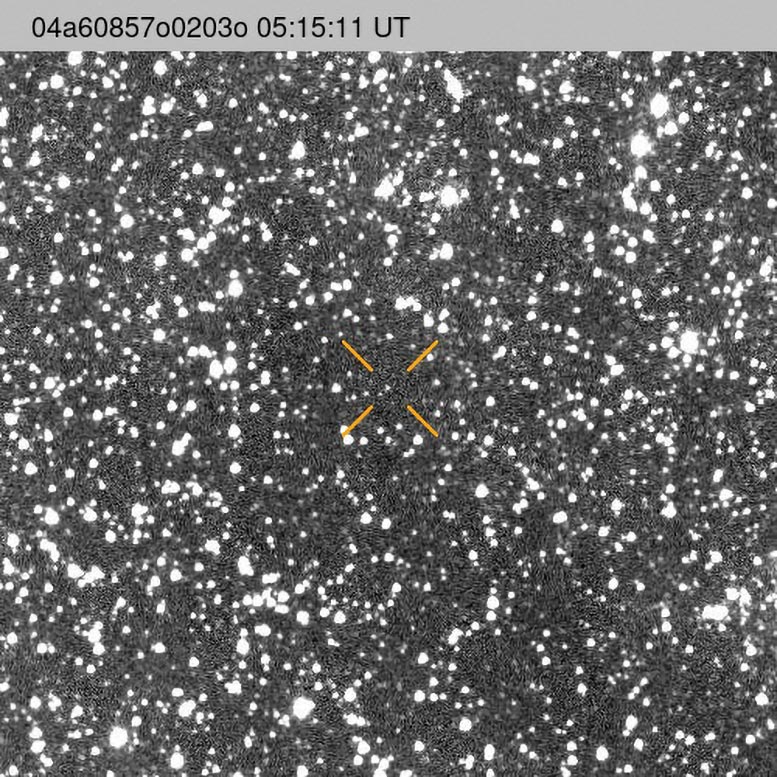
3I/ATLAS has a hyperbolic velocity of just under 60 kilometers per second—roughly 130,000 miles per hour—compared to 26 for ‘Oumuamua and 32 for Borisov. The diameter of 3I/ATLAS is currently estimated to be as much as 10 kilometers, or 6 miles, which would be 100 times that of ‘Oumuamua and 10 times that of Borisov.
But Taylor is confident those numbers will shrink as astronomers get better observations of 3I/ATLAS. Such a large size would imply galaxies are way more efficient at making these kinds of objects than is physically possible.
Finally, ‘Oumuamua and Borisov have ages measured in millions of years, while 3I/ATLAS appears to be between 3 billion and 11 billion years old.
“It’s a wide range,” Taylor said. “But 11 billion years is pretty old. It’s about as old as the galaxy.”
This is another number that Taylor suspects will ultimately turn out to be toward the smaller end of the range. But it will be interesting regardless because it can provide more clues about how our galaxy was forming stars, planets, and other objects earlier in its history.
Racing to confirm the object
Taylor was recruited for the project while traveling to help confirm 3I/ATLAS was an interstellar object and make early characterizations. And there was a time crunch. If the ATLAS team had noticed 3I, odds were other astronomers had, too, and the team wanted to confirm its suspicions and get the news out first.
“I was fully on vacation in Fiji with my family when this was announced. When I heard, I just thought, ‘All right. Well, that’s my next two days,’” Taylor said. “It’s very exciting, but it’s also more stressful than you might think.”
Seligman had a little bit more notice, but not much. News started to spread within the group on July 1.
“I heard something about the object before I went to bed, but we didn’t have a lot of information yet,” Seligman said. “By the time I woke up around 1 a.m., my colleagues, Marco Micheli from the European Southern Observatory and Davide Farnocchia from NASA’s Jet Propulsion Laboratory, were emailing me that this was likely for real. I started sending messages telling everyone to turn their telescopes to look at this object.”
Final confirmation and follow-up
Larry Denneau, a member of the ATLAS team, reviewed and submitted the discovery observations from the European Southern Observatory’s Very Large Telescope in Chile shortly after it was observed.
“We have had false alarms in the past about interesting objects, so we know not to get too excited on the first day,” Denneau said. “But the incoming observations were all consistent, and late that night it looked like we had the real thing.”
John Tonry, another member of ATLAS and professor at the University of Hawaii, was instrumental in the design and construction of ATLAS, the survey that discovered 3I.
“It’s really gratifying every time our hard work surveying the sky discovers something new, and this comet that has been traveling for millions of years from another star system is particularly interesting,” he said.
Once 3I/ATLAS was confirmed, Seligman and Karen Meech, faculty chair for the Institute for Astronomy at the University of Hawaii, both managed the communications flow and worked on getting the data pulled together for submitting the paper.
“Once 3I/ATLAS was identified as likely interstellar, we mobilized rapidly,” Meech said. “We activated observing time on major facilities like the Southern Astrophysical Research Telescope and the Gemini Observatory to capture early, high-quality data and build a foundation for detailed follow-up studies.”
References: “Discovery and Preliminary Characterization of a Third Interstellar Object: 3I/ATLAS” by Darryl Z. Seligman, Marco Micheli, Davide Farnocchia, Larry Denneau, John W. Noonan, Henry H. Hsieh, Toni Santana-Ros, John Tonry, Katie Auchettl, Luca Conversi, Maxime Devogèle, Laura Faggioli, Adina D. Feinstein, Marco Fenucci, Marin Ferrais, Tessa Frincke, Michaël Gillon, Olivier R. Hainaut, Kyle Hart, Andrew Hoffman, Carrie E. Holt, Willem B. Hoogendam, Mark E. Huber, Emmanuel Jehin, Theodore Kareta, Jacqueline V. Keane, Michael S. P. Kelley, Tim Lister, Kathleen Mandt, Jean Manfroid, Dušan Marčeta, Karen J. Meech, Mohamed Amine Miftah, Marvin Morgan, Francisco Ocaña, Eloy Peña-Asensio, Benjamin J. Shappee, Robert J. Siverd, Aster G. Taylor, Michael A. Tucker, Richard Wainscoat, Robert Weryk, James J. Wray, Atsuhiro Yaginuma, Bin Yang, Quanzhi Ye and Qicheng Zhang, 3 July 2025, arXiv.
DOI: 10.48550/arXiv.2507.02757
“The Kinematic Age of 3I/ATLAS and its Implications for Early Planet Formation” by Aster G. Taylor and Darryl Z. Seligman, 10 July 2025, arXiv.
DOI: 10.48550/arXiv.2507.08111
Never miss a breakthrough: Join the SciTechDaily newsletter.
Follow us on Google and Google News.
1 Comment
well for those who still clinging to the old dispaarged ‘comets are lumps of frozen slush’ I guess you will not get a chance this time to be proven wrong again, as all the close landings of asteroids and comets have shown, as none of them were frozen slushy icebergs, but hey… the only other theory out there that fully explains the phenomenon is the EU