

If you gaze at the vast galaxies filled with countless stars, it’s easy to assume they are star factories, churning out brilliant balls of gas. However, it’s the less evolved dwarf galaxies dwarf galaxies have bigger regions of star factories, with higher rates of star formation.
Recent findings by researchers from the University of Michigan shed light on this phenomenon: Dwarf galaxies experience a delay of about 10 million years before they expel the gas congesting their space. This delay allows star-forming regions in these galaxies to retain their gas and dust longer, fostering the formation and development of more stars.
Dwarf Galaxies: Cradles of Star Formation
In these relatively pristine dwarf galaxies, massive stars—stars about 20 to 200 times the mass of our sun—collapse into black holes instead of exploding as supernovae. But in more evolved, polluted galaxies, like our Milky Way, they are more likely to explode, thereby generating a collective superwind. Gas and dust get blasted out of the galaxy, and star formation quickly stops.
Their findings are published in the Astrophysical Journal.
“As stars go supernova, they pollute their environment by producing and releasing metals,” said Michelle Jecmen, study first author and an undergraduate researcher. “We argue that at low metallicity—galaxy environments that are relatively unpolluted—there is a 10-million-year delay in the start of strong superwinds, which, in turn, results in higher star formation.”
The Hubble Tuning Fork and Galactic Classification
The U-M researchers point to what’s called the Hubble tuning fork, a diagram that depicts the way astronomer Edwin Hubble classified galaxies. In the handle of the tuning fork are the largest galaxies. Huge, round, and brimming with stars, these galaxies have already turned all of their gas into stars. Along the tines of the tuning fork are spiral galaxies that do have gas and star-forming regions along their compact arms. At the end of the tuning fork’s tines are the least evolved, smallest galaxies.
“But these dwarf galaxies have just these really mondo star-forming regions,” said U-M astronomer Sally Oey, senior author of the study. “There have been some ideas around why that is, but Michelle’s finding offers a very nice explanation: These galaxies have trouble stopping their star formation because they don’t blow away their gas.”
Additionally, this 10-million-year period of quiet offers astronomers the opportunity to peer at scenarios similar to the cosmic dawn, a period of time just after the Big Bang, Jecmen said. In pristine dwarf galaxies, gas clumps together and forms gaps through which radiation can escape. This previously known phenomenon is called the “picket fence” model, with UV radiation escaping between slats in the fence. The delay explains why gas would have had time to clump together.
Cosmic Dawn and Ultraviolet Radiation
Ultraviolet radiation is important because it ionizes hydrogen—a process that also occurred right after the Big Bang, causing the universe to go from opaque to transparent.
“And so looking at low-metallicity dwarf galaxies with lots of UV radiation is somewhat similar to looking all the way back to the cosmic dawn,” Jecmen said. “Understanding the time near the Big Bang is so interesting. It’s foundational to our knowledge. It’s something that happened so long ago—it’s so fascinating that we can see sort of similar situations in galaxies that exist today.”
Observational Evidence
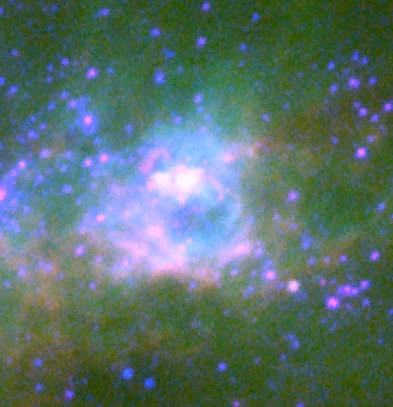
A second study, published in the Astrophysical Journal Letters and led by Oey, used the Hubble Space Telescope to look at Mrk 71, a region in a nearby dwarf galaxy about 10 million light years away. In Mrk 71, the team found observational evidence of Jecmen’s scenario. Using a new technique with the Hubble Space Telescope, the team employed a filter set that looks at the light of triply ionized carbon.
In more evolved galaxies with lots of supernova explosions, those explosions heat gas in a star cluster to very high temperatures—to millions of degrees Kelvin, Oey said. As this hot superwind expands, it blasts the rest of the gas out of the star clusters. But in low metallicity environments such as Mrk 71, where stars aren’t blowing up, energy within the region is radiated away. It doesn’t have the chance to form a superwind.
The team’s filters picked up a diffuse glow of the ionized carbon throughout Mrk 71, demonstrating that the energy is radiating away. Therefore, there is no hot superwind, instead allowing dense gas to remain throughout the environment.
Oey and Jecmen say there are many implications for their work.
“Our findings may also be important in explaining the properties of galaxies that are being seen at cosmic dawn by the James Webb Space Telescope right now,” Oey said. “I think we’re still in the process of understanding the consequences.”
References: “Delayed Massive-star Mechanical Feedback at Low Metallicity” by Michelle C. Jecmen and M. S. Oey, 21 November 2023, The Astrophysical Journal.
DOI: 10.3847/1538-4357/ad0460
“Nebular C iv λ1550 Imaging of the Metal-poor Starburst Mrk 71: Direct Evidence of Catastrophic Cooling” by M. S. Oey, Amit N. Sawant, Ashkbiz Danehkar, Sergiy Silich, Linda J. Smith, Jens Melinder, Claus Leitherer, Matthew Hayes, Anne E. Jaskot, Daniela Calzetti, You-Hua Chu, Bethan L. James and Göran Östlin, 21 November 2023, The Astrophysical Journal Letters.
DOI: 10.3847/2041-8213/ad07dd
Never miss a breakthrough: Join the SciTechDaily newsletter.
Follow us on Google and Google News.