
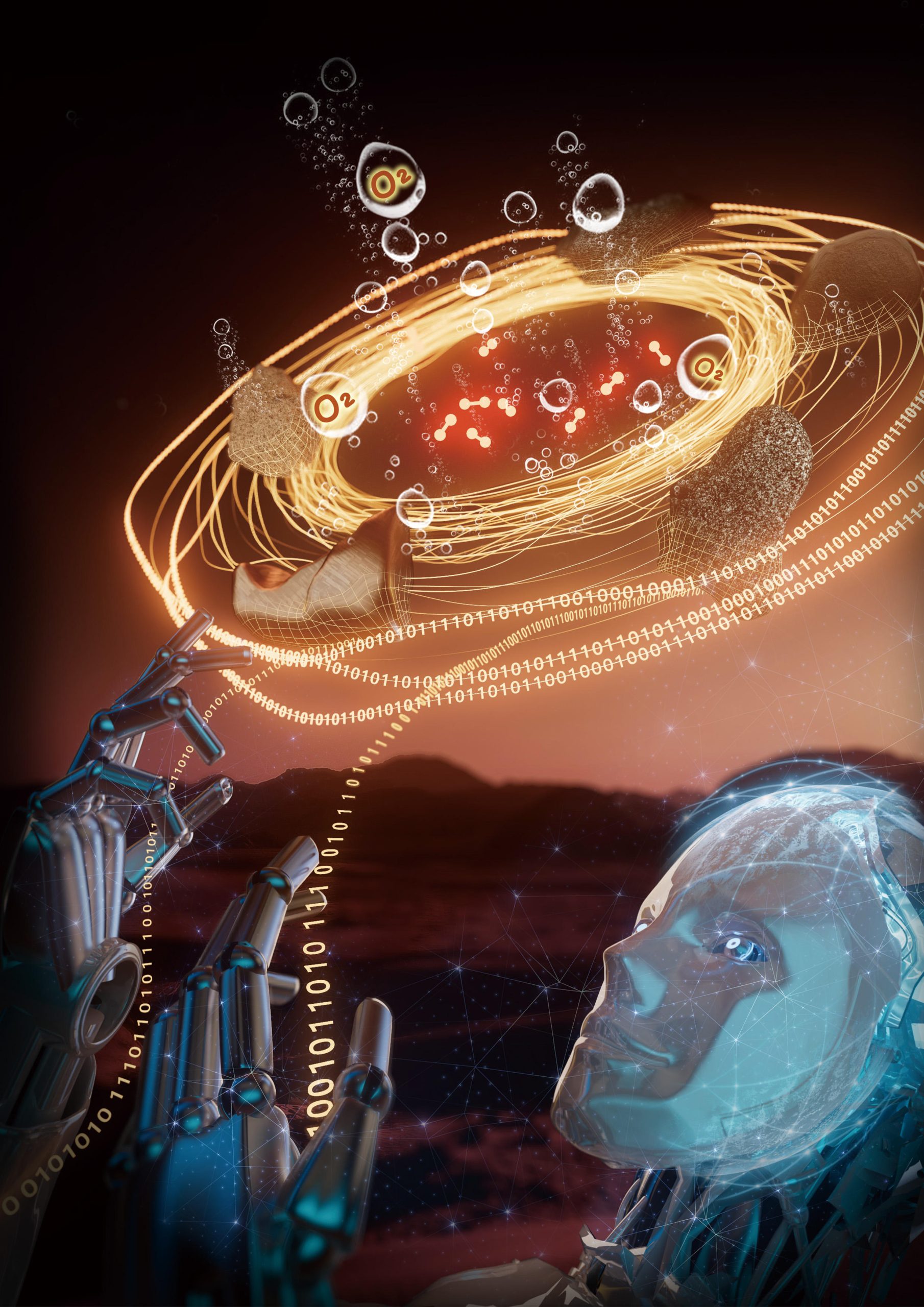
An AI chemist has successfully created a catalyst for producing oxygen from Martian meteorites.
Immigration to and living on Mars have often been themes in science fiction. Before these dreams can become reality, humanity faces significant challenges, such as the scarcity of vital resources like oxygen needed for long-term survival on the Red Planet. Yet, recent discoveries of water activity on Mars have sparked new hope for overcoming these obstacles.
Scientists are now exploring the possibility of decomposing water to produce oxygen through electrochemical water oxidation driven by solar power with the help of oxygen evolution reaction (OER) catalysts. The challenge is to find a way to synthesize these catalysts in situ using materials on Mars, instead of transporting them from the Earth, which is of high cost.
Advancements in AI and Martian Chemistry
To tackle this problem, a team led by Prof. Luo Yi, Prof. Jiang Jun, and Prof. Shang Weiwei from the University of Science and Technology of China (USTC) of the Chinese Academy of Sciences (CAS), recently made it possible to synthesize and optimize OER catalysts automatically from Martian meteorites with their robotic artificial intelligence (AI)-chemist.
Their research, in collaboration with Deep Space Exploration Laboratory, was recently published in the journal Nature Synthesis.
“The AI chemist innovatively synthesizes OER catalyst using Martian material based on interdisciplinary cooperation,” said Prof. Luo Yi, leading scientist of the team.
In each experimental cycle, the AI chemist first analyzes the elemental composition of the Martian ores using the laser-induced breakdown spectroscopy (LIBS) as its eyes. Then, it carries out a series of pretreatments on the ores, including weighing in the solid-dispensing workstation, preparing feedstock solutions in the liquid-dispensing workstation, separation from liquid in the centrifugation workstation, and solidification in the dryer workstation.
A robotic AI-Chemist makes useful Oxygen generation catalysts with Martian meteorites. Credit: AI-Chemist Group at University of Science and Technology of China
The resulting metal hydroxides are treated with Nafion adhesive to prepare the working electrode for OER testing at the electrochemical workstation. The testing data are sent to the computational ‘brain’ of the AI chemist in real-time for machine learning (ML) processing.
The AI chemist’s ‘brain’ employs quantum chemistry and molecular dynamics simulations for 30,000 of high-entropy hydroxides with different elemental ratios and calculates their OER catalytic activities via density functional theory. The simulation data are used to train a neural network model for rapidly predicting the catalysts’ activities with different elemental compositions.
Finally, through Bayesian optimization, the ‘brain’ predicts the combination of available Martian ores needed for synthesizing the optimal OER catalyst.
Achieving a Breakthrough in Oxygen Production
So far, the AI chemist has created an excellent catalyst using five types of Martian meteorites under unmanned conditions. This catalyst can operate steadily for over 550,000 seconds at a current density of 10 mA cm-2 and an overpotential of 445.1 mV. A further test at -37 °C, the temperature on Mars, confirmed that the catalyst can steadily produce oxygen without any apparent degradation.
Within two months, the AI chemist has completed the complex optimization of catalysts that would take 2000 years for a human chemist.
The team is working to turn the AI chemist into a general experiment platform for various chemical syntheses without human intervention. The reviewer of the paper highly remarked: “This type of research is of wide interest and is under rapid development in organic/inorganic material synthesis and discovery.”
“In the future, humans can establish an oxygen factory on Mars with the assistance of an AI chemist,” said Jiang. Only 15 hours of solar irradiation is needed to produce sufficient oxygen concentration required for human survival. “This breakthrough technology brings us one step closer to achieving our dream of living on Mars,” he said.
Reference: “Automated synthesis of oxygen-producing catalysts from Martian meteorites by a robotic AI chemist” by Qing Zhu, Yan Huang, Donglai Zhou, Luyuan Zhao, Lulu Guo, Ruyu Yang, Zixu Sun, Man Luo, Fei Zhang, Hengyu Xiao, Xinsheng Tang, Xuchun Zhang, Tao Song, Xiang Li, Baochen Chong, Junyi Zhou, Yihan Zhang, Baicheng Zhang, Jiaqi Cao, Guozhen Zhang, Song Wang, Guilin Ye, Wanjun Zhang, Haitao Zhao, Shuang Cong, Huirong Li, Li-Li Ling, Zhe Zhang, Weiwei Shang, Jun Jiang and Yi Luo, 13 November 2023, Nature Synthesis.
DOI: 10.1038/s44160-023-00424-1
Never miss a breakthrough: Join the SciTechDaily newsletter.
Follow us on Google and Google News.
6 Comments
Let me know when you figure out how to replace the magnetic field, until then there’s not a lot you can do on mars besides live underneath the surface.
Why can’t we send AI Robots to Mars and they can prepare a wonderful oasis for their Masters’ (Humans’) arrival.
The first word should be emigration, not immigration. Seriously, dude?
The real big problem with Mars is its lack of a magnetic field. If you don’t know why, research it.
It is hard to have an interest in an article that spouts nonsense, even if the middle of the article has rational content. We have no science to “produce” or “synthesize” oxygen. People have been trying to do that with gold for a thousand years but it does not work.
“Planting a flag on Mars is akin to planting one on a toxic dump.
Perchlorates are pervasive there: less than a teaspoon of Martian soil can disrupt the thyroid, and 1 lb contains enough to kill a person.
On Earth, Martian soil would qualify as a toxic waste site under most legal frameworks due to its perchlorate content.