
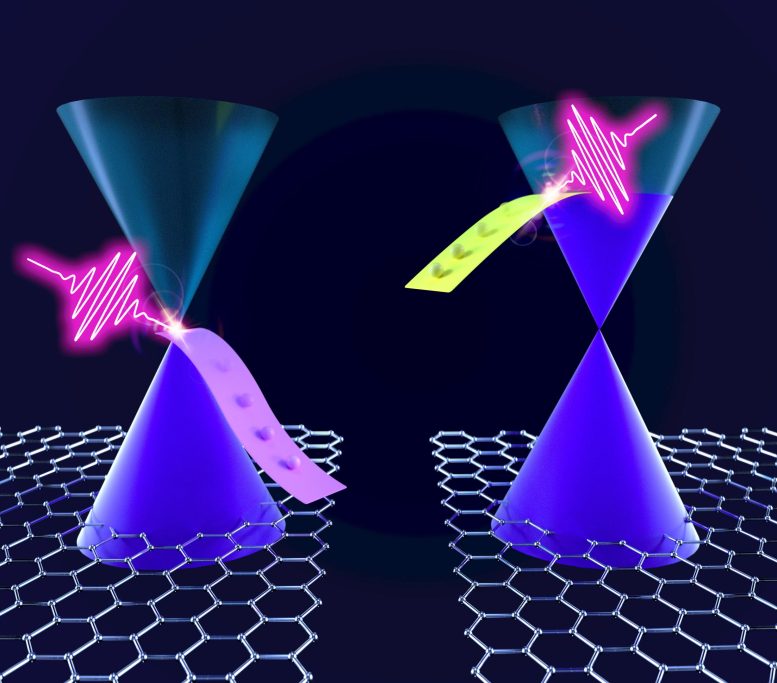
An international study, published in ACS Nano, has demonstrated an unprecedented level of control of the optical properties of graphene. The work has promising applications in different technological fields ranging from photonics to telecommunications.
Graphene is the thinnest material ever produced, with the thickness of a single atomic layer, thinner than a billionth of a meter, it is able to efficiently absorb light from the visible to the infrared through the photoexcitation of its charge carriers. After light absorption, its photoexcited charge carriers cool down to the initial equilibrium state in a few picoseconds, corresponding to a millionth of a millionth of a second. The remarkable speed of this relaxation process makes graphene particularly promising for a number of technological applications, including light detectors, sources, and modulators.
External Electrical Field Alters Graphene’s Relaxation Time
A recent study published in ACS Nano has shown that the relaxation time of graphene charge carriers can be significantly modified by applying an external electrical field. The research was conceived within an international collaboration between the CNR-IFN, Politecnico di Milano, the University of Pisa, the Graphene Center of Cambridge (UK), and ICN2 of Barcelona (Spain).
“The change in the relaxation time of charge carriers in graphene that we have observed, demonstrates an unprecedented level of control on the optical response of a crystal and allows to obtain a large variety of behaviors using a single material,” says Eva Pogna, researched from CNR-IFN, first author of the work.
This work paves the way for the development of devices that exploit the control of the relaxation time of charge carriers to support novel functionalities. For example, if graphene is used as saturable absorber in a laser cavity to generate ultrashort light pulses, by changing the relaxation time of the charge carriers, we can control the duration of the output pulses.
“The specific device that we have used to study graphene, proved to be crucial to observe the strong tunability of its optical properties with the external electric field, allowing to change the number of charge carriers over a broad range by exploiting ionic liquid gating, which is a state-of-the-art technology introduced to study superconductors” explains Andrea Ferrari, director of the Graphene Center in Cambridge.
The graphene-based device has been studied by ultrafast spectroscopy, which allowed to monitor the variation of the relaxation time of the charge carriers.
Potential Applications in Photonics and Telecommunications
“This work represents the latest step of a long-standing research collaboration devoted to the study of the ultrafast carrier dynamics in graphene, aimed at exploring the great potential of this fascinating material” as added by Klaas-Jan Tielrooij, leader of the Ultrafast Dynamics in Nanoscale Systems group at ICN2.
“This discovery is of large interest for a number of technological applications, ranging from photonics, for pulsed laser sources or optical limiters that prevent optical components damaging, to telecommunication, for ultrafast detectors and modulators” concludes Giulio Cerullo, professor of the Physics Department of Politecnico di Milano.
Reference: “Electrically Tunable Nonequilibrium Optical Response of Graphene” by Eva A. A. Pogna, Andrea Tomadin, Osman Balci, Giancarlo Soavi, Ioannis Paradisanos, Michele Guizzardi, Paolo Pedrinazzi, Sandro Mignuzzi, Klaas-Jan Tielrooij, Marco Polini, Andrea C. Ferrari and Giulio Cerullo, 21 February 2022, ACS Nano.
DOI: 10.1021/acsnano.1c04937
Never miss a breakthrough: Join the SciTechDaily newsletter.
Follow us on Google and Google News.