
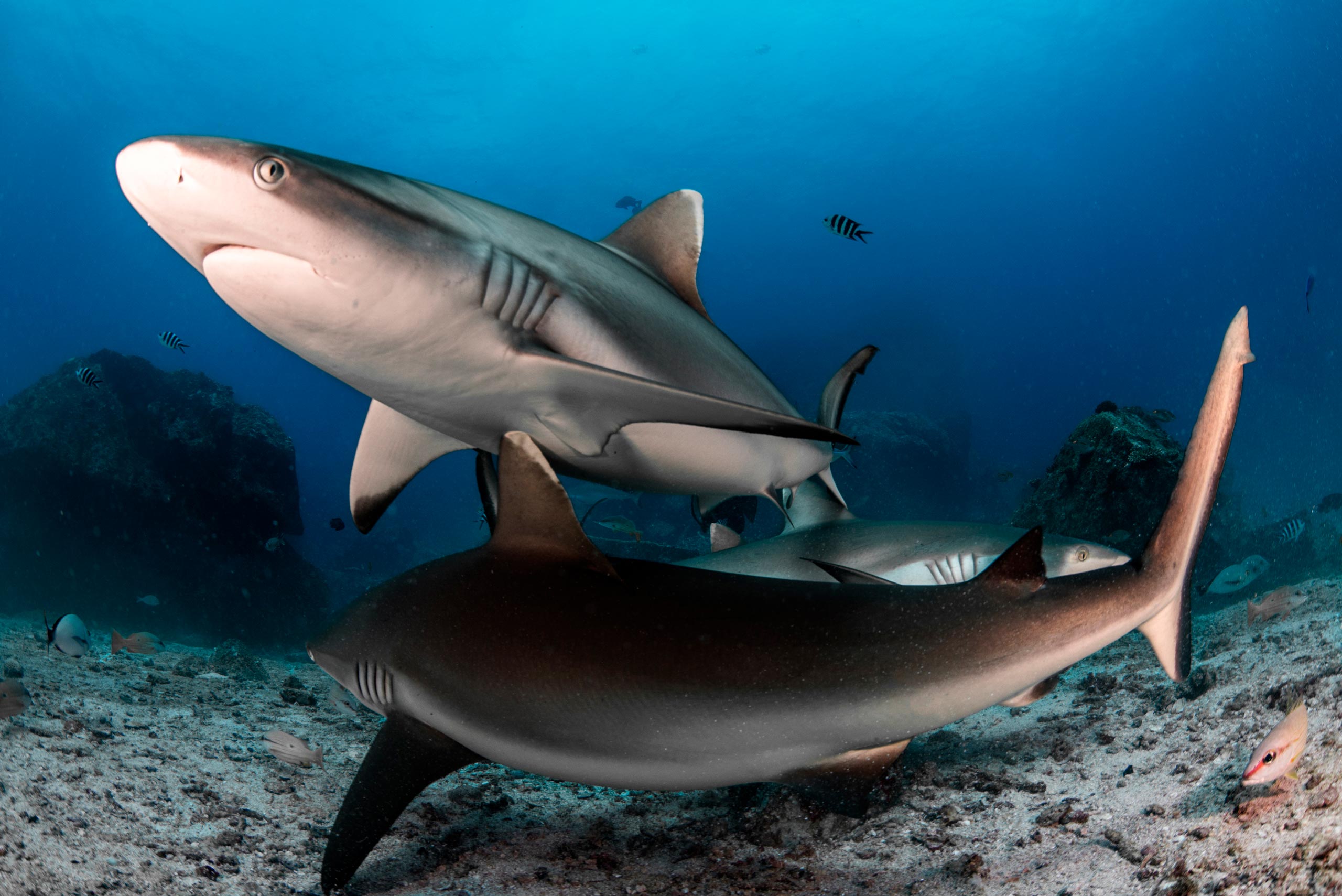
A first report of grey reef sharks resting under reef ledges in Seychelles changes what we know about how they breathe (they don’t need to swim continuously to stay alive) – and re-opens the case for the science of sleeping sharks.
Predators in perpetual motion. Sleepless in our seas. If that’s your image of sharks, you’re not alone. And for good reason: sharks must swim to breathe (or so we were told). The science of how sharks sleep and breathe is linked, and while all sharks use gills to breathe, there are two ways that they move oxygen-rich sea water over those gills.
Some sharks, called obligate ram ventilators, ‘ram’ oxygen-rich sea water over their gills and need to keep moving to do so. Other species, called buccal pumpers, actively pump sea water over their gills while stationary.
Evidence of Rest in Sharks: A New Perspective
Science today tells us that sharks can be still – and there is some suggestion that they sleep. But there is no solid evidence of sleep behavior in ram ventilators. Scientists have hypothesized that they don’t sleep at all, or they sleep using half their brain (like sperm whales and bottlenose dolphins), or they sleep facing into ocean currents.
A new paper “Just keep swimming? Observations of resting behavior in grey reef sharks Carcharhinus amblyrhynchos (Bleeker, 1856),” published this month in Journal of Fish Biology up-ends what we know about one obligate ram ventilator. The grey reef shark is an Endangered reef dweller in the family Carcharhinidae and was the quintessential representative of a shark that moves to breathe.
The first evidence of grey reef sharks resting under reef ledges in Seychelles. Credit: Filmed by Craig Foster | © Save Our Seas Foundation
“On routine survey dives around D’Arros we found grey reef sharks resting under coral reef ledges,” begins Dr. Robert Bullock, the director of research at the Save Our Seas D’Arros Research Centre (SOSF-DRC) in Seychelles. “This is not something we believed they could do. The grey reef shark has been considered a ram-ventilating species, unable to rest, so to find these ones resting turns our fundamental understanding of them on its head.”
Sharks at Rest: A Surprising Discovery
The researchers encountered grey reef sharks resting alone and in groups at different sites around Seychelles. And through it all, the sharks seemed blissfully unaware of their observers. It’s a key observation: scientists think that increases in arousal thresholds count as the hallmark of sleep rather than just rest.
The sharks remained still, except for lower jaw movements that suggest these ram-ventilating sharks can switch to buccal pumping behavior. With little to no currents at the sites and sharks at rest facing in all directions, it seems the idea that the only way they’d rest is facing into currents holds little water for grey reef sharks.
Craig Foster, founder of the SeaChange Project, was one of the divers and authors of the paper. “There is something very special,” he says, “about “tiptoeing” around underwater at a depth of 25 meters and looking into the open eyes of sleeping sharks, moving carefully so as not to wake the peaceful beauties.”
Implications and Future Research
“I love things that challenge our current thinking, and I’ve always thought of the grey reef shark as a clear example of a species that needs to swim to breathe. Clearly not from this discovery!” Dr. James Lea, the CEO of the Save Our Seas Foundation, is enthusiastic about what the paper portends. “This raises all kinds of other questions,” he declares. “How are they coping? How long for? How often? We have so much to learn still and to me that’s exciting.”
If the grey reef shark can switch its mode of breathing, and rest, there’s more to uncover about similar sharks. “It’s key to understanding how they use their environment and also how this may change in response to shifts in environmental conditions,” explains Dr. Lea. “How important is this rest, or possible sleep, for the sharks? And what’s the impact on them if they can’t get that rest if conditions change, such as oxygen levels rising or falling due to a changing climate?”
A Reminder of Our Connection with Nature
The authors all agree that this discovery also says a lot about our own relationship with the natural world. “I hope that these findings serve as a reminder of how much we still do not know and how exciting that is. Science is about being wrong quite a lot. And that’s OK,” reflects Dr. Bullock. Mr. Foster believes that what we know about the wild is critical to conservation. “Knowing how our shark kin sleep is to be closer to their fascinating world and to wake up from our own slumber and realize we cannot live without these magnificent marine beings,” he states.
Reference: “Just keep swimming? Observations of resting behavior in gray reef sharks Carcharhinus amblyrhynchos (Bleeker, 1856)” by Robert W. Bullock, Craig Foster and James S. E. Lea, 20 November 2023, Journal of Fish Biology.
DOI: 10.1111/jfb.15623
Never miss a breakthrough: Join the SciTechDaily newsletter.
Follow us on Google and Google News.