
Close Menu
    Facebook X (Twitter) Instagram
    SciTechDaily
    • Biology
    • Chemistry
    • Earth
    • Health
    • Physics
    • Science
    • Space
    • Technology
    Facebook X (Twitter) Pinterest YouTube RSS
    SciTechDaily
    Home»Space»Stunning View of Comet NEOWISE Over Madrid As Space Station Streaks Past
    Space

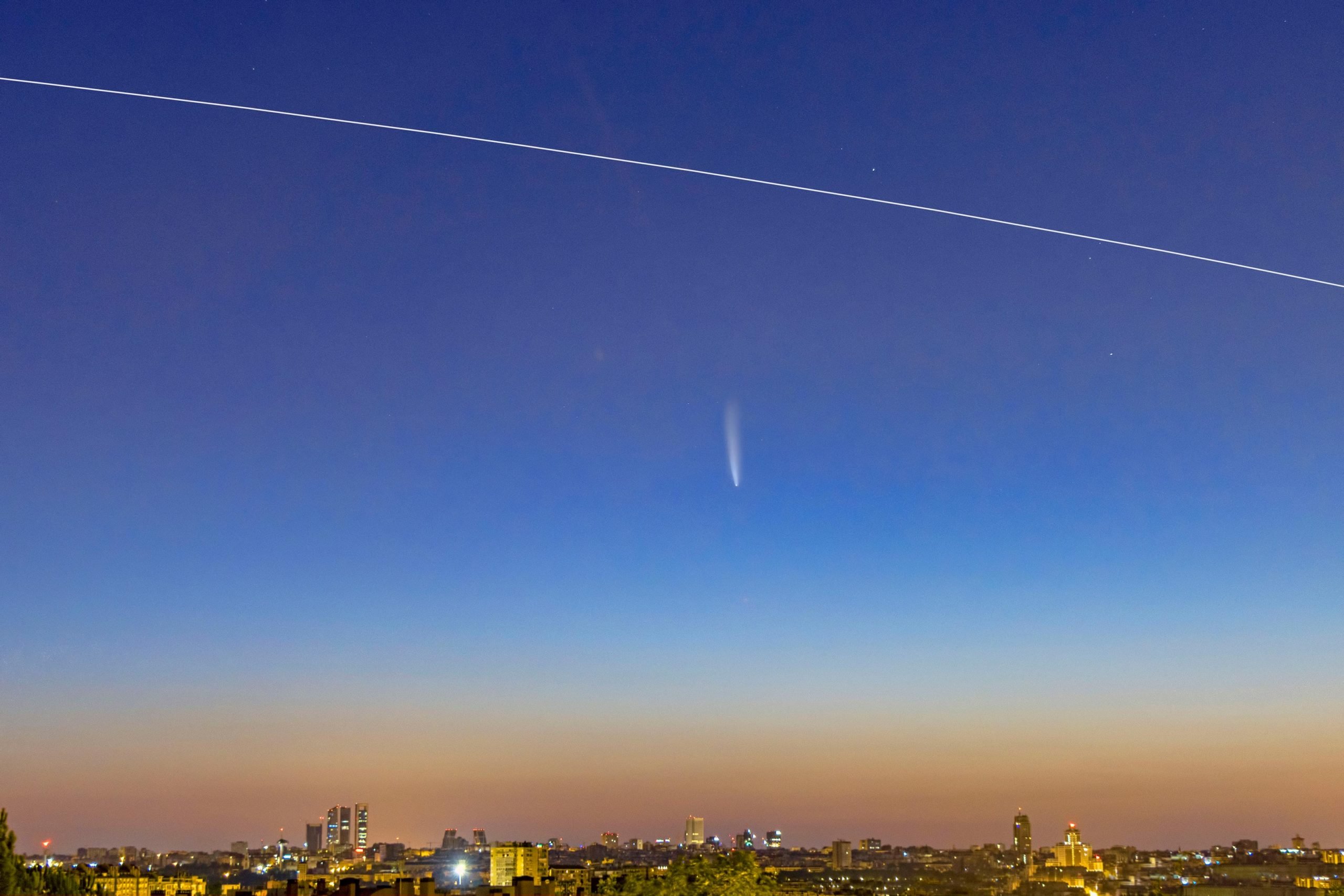
    Stunning View of Comet NEOWISE Over Madrid As Space Station Streaks Past

    By European Space AgencyJuly 18, 2020No Comments2 Mins Read
    Facebook Twitter Pinterest Telegram LinkedIn WhatsApp Email Reddit
    Share
    Facebook Twitter LinkedIn Pinterest Telegram Email Reddit
    Comet NEOWISE ISS Madrid
    Credit: Javier Manteca

    Skygazers across the Northern Hemisphere are being treated to stunning views of comet NEOWISE as it streaks past Earth. Amateur astrophotographer Javier Manteca got a bonus: the International Space Station and the comet are both seen transiting Madrid in this photo captured on July 11, 2020.

    Taken at dawn, the picture is a composition of 17 stacked images exposed every 2.5 seconds to form the skyline.

    Comet C/2020 F3 NEOWISE is named after NASA’s Near-Earth Object Wide-field Infrared Survey Explorer mission that discovered it in March 2020. The comet completed its perihelion, or closest pass of the Sun, on 3 July and is headed back out of our Solar System, not to return for another 6800 years.

    Comets are the icy remnants from the formation of the planets 4.6 billion years ago, prompting scientists to think of them as cosmic time capsules. Comets have distinctive tails caused by dust grains being swept away from the comet’s nucleus.

    The comet’s flyby of Earth is a rare opportunity to observe and collect data on these cosmic time capsules. Many spacecraft have observed the comet, including the ESA/NASA Solar and Heliospheric Observatory as well as astronauts on board the International Space Station.

    ESA’s comet chaser Rosetta trailed comet 67P/Churyumov–Gerasimenko for two years before landing the Philae probe on its surface. The mission amassed a wealth of data that will be studied for years to come.

    As comet NEOWISE zooms past Earth at a comfortable (and safe) distance of 103 million kilometers, stargazers can catch more views of the comet through July. Consult Earth and Sky or Astronomy Now for times and positions.

    Never miss a breakthrough: Join the SciTechDaily newsletter.
    Follow us on Google and Google News.

    Astronomy Comet European Space Agency International Space Station NEOWISE Popular
    Share. Facebook Twitter Pinterest LinkedIn Email Reddit

    Related Articles

    Rare Comet Older Than the Sun Seen by Mars Orbiters

    SOHO Tracks Comet C/2023 A3’s Spectacular Flight Through Space With Rare Anti-Tail [Video]

    Peek-a-Boo Moon: Astronaut on Space Station Captures Spectacular Photos of the Lunar Eclipse

    From Comet NEOWISE to Comet Interceptor [Video]

    Stunning Photo Captures International Space Station Above Comet NEOWISE

    Comet NEOWISE Sizzles As It Slides by the Sun – A Treat for Observers on Earth and in Space

    Comet NEOWISE Has Suddenly Become Visible to the Unaided Eye

    New Comet SWAN Discovered by Solar Observatory Is Visible From Earth Without a Telescope

    ESA Identifies Five Candidate Landing Sites on Comet 67P

    Leave A Reply Cancel Reply

    • Facebook
    • Twitter
    • Pinterest
    • YouTube

    Don't Miss a Discovery

    Subscribe for the Latest in Science & Tech!

    Trending News

    Artificial Sweeteners May Harm Future Generations, Study Suggests

    Splashdown! NASA Artemis II Returns From Record-Breaking Moon Mission

    What If Consciousness Exists Beyond Your Brain

    Scientists Finally Crack the 100-Million-Year Evolutionary Mystery of Squid and Cuttlefish

    Beyond “Safe Levels”: Study Challenges What We Know About Pesticides and Cancer

    Researchers Have Found a Dietary Compound That Increases Longevity

    Scientists Baffled by Bizarre “Living Fossil” From 275 Million Years Ago

    Your IQ at 23 Could Predict Your Wealth at 27, Study Finds

    Follow SciTechDaily
    • Facebook
    • Twitter
    • YouTube
    • Pinterest
    • Newsletter
    • RSS
    SciTech News
    • Biology News
    • Chemistry News
    • Earth News
    • Health News
    • Physics News
    • Science News
    • Space News
    • Technology News
    Recent Posts
    • What if Dark Matter Has Two Forms? Bold New Hypothesis Could Explain a Cosmic Mystery
    • Researchers Expose Hidden Chemistry of “Ore-Forming” Elements in Biology
    • Geologists Reveal the Americas Collided Earlier Than We Thought
    • 20x Difference: Study Reveals True Source of Airborne Microplastics
    • Scientists Uncover Hidden Force Powering Yellowstone’s Supervolcano
    Copyright © 1998 - 2026 SciTechDaily. All Rights Reserved.
    • Science News
    • About
    • Contact
    • Editorial Board
    • Privacy Policy
    • Terms of Use

    Type above and press Enter to search. Press Esc to cancel.