
Close Menu
    Facebook X (Twitter) Instagram
    SciTechDaily
    • Biology
    • Chemistry
    • Earth
    • Health
    • Physics
    • Science
    • Space
    • Technology
    Facebook X (Twitter) Pinterest YouTube RSS
    SciTechDaily
    Home»Science»517 Million Years Ago: Scientists Uncover Oldest-Known Evolutionary “Arms Race”
    Science

    517 Million Years Ago: Scientists Uncover Oldest-Known Evolutionary “Arms Race”

    By American Museum of Natural HistoryJanuary 6, 20253 Comments3 Mins Read
    Facebook Twitter Pinterest Telegram LinkedIn WhatsApp Email Reddit
    Share
    Facebook Twitter LinkedIn Pinterest Telegram Email Reddit
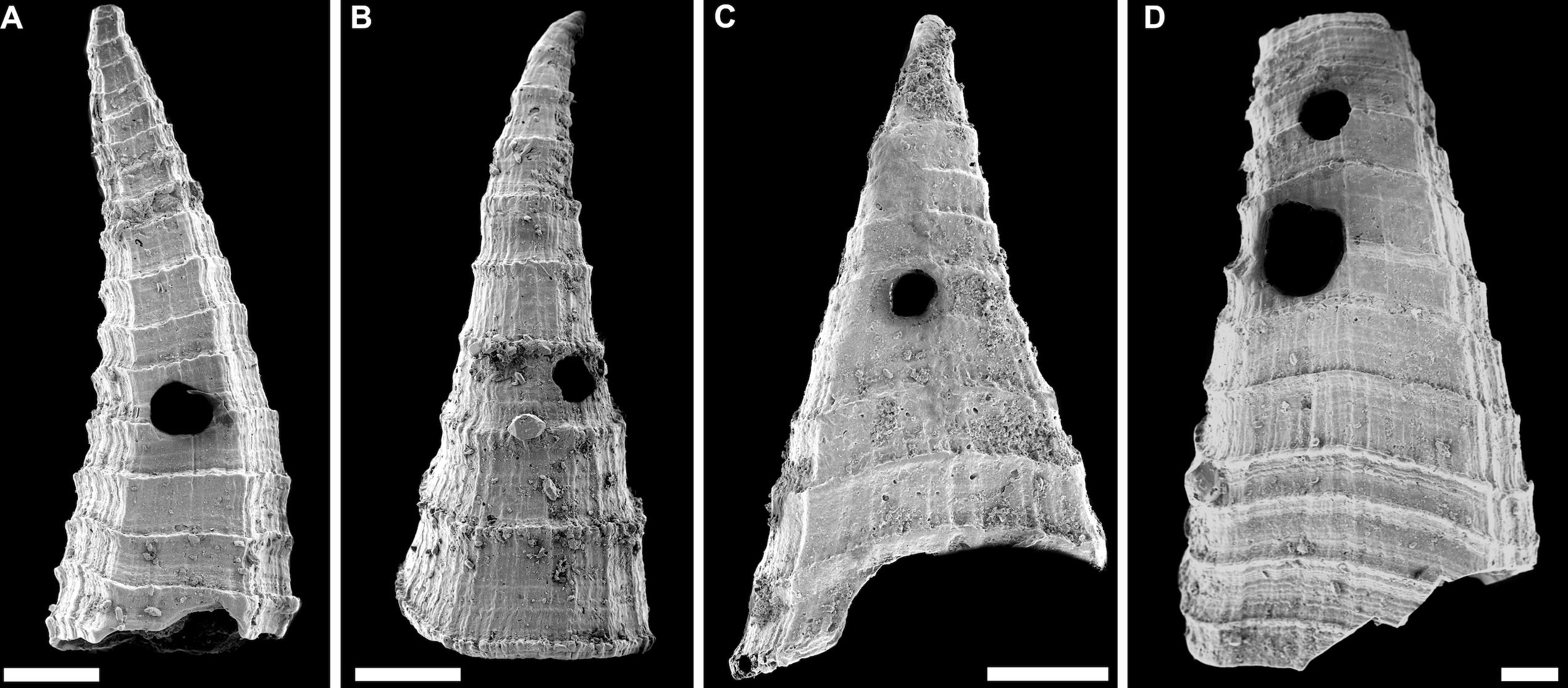
    Lapworthella fasciculata Shells
    Examples of Lapworthella fasciculata shells (under scanning electron microscope) from the Mernmerna Formation, Flinders Ranges, South Australia, showing holes made by a perforating predator. Scale bars represent 200 micrometers. Credit: R. Bicknell, et al (2025) Current Biology

    Hundreds of perforated Cambrian shells reveal distinctive predator-prey dynamics in the ocean 517 million years ago.

    Researchers from the American Museum of Natural History have uncovered the earliest known evidence of an evolutionary arms race in the fossil record. The 517-million-year-old predator-prey interactions took place in an ancient ocean that once covered present-day South Australia. These interactions involved a small, shelled organism distantly related to modern brachiopods and an unidentified marine predator capable of puncturing its shell.

    Published in Current Biology, the study marks the first confirmed instance of an evolutionary arms race from the Cambrian period.

    “Predator-prey interactions are often touted as a major driver of the Cambrian explosion, especially with regard to the rapid increase in diversity and abundance of biomineralizing organisms at this time. Yet, there has been a paucity of empirical evidence showing that prey directly responded to predation, and vice versa,” said Russell Bicknell, a postdoctoral researcher in the Museum’s Division of Paleontology and lead author of the study.

    An evolutionary arms race is a process where predators and prey continuously adapt and evolve in response to each other. This dynamic is often described as an arms race because one species’ improved abilities lead to the other species improving its abilities in response.

    Analyzing 517-Million-Year-Old Shells

    Bicknell and colleagues from the University of New England and Macquarie University—both in Australia—studied a large sample of fossilized shells of an early Cambrian tommotiid species, Lapworthella fasciculata, from South Australia. More than 200 of these extremely small specimens, ranging in size from slightly larger than a grain of sand to just smaller than an apple seed, have holes that were likely made by a hole-punching predator—most likely a kind of soft-bodied mollusk or worm.

    The researchers analyzed these specimens in relation to their geologic ages, finding an increase in shell wall thickness that coincides with an increase in the number of perforated shells in a short amount of time. This suggests that a microevolutionary arms race was in place, with L. fasciculata finding a way to fortify its shell against predation and the predator, in turn, investing in the ability to puncture its prey despite its ever-bulkier armor.

    “This critically important evolutionary record demonstrates, for the first time, that predation played a pivotal role in the proliferation of early animal ecosystems and shows the rapid speed at which such phenotypic modifications arose during the Cambrian Explosion event,” Bicknell says.

    Reference: “Adaptive responses in Cambrian predator and prey highlight the arms race during the rise of animals” by Russell D.C. Bicknell, Nicolás E. Campione, Glenn A. Brock and John R. Paterson, 3 January 2025, Current Biology.
    DOI: 10.1016/j.cub.2024.12.007

    This research was funded in part by the University of New England, the American Museum of Natural History, and the Australian Research Council (grant #s DP200102005 and DE190101423).

    Never miss a breakthrough: Join the SciTechDaily newsletter.
    Follow us on Google and Google News.

    American Museum of Natural History Evolution Paleontology Popular
    Share. Facebook Twitter Pinterest LinkedIn Email Reddit

    Related Articles

    This 345-Million-Year-Old Fossil Fooled Scientists for Decades

    These 567-Million-Year-Old Fossils Are Rewriting the Story of Life on Earth

    167-Million-Year-Old Lizard With Snake-Like Jaws Puzzles Scientists

    Real Life Sea Monster – Scientists Discover Colossal New Species of Mosasaur

    Tiny Ancient Relative of Dinosaurs and Pterosaurs Discovered in Madagascar

    Ceratopsian Dinosaur Mystery Solved – By Soft-Shelled Eggs?

    It Seems There Were Too Many Meat-Eating Dinosaurs – This May Be the Explanation

    New Evidence Shows Humans Mastered Fire Earlier Than Thought

    Microraptor Feathers Were Black With Iridescent Sheen

    3 Comments

    1. D. J. Hulett on January 8, 2025 3:05 pm

      I’ve scooped thousands of those from Mississippi sediments.
      It’s nothing new.

      Reply
    2. CM on January 13, 2025 9:04 pm

      The evoutionary process has been completely debunked. No transitional fossils have been discovered. This is a fact.

      Reply
      • Sl on January 15, 2025 3:02 am

        No it hasnt

        Reply
    Leave A Reply Cancel Reply

    • Facebook
    • Twitter
    • Pinterest
    • YouTube

    Don't Miss a Discovery

    Subscribe for the Latest in Science & Tech!

    Trending News

    A Hidden Substance in Drinking Water May Be Linked to Heart Problems in Children

    Chemical Breakthrough Could Unlock the “Holy Grail” of Solid-State Battery Technology

    Could Type 2 Diabetes Be Reversed? 14-Year Study Reveals Remarkable Results

    Earthquake Faults Can Suddenly Become Almost As Fluid as Water, Study Finds

    The Hidden Brain Mechanism That Makes You Love Coffee, Chocolate, Fat, and Sugar

    A New Era of Bionic Vision? AI Helps Scientists Unlock the Brain’s Visual Cortex

    Scientists Discover Crows Make Decisions Twice As Fast as Humans

    Animal vs. Plant Protein: New Study Reveals Unexpected Testosterone Differences

    Follow SciTechDaily
    • Facebook
    • Twitter
    • YouTube
    • Pinterest
    • Newsletter
    • RSS
    SciTech News
    • Biology News
    • Chemistry News
    • Earth News
    • Health News
    • Physics News
    • Science News
    • Space News
    • Technology News
    Recent Posts
    • Is Einstein Wrong? Deep-Sea Neutrinos Put the Laws of Physics to the Test
    • Scientists Discover a Hidden Weakness in Prostate Cancer That Could Transform Treatment
    • A New Approach Could Eliminate “Zombie” Cancer Cells That Survive Chemotherapy
    • Hidden Brain Signals Could Predict Alzheimer’s Years Before Symptoms Appear
    • Smithsonian Scientists Built a Virtual Universe 1.5 Billion Light-Years Across
    Copyright © 1998 - 2026 SciTechDaily. All Rights Reserved.
    • Science News
    • About
    • Contact
    • Editorial Board
    • Privacy Policy
    • Terms of Use

    Type above and press Enter to search. Press Esc to cancel.