
Close Menu
    Facebook X (Twitter) Instagram
    SciTechDaily
    • Biology
    • Chemistry
    • Earth
    • Health
    • Physics
    • Science
    • Space
    • Technology
    Facebook X (Twitter) Pinterest YouTube RSS
    SciTechDaily
    Home»Space»Astronomers Reveal the Role of Mergers in Shaping Galaxies
    Space

    Astronomers Reveal the Role of Mergers in Shaping Galaxies

    By Harvard-Smithsonian Center for AstrophysicsJune 26, 2017No Comments3 Mins Read
    Facebook Twitter Pinterest Telegram LinkedIn WhatsApp Email Reddit
    Share
    Facebook Twitter LinkedIn Pinterest Telegram Email Reddit
    The Role of Mergers and Halo Spin in Shaping Galaxy Morphology
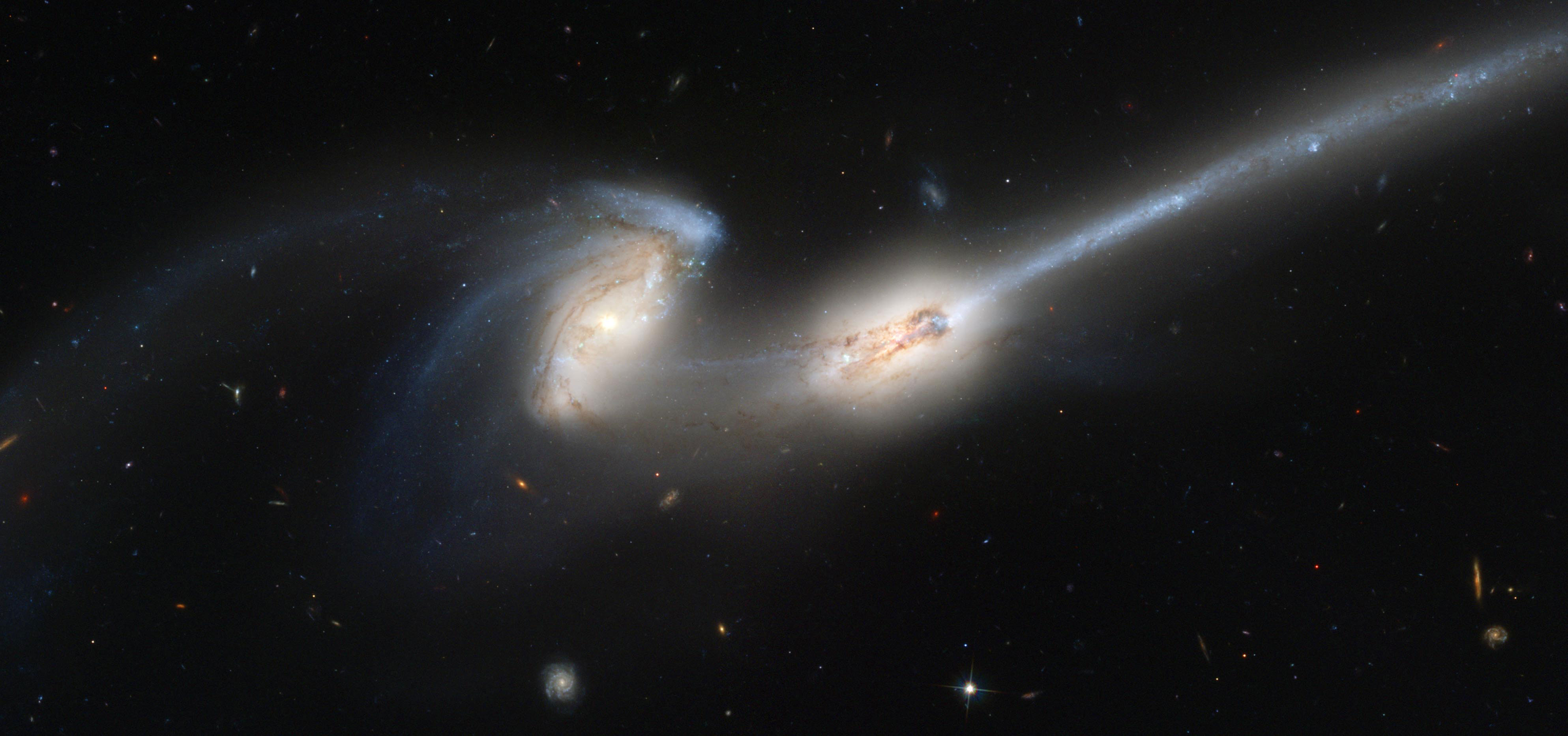
    An image of the colliding galaxies NGC4676, “The Mice,” as seen by Hubble.

    A new analysis of eighteen thousand colliding galaxies reveals that mergers like the one in galaxy NGC 4676 are the dominant mechanism for determining the shape of galaxies more massive than the Milky Way, while for lower mass galaxies mergers do not play a significant role.

    Since Edwin Hubble proposed his galaxy classification scheme in 1926, numerous studies have investigated the physical mechanisms responsible for the shapes of spiral and elliptical galaxies. Because the processes are complex, however, studies frequently rely on computer simulations as their main tool. The discs of galaxies are believed to form through the collapse of gas which acquires its initial spin in the early Universe. During their subsequent evolution, galaxies undergo a wide range of phenomena, from the accretion of matter — or its outflow — to mergers with other galaxies, all of which modify the disk’s spin and angular momentum.

    Astronomers think that spiral galaxies with the largest galactic discs formed preferentially in protogalaxies with the highest angular momentum, although early attempts to verify this prediction using computer simulations failed. (More recently, simulations have been able to verify this trend.) Elliptical galaxies, on the other hand, are believed to be the remnants of repeated galaxy mergers, but their shapes depend on many details like the galaxies’ masses, gas content, and the collision parameters. As a result, these mergers need to be considered over a cumulative, cosmological context with large numbers of examples to evaluate their development from a statistical perspective.

    CfA astronomers Vicente Rodriguez-Gomez, Annalisa Pillepich, and Lars Hernquist led a team that analyzed the morphologies of about eighteen thousand galaxies in the Illustris computer simulation. Both disc and spheroidal galaxies arise naturally in this simulation. They find that massive merging galaxies develop into spirals or spheroidal shapes depending on their gas content (as expected, since the star formation activity depends crucially on the gas). Unexpectedly, they find that for lower mass galaxies — roughly the mass of the Milky Way or smaller — mergers do not seem to play a significant role in determining the morphology. The reason appears to be that in higher mass mergers a galaxy accretes many more stars from the partner, and this plays a critical role. Their significant conclusion is that only in massive galaxies are mergers the dominant factor in shaping the system.

    Reference: “The Role of Mergers and Halo Spin in Shaping Galaxy Morphology” by Vicente Rodriguez-Gomez, Laura V. Sales, Shy Genel, Annalisa Pillepich, Jolanta Zjupa, Dylan Nelson, Brendan Griffen, Paul Torrey, Gregory F. Snyder, Mark Vogelsberger, Volker Springel, Chung-Pei Ma and Lars Hernquist, 6 February 2017, MNRAS.
    DOI: 10.1093/mnras/stx305
    PDF

    Never miss a breakthrough: Join the SciTechDaily newsletter.
    Follow us on Google and Google News.

    Astronomy Astrophysics Cosmology Galaxy Evolution Harvard-Smithsonian Center for Astrophysics
    Share. Facebook Twitter Pinterest LinkedIn Email Reddit

    Related Articles

    The Local Group as a Time Machine: Studying the High-Redshift Universe with Nearby Galaxies

    LMT Reveals Gas and Dust Properties of Distant Galaxies

    The First Systematic Analysis of the Energy Distribution of Interacting Galaxies

    New Computer Simulations Help Reveal How Spiral Galaxies Get Their Arms

    Researchers Study Early Galaxies and Their Specific Properties

    Centaurus a Hides a Gaseous Spiral at Its Core

    Arepo Software Helps Simulate the Birth and Evolution of Galaxies

    Calculations Show the Ideal Time to Study the Cosmos

    Using Infrared Images from Hubble & Spitzer, Scientists Discover 25 Distant Galaxies

    Leave A Reply Cancel Reply

    • Facebook
    • Twitter
    • Pinterest
    • YouTube

    Don't Miss a Discovery

    Subscribe for the Latest in Science & Tech!

    Trending News

    A SpaceX Falcon 9 Rocket Hit the Moon and Blasted Open a 60-Foot Crater

    Study Reveals Your Organs May Be Aging at Very Different Speeds

    Scientists Finally Solve a 20-Year Mystery About Diamond Melting

    Ultra-Processed Foods Linked to 30% Higher Prostate Cancer Risk

    More Screen Time, Better Thinking? An 8-Year Study Finds a Surprising Link

    Cleaner Cars May Be Hiding a New Pollution Problem

    Common Plant Chemical Linked to Widespread Organ Damage in Aquatic Animals

    Dogs and Humans May Share a Surprising Biological Secret to Longevity

    Follow SciTechDaily
    • Facebook
    • Twitter
    • YouTube
    • Pinterest
    • Newsletter
    • RSS
    SciTech News
    • Biology News
    • Chemistry News
    • Earth News
    • Health News
    • Physics News
    • Science News
    • Space News
    • Technology News
    Recent Posts
    • A Relentless Storm Pattern Is Making Arctic Sea Ice Disappear Faster
    • Monkeys Just Challenged a Major Assumption About How Human Ancestors Climbed
    • A Billion Years Before the Grand Canyon, a Giant Cliff May Have Stretched Across America
    • Longer Breastfeeding Linked to Fewer ADHD Symptoms in Children
    • The Immune Systems of 110-Year-Olds Are Hiding a Remarkable Secret
    Copyright © 1998 - 2026 SciTechDaily. All Rights Reserved.
    • Science News
    • About
    • Contact
    • Editorial Board
    • Privacy Policy
    • Terms of Use

    Type above and press Enter to search. Press Esc to cancel.