

Oropouche virus is more common and dangerous than believed, especially in warm, rainy regions. Experts recommend insect protection and more research on pregnancy risks.
Like dengue and Zika, the Oropouche virus causes a febrile illness. Recent evidence suggests that infection during pregnancy may harm unborn children. Now, researchers at Charité – Universitätsmedizin Berlin have found that the virus is far more widespread across Latin America than previously thought. Their findings, published in The Lancet Infectious Diseases, also indicate that climate plays a key role in the virus’s transmission.
First identified in Latin America in the 1950s, Oropouche virus has been considered relatively rare, with most countries reporting only a handful of cases each year. However, a comprehensive new study led by Prof. Jan Felix Drexler, head of the Virus Epidemiology Lab at Charité’s Institute of Virology, reveals that its true prevalence is significantly underestimated.
“Our data shows that Oropouche virus is massively under-diagnosed in Latin America,” says Drexler, who also conducts research at the German Center for Infection Research (DZIF). “In some areas, at least one person in ten has experienced a prior infection with the pathogen.”
More widespread than thought – but still insufficiently investigated
Oropouche virus causes nonspecific symptoms such as fever, chills, headache, pain in the limbs, and, in some cases, nausea and skin rashes. For a long time, the disease was considered to be predominantly mild, and reports of more severe bouts, including meningitis, were rare.
For reasons that remain unknown, reported infections in Latin America and the Caribbean have soared beyond 20,000 cases since late 2023. Two deaths have been reported in young, healthy women, and there are several cases in which an infection during pregnancy appears to have caused miscarriage or malformations in unborn babies.
“We still know relatively little about the virus,” explains Jan Felix Drexler. “The consequences of an infection, including on unborn babies, require further investigation. It’s not yet clear whether there are parallels with the Zika virus. Overall, however, it appears to cause harm to unborn babies less frequently than Zika.” There is no vaccine for Oropouche virus, nor is there a specific treatment for Oropouche fever.
In their study, the research team examined over 9,400 blood samples collected from healthy and diseased people in Bolivia, Brazil, Colombia, Costa Rica, Ecuador, and Peru between 2001 and 2022. Antibodies against Oropouche virus – indicating a prior infection with the pathogen – were present in roughly 6% of samples across all territories.
However, the researchers identified considerable regional variations: while antibodies against the virus were present in an average of 2% of samples from Costa Rica, they appeared in 5% of samples from Ecuador and over 10% of samples from the Amazon region. People at higher altitudes were less likely to have experienced a prior Oropouche infection than those at warmer, lower altitudes. A comparison of blood samples from different years also indicates fluctuations in infection rates from year to year.
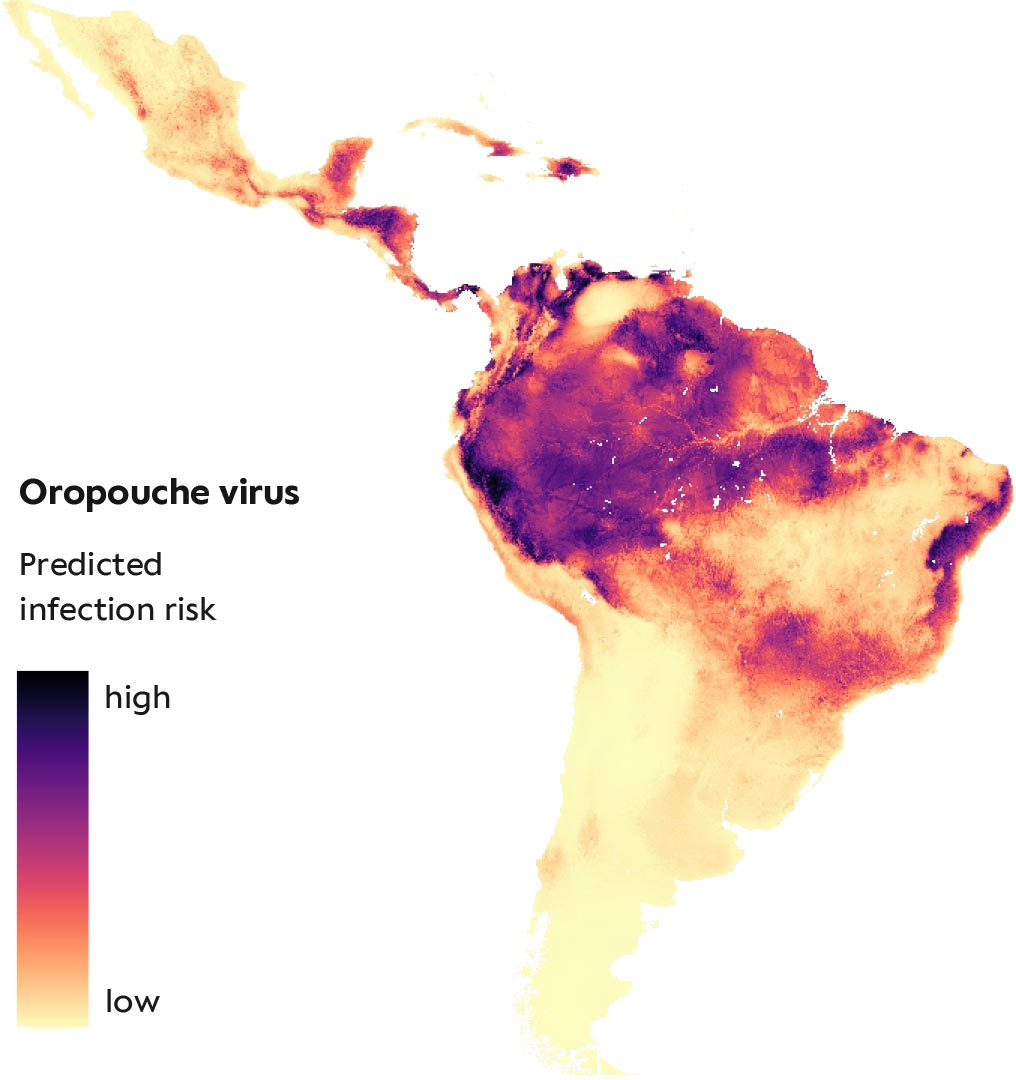
Study estimates Oropouche infection risk for all Latin American countries
But what drives infections? In an effort to find out, researchers deployed machine learning techniques to analyze whether an association exists between Oropouche infections and various environmental and demographic factors.
Their analysis found that climatic conditions, such as rain and constant temperatures, appear to exert the greatest influence on Oropouche virus infections.
“We therefore assume that the current Oropouche outbreak has been fueled by weather phenomenons like El Niño,” explains Drexler. “By contrast, we have not found evidence that changing properties of the virus could provide an alternative explanation for the high case count at present. I think it’s possible that Oropouche virus will become even more widespread in the future as climate change progresses.”
Based on these insights, the research team estimated the Oropouche infection risk across Latin America, depicting this on an overview map. “The primary distribution area for Oropouche virus is the Amazon rainforest,” summarizes Drexler. “However, there is also a high risk of infection in parts of Central America and the Caribbean, as well as in southern and coastal areas of Brazil.”
Practical protection against infection
“Alongside the dengue and chikungunya viruses, Oropouche virus is probably the most common virus transmitted by insect bites in Latin America,” emphasizes Drexler.
He recommends taking systematic measures to prevent insect bites in order to protect against infection when visiting the region.
“When it comes to protecting against Oropouche virus, and also against other tropical viruses like dengue and Zika, it’s worth wearing long clothes and using insect repellent, such as DEET or icaridin,” says the virologist. “Mosquito nets can also offer protection if their mesh is sufficiently fine.”
The virus is primarily transmitted by flies commonly known as “no-see-ums” – tiny mosquitoes up to 3 millimeters long, which are able to pass through the mesh of conventional mosquito nets. Prof. Drexler recommends that pregnant women consult a doctor before spending time in at-risk regions for as long as the high infection rates persist, and until more is known about the effects of Oropouche on unborn babies.
Reference: “The spatiotemporal ecology of Oropouche virus across Latin America: a multidisciplinary, laboratory-based, modelling study” by Carlo Fischer, Anna Frühauf, Lucia Inchauste, Murilo Henrique Anzolini Cassiano, Heriberto Arévalo Ramirez, Karine Barthélémy, Lissete Bautista Machicado, Fernando Augusto Bozza, Carlos Brites, Miguel Mauricio Cabada, César A Cabezas Sánchez, Angie Cervantes Rodríguez, Xavier de Lamballerie, Roxana de los Milagros Peralta Delgado, Edmilson F de Oliveira-Filho, Mathieu Domenech de Cellès, Carlos Franco-Muñoz, María Paquita García Mendoza, Miladi Gatty Nogueira, Rosa-Margarita Gélvez-Ramírez, Manuel Gonzalez Gonzalez, Eduardo Gotuzzo, Stephanie Kramer-Schadt, Suvi Kuivanen, Katherine Laiton-Donato, Anyela Lozano-Parra, Edward Málaga-Trillo, Dora Valencia Manos Alva, Dorothée Missé, Andres Moreira-Soto, Thiago Moreno Souza, Karen Mozo, Eduardo Martins Netto, Nadine Olk, Johanna Maribel Pachamora Diaz, Célia Pedroso Jorge, Ana Micsuco Pérez Astudillo, Marta Piche-Ovares, Stephane Priet, Bladimiro Rincón-Orozco, Juan José Romero-Zúñiga, Silvia Paola Salgado Cisneros, Andreas Stöcker, Juan Carlos Villalobos Ugalde, Luis Angel Villar Centeno, Moritz Wenzler-Meya, Juan Carlos Zevallos and Jan Felix Drexler, 14 April 2025, The Lancet Infectious Diseases.
DOI: 10.1016/S1473-3099(25)00110-0
This research is part of the Zoonosis Emergence across Degraded and Restored Forest Ecosystems (ZOE) project, which receives funding from the European Commission through the Horizon Europe framework program, alongside support from many other funding organizations.
Never miss a breakthrough: Join the SciTechDaily newsletter.
Follow us on Google and Google News.
1 Comment
Gain of Function at play?