
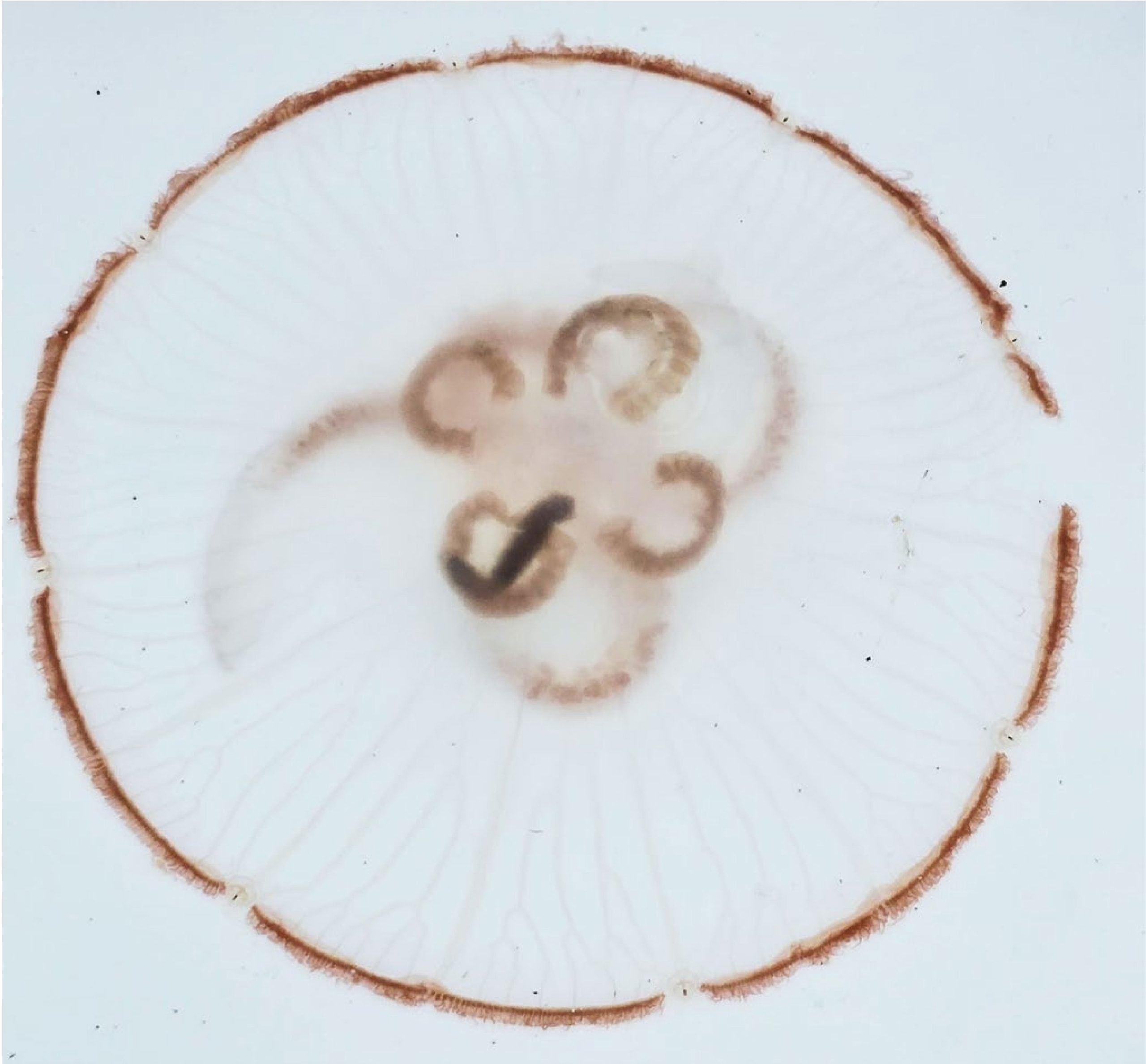
A newly observed feeding behavior suggests jellyfish may exploit short-lived seasonal events in surprising ways.
Most polychaete worms spend their lives hidden in burrows on the seafloor. But adults of two species, Alitta succinea and Platynereis dumerilii, emerge on warm summer nights around the full moon to reproduce.
During these events, thousands of worms gather and swim together in open water. As they release eggs and sperm, their bodies rupture, and they die. This brief spectacle attracts many predators, including trout and other fish. Now, biologists from the University of Southern Denmark (SDU) have found that certain jellyfish also feed on these swarming worms.
“Although jellyfish are known to be omnivorous and generally consume whatever they encounter, it is the first time this behavior is documented,” says one of the researchers behind the discovery, biologist and postdoc Hannah Yeo from SDU’s Marine Biology Research Center in Kerteminde, Denmark.
The research team also included Laura Ferreira (SDU and University of Copenhagen), Erik Kristensen (SDU), Anders Garm (UCPH), and Jamileh Javidpour (SDU). Their results were published in the journal Hydrobiologia.
Over one year, the scientists documented 56 instances of jellyfish with at least one polychaete worm in their gut. The worms appeared in two jellyfish species, the common moon jelly Aurelia aurita and the invasive comb jelly Mnemiopsis leidyi. The most frequently observed worm species was Platynereis dumerilii.
All observations came from Kerteminde Fjord and nearby Kertinge Nor in Denmark. Of 166 collected Aurelia aurita, 45 contained at least one polychaete. Among 71 Mnemiopsis leidyi, three had consumed at least one polychaete.
Digested in a few hours
The researchers believe the true number of feeding events is higher.
“It takes only a couple of hours for the jellyfish to digest these worms, so there were probably more cases than the ones we observed,” says co-author Professor Erik Kristensen from the Department of Biology at SDU.
To confirm that the worms provided real nutrition and were not accidentally ingested, the team analyzed isotopes in jellyfish tissue. The results showed that nutrients from the worms were absorbed, not simply passed through.
Polychaetes are unlikely to be a major food source overall, but their mass spawning creates a short-lived, high-energy food supply in summer that may support jellyfish growth.
The findings raise additional concerns about the invasive Mnemiopsis leidyi, which can outcompete native species.
“We suspect that Mnemiopsis consumed more worms than we could detect. They also hunt at night, which is exactly when the worms swarm. By the time we sampled them in daylight, the worms would have been fully digested and impossible for us to see,” says co-author Jamileh Javidpour, associate professor at SDU. “Mnemiopsis are invasive and unwanted in Danish waters because they can outcompete native species. They are highly opportunistic feeders, and this appears to be yet another food source they are able to exploit.”
Beyond feeding behavior, the study highlights a previously overlooked flow of energy in marine ecosystems. Typically, energy moves downward as organic matter sinks to bottom-dwelling animals, such as dead worms after spawning.
“But here we see energy moving upward instead: bottom-dwelling animals rising into the water column and being hunted there. While several predator species are known to exploit these spawning events, it has not been documented before in jellyfish or Mnemiopsis. This means gelatinous zooplankton are tapping into a benthic energy source that has been largely overlooked,” said Jamileh Javidpour, concluding:
“We need to consider this upward transfer when modeling the resilience of coastal ecosystems. Even sporadic access to benthic resources may influence how both native and invasive gelatinous species compete and persist.”
Reference: “Polychaete capture by native jellyfish and invasive ctenophore reveals a novel benthic–pelagic trophic link” by Hannah H. J. Yeo, Laura Ferreira, Erik Kristensen, Anders Garm and Jamileh Javidpour, 4 March 2026, Hydrobiologia.
DOI: 10.1007/s10750-026-06174-3
Never miss a breakthrough: Join the SciTechDaily newsletter.
Follow us on Google and Google News.