
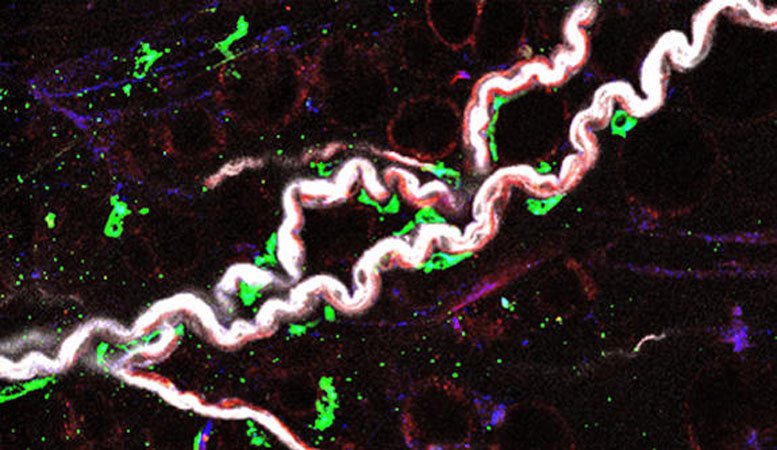
In a newly published study, biologists from Yale University described how nervous systems and immune systems talk to each other to control metabolism and inflammation.
The new finding furthers scientists’ understanding of why older adults fail to burn stored belly fat, which raises the risk of chronic disease. The study also points to potential therapeutic approaches to target the problem, the researchers said.
Led by Vishwa Deep Dixit, professor of comparative Medicine and immunobiology, the study was published September 27 in Nature.
Older adults, regardless of body weight, have increased belly fat. However, when they need to expend energy, older people do not burn the energy stored in fat cells as efficiently as younger adults, leading to the accumulation of harmful belly fat. The underlying cause for this unresponsiveness in fat cells was unknown.
In the study, Dixit and his collaborators at Yale, University of Tennessee Health Science Center, and University of Bonn focused on specialized immune cells known as macrophages, which are typically involved in controlling infections. The Dixit lab discovered a new type of macrophage that resides on the nerves in belly fat. These nerve-associated macrophages become inflamed with age and do not allow the neurotransmitters, which are chemical messengers, to properly function.
The researchers also isolated the immune cells from fat tissue of young and old mice, and together with Professor Schultze and his team at the Life and Medical Sciences Institute of the University of Bonn, Germany then sequenced and computationally modeled the genome to understand the problem. “We discovered that the aged macrophages can break down the neurotransmitters called catecholamines, and thus do not allow fat cells to supply the fuel when the demand arises,” said Dixit, who is also a member of the Yale Center for Research on Aging.
The researchers found that when they lowered a specific receptor that controls inflammation, the NLRP3 inflammasome, in aged macrophages, the catecholamines could act to induce fat breakdown, similar to that of young mice.
“The key finding is that the immune cells talk to the nervous system to control metabolism,” said Dixit.
In further experiments, the researchers blocked an enzyme that is increased in aged macrophages, restoring normal fat metabolism in older mice. Dixit noted that this enzyme, monoamine oxidase-A or MAOA, is inhibited by existing drugs in the treatment of depression. “Theoretically one could repurpose these MAOA inhibitor drugs to improve metabolism in aged individuals,” he said. But he also cautioned that more research is needed to specifically target these drugs to belly fat and to test the safety of this approach.
In future research, Dixit and his colleagues will further examine the immune cells and their interaction with nerves, and how this neuro-immune dialogue controls health and disease. If controlling inflammation in aging immune cells can improve metabolism, it may have other positive effects on the nervous system or on the process of aging itself, said the researchers.
“The purpose of our research is to achieve greater understanding of immune cell interactions with nerves and fat cells to potentially reduce belly fat, enhance metabolism, and improve performance in the elderly,” said Christina D. Camell, the first author of the study.
Reference: “Inflammasome-driven catecholamine catabolism in macrophages blunts lipolysis during ageing” by Christina D. Camell, Jil Sander, Olga Spadaro, Aileen Lee, Kim Y. Nguyen, Allison Wing, Emily L. Goldberg, Yun-Hee Youm, Chester W. Brown, John Elsworth, Matthew S. Rodeheffer, Joachim L. Schultze and Vishwa Deep Dixit, 27 September 2017, Nature.
DOI: 10.1038/nature24022
Other study authors are Jil Sander, Olga Spadaro, Aileen Lee, Kim Y. Nguyen, Allison Wing, Emily L. Goldberg, Yun-Hee Youm, Chester W. Brown, John Elsworth, Matthew S. Rodeheffer, and Joachim L. Schultze.
The study was supported in part by National Institutes of Health grants, the Glenn Foundation for Medical Research, and Cure Alzheimer’s Fund to Dixit Laboratory.
Never miss a breakthrough: Join the SciTechDaily newsletter.
Follow us on Google and Google News.
4 Comments
Excellent article. But don’t just start giving elderly people drugs that affect mood. It can make them lose ability to think clearly enough to protect themselves from scams. It’s fun to be free and easy, but you can go broke. Let us keep our brains intact, please, and help metabolize the belly fat another way.
Great research. Now I know the problem. I’m 75. I do yoga and follow “fat for Fuel” by Mercola.
Anything using the term “belly fat” does not garner anything but skepticism from me. That’s a term that “fat burning” pills (diuretics that make you lose water weight) and magic treatments/diets use.
You need to consume less calories than your body burns every day in order to lose fat. That is the “secret” to weight loss. No matter your age, height or weight. Figure out how many calories you use every day, and eat less than that. You will lose fat. Google “TDEE calculator” to find out what your numbers are. Not just eating “less” or “healthier”. Less calories. By counting every gram of every food you eat. Hard? Yes. Being unhappy and overweight? Hard. Pick your hard.
I know the new trend for health nuts is “inflammation” and how to combat it with crash diets and cucumber water and magic pills, but seriously, all you have to do is eat less than you burn. You don’t even have to exercise. It’s called calories in, calories out.
Go figure! I don’t like fat it is offensive to me. A little story, over friends house having chicken for the meal oops with the skin on.
Friend both he and her are over weight. He with diabetes a band
and can’t lose weight. I discard the skin he ask if I am going to eat it I say no it’s the worst part he ask for it saying it’s the best. He is in the worst shape ever around 300# at 66. The band didn’t do any good.