
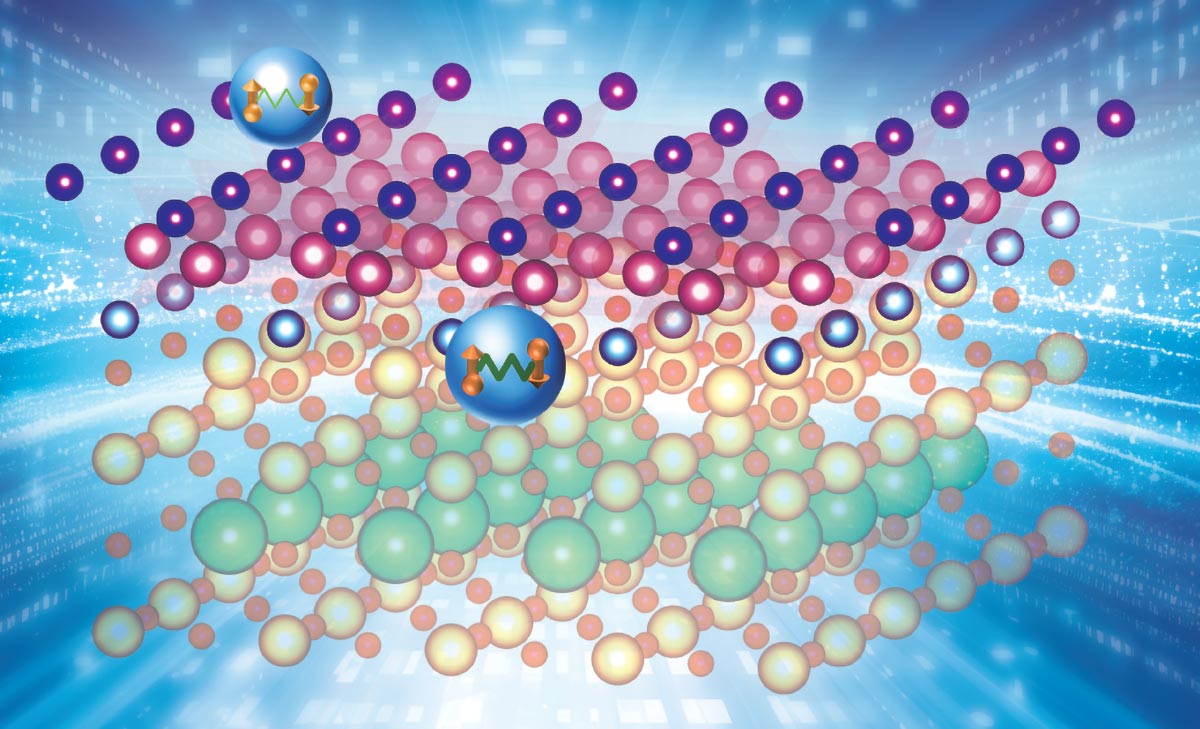
Atomic-scale imaging reveals that chalcogen atoms play a crucial role in Cooper pairing in Fe-based superconductors, offering new insights into high-Tc superconductivity mechanisms.
Superconductivity in quantum materials, whether the Cooper pairing on the Fermi surface is mediated by phonons or by electronic fluctuations, is fundamentally described by Bardeen-Cooper-Schrieffer (BCS) theory. In this framework, superconductivity arises from the condensation of zero-momentum Cooper pairs on the crystal lattice, with the pairing following the symmetry of the lattice.
In recent years, an exotic superconducting state called the pair density wave (PDW) has attracted significant research interest. In the PDW state, Cooper pairs form with finite momentum, which breaks the translational symmetry of the crystal and leads to spatially periodic modulations of the superconducting order parameter. Experimental evidence of the PDW state has been observed in unconventional superconductors such as cuprates and iron-based high-temperature (high-Tc) superconductors, where the modulation period spans several unit cells.
However, modulations of the pair density within a single unit cell, which could provide microscopic insights into unconventional Cooper pairing mechanisms at the sub-unit-cell scale, have not yet been thoroughly investigated.
Using scanning tunneling microscopy/spectroscopy (STM/S), the research team led by Prof. Jian Wang (Peking University) conducted precise atomic-scale measurements on high-quality monolayer Fe(Te,Se) and FeSe superconducting films grown on SrTiO₃(001) substrates. These films possess the highest superconducting transition temperature (approximately 60 Kelvin, or -213°C) among iron-based superconductors.
Discovering Periodic Superconducting Modulations
By performing experiments with extraordinary high spatial resolution, the researchers captured clear variations in superconducting properties at different atomic sites within a single lattice unit cell.
The study revealed that the size of the superconducting gap and the sharpness of coherence peaks exhibit periodic spatial modulations with the same period of the crystal lattice. Crucially, these modulations strictly correspond to the crystal lattice structure, with maxima and minima precisely located at the crystallographic positions of the chalcogen atoms, revealing the breaking of the glide-mirror symmetry introduced by the SrTiO3 substrate. This phenomenon indicates that the chalcogen atoms and their p-orbitals play an essential part in the local Cooper pairing and phase coherence establishment.
“This discovery allows us to see the fine structure of the superconducting state at the atomic scale for the first time,” said the researcher. “It’s like observing the ‘dance’ of superconducting electron pairs, where the chalcogen atoms act as the conductors.” Previously, the role of chalcogen atoms in the Cooper pairing of iron-based superconductors was often underestimated in theoretical studies, but this new finding will prompt scientists to reconsider the microscopic mechanisms of the unconventional superconductivity in iron-based superconductors.
This research expands the experimental investigation of the pairing mechanism to the sub-unit-cell scale, and opens a new pathway for understanding the pairing mechanism of unconventional superconductors whose crystal unit cell contains multiple atoms. The research team plans to extend this approach to other superconducting systems and explore how atomic-scale information can help us understand the mysterious high-Tc superconductivity.
Reference: “Observation of Superconducting Pair Density Modulation within Lattice Unit Cell” by Tianheng Wei, Yanzhao Liu, Wei Ren, Zhen Liang, Ziqiang Wang and Jian Wang, 1 February 2025, Chinese Physics Letters.
DOI: 10.1088/0256-307X/42/2/027404
Never miss a breakthrough: Join the SciTechDaily newsletter.
Follow us on Google and Google News.
2 Comments
What “next-gen” superconductors? There’s no “current-gen” superconductors to speak of. The “next-gen” would actually be the “first-gen”.
The study revealed that the size of the superconducting gap and the sharpness of coherence peaks exhibit periodic spatial modulations with the same period of the crystal lattice.
VERY GOOD!
Ask the researchers:
Periodicity is ubiquitous in spatiotemporal motion. Do you want to understand the spatiotemporal roots of this physical phenomenon?
If you are interested, please browse https://zhuanlan.zhihu.com/p/1900140514277320438.