
Close Menu
    Facebook X (Twitter) Instagram
    SciTechDaily
    • Biology
    • Chemistry
    • Earth
    • Health
    • Physics
    • Science
    • Space
    • Technology
    Facebook X (Twitter) Pinterest YouTube RSS
    SciTechDaily
    Home»Space»Researchers Examine Phase Changes for Insight to Planet Formation
    Space

    Researchers Examine Phase Changes for Insight to Planet Formation

    By Lawrence Livermore National LaboratoryFebruary 10, 2012No Comments3 Mins Read
    Facebook Twitter Pinterest Telegram LinkedIn WhatsApp Email Reddit
    Share
    Facebook Twitter LinkedIn Pinterest Telegram Email Reddit
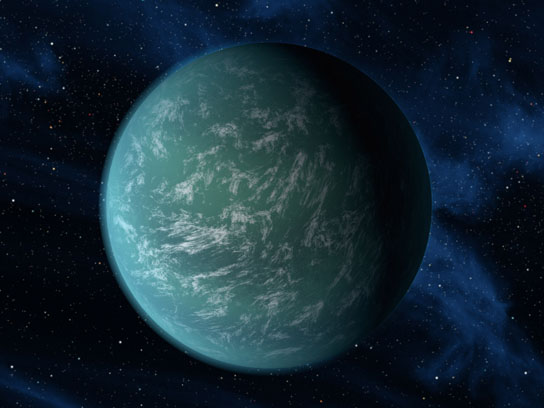
    artist's conception of planet Kepler-22b
    An artist’s conception of planet Kepler-22b, which orbits in a star’s habitable zone — the region around a star where liquid water, a requirement for life on Earth, could persist. The planet is 2.4 times the size of Earth. Credit: NASA

    Researchers have gained a deeper insight into planet formation by studying the phase changes between different types of melts. Scientists at Lawrence Livermore National Laboratory discovered that molten magnesium silicate abruptly transforms to a more dense liquid with increasing pressure when a high-powered laser applies extreme temperature and pressure.

    Just as graphite can transform into diamond under high pressure, liquid magmas may similarly undergo major transformations at the pressures and temperatures that exist deep inside Earth-like planets.

    Using high-powered lasers, scientists at Lawrence Livermore National Laboratory and collaborators discovered that molten magnesium silicate undergoes a phase change in the liquid state, abruptly transforming to a more dense liquid with increasing pressure. The research provides insight into planet formation.

    “Phase changes between different types of melts have not been taken into account in planetary evolution models,” said lead scientist Dylan Spaulding, a University of California, Berkeley graduate student who conducted most of his thesis work at the Laboratory’s Jupiter Laser Facility. “But they could have played an important role during Earth’s formation and may indicate that extra-solar ‘Super-Earth’ planets are structured differently from Earth.”

    Melts play a key role in planetary evolution. The team said that pressure-induced liquid-liquid phase separation in silicate magmas may represent an important mechanism for global-scale chemical differentiation and also may influence the thermal transport and convective processes that govern the formation of a mantle and core early in planetary history. Liquid-liquid phase separation is similar to the difference between oil and vinegar — they want to separate because they have different densities. In the new research, however, the researchers noticed a sudden change between liquid states of silicate magma that displayed different physical properties even though they both have the same composition when high pressure and temperatures were applied.

    The team used LLNL’s Janus laser and OMEGA at the University of Rochester to conduct the experiments to achieve the extreme temperatures and pressures that exist in the interiors of exoplanets — those objects outside our solar system.

    In each experiment, a powerful laser pulse generated a shock wave while it traveled through the sample. By looking for changes in the velocity of the shock and the temperature of the sample, the team was able to identify discontinuities that signaled a phase change in the material.

    “In this case, the decay in shock-velocity and thermal emission both reverse themselves during the same brief time interval,” Spaulding said.

    The team concluded that a liquid-liquid phase transition in a silicate composition similar to what would be found in terrestrial planetary mantles could help explain the thermal-chemical evolution of exoplanet interiors.

    The research appears in the February 10 edition of the journal, Physical Review Letters.

    Never miss a breakthrough: Join the SciTechDaily newsletter.
    Follow us on Google and Google News.

    Exoplanet Lasers Lawrence Livermore National Laboratory Phase Change Planet Formation Planets
    Share. Facebook Twitter Pinterest LinkedIn Email Reddit

    Related Articles

    When Dinosaurs Roamed, New Worlds Were Born – Now Scientists Are Studying Them

    WASP-12 b, A Planet Being Consumed By Its Own Sun

    Tidal Heating Suggests Less Habitable Planets

    Revealing Data from Super-Earth 55 Cancri e

    Saturn’s Moon Phoebe Has Planet-Like Qualities

    Three Earthlike Planets Could be Hospitable to Life

    Simulations Show Jupiter’s Core is Liquefying

    Researchers Analyze Earthshine for Life in the Universe

    Milky Way Galaxy Has Over 100 Billion Planets

    Leave A Reply Cancel Reply

    • Facebook
    • Twitter
    • Pinterest
    • YouTube

    Don't Miss a Discovery

    Subscribe for the Latest in Science & Tech!

    Trending News

    Millions Take This Joint Supplement but Scientists Found a Concerning Alzheimer’s Link

    Why Evolution Stalled for Millions of Years Before Suddenly Exploding

    New Feathered Dinosaur May Have Solved a 120-Million-Year-Old Fossil Mystery

    Ozempic and Similar Drugs Linked to Dramatic Drop in Addiction Rates

    Ancient Meteorite Reveals a Forgotten Planet That Existed 4.5 Billion Years Ago

    Scientists Reveal What Happened When 12 People Were Trapped Together in Antarctica for 10 Months

    The “Impossible” Earthquake Beneath Utah Was Real After All

    A Major Update Just Hit Cholesterol Guidelines – Here’s What Every Adult Needs To Know

    Follow SciTechDaily
    • Facebook
    • Twitter
    • YouTube
    • Pinterest
    • Newsletter
    • RSS
    SciTech News
    • Biology News
    • Chemistry News
    • Earth News
    • Health News
    • Physics News
    • Science News
    • Space News
    • Technology News
    Recent Posts
    • How Flocking Birds “Defy” One of Physics’ Most Fundamental Laws
    • Your GPS Lies in Cities. Scientists Finally Fixed It
    • Physicists Create a New Kind of Schrödinger’s Cat State From Exotic Quantum Building Blocks
    • One Simple Food Swap Could Cut Carbon Emissions As Much as a Flight Across Europe
    • Scientists Uncover the Hidden Process That Can Turn Magma Into an Explosive Force
    Copyright © 1998 - 2026 SciTechDaily. All Rights Reserved.
    • Science News
    • About
    • Contact
    • Editorial Board
    • Privacy Policy
    • Terms of Use

    Type above and press Enter to search. Press Esc to cancel.