
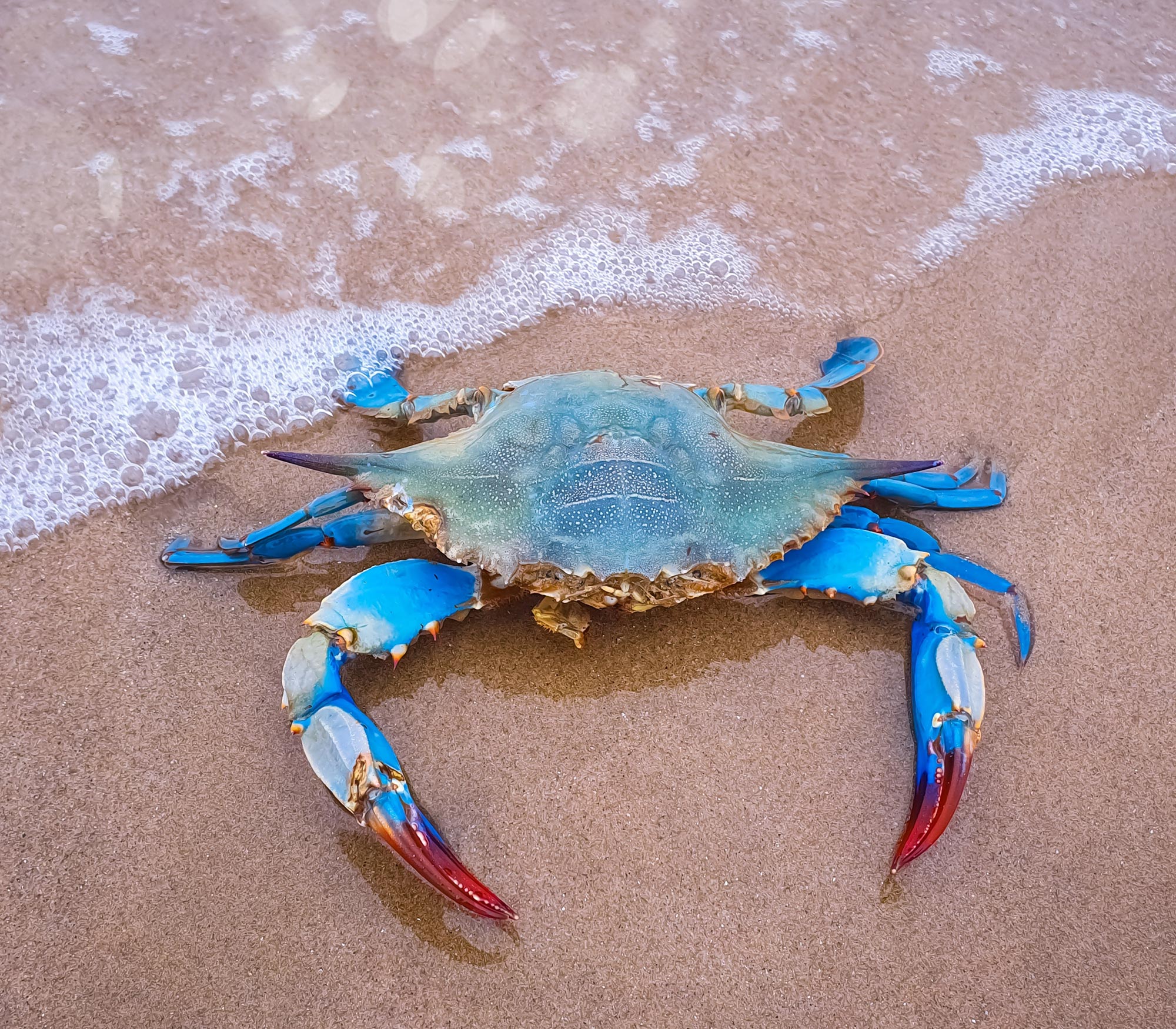
Parasitic worms on blue crab eggs may reveal a crab’s spawning history. Their resilience in varied salinities makes them promising for fishery monitoring.
Parasitic worms that feed on crab eggs may seem unsettling, but for blue crabs in the Chesapeake Bay, they are a common part of life. A recent study in PLOS One by scientists at William & Mary’s Batten School and the Virginia Institute of Marine Science (VIMS) indicates that these worms could be used as an effective biomarker to help manage the blue crab fishery.
The latest Winter Dredge Survey, conducted by the Batten School of Coastal & Marine Sciences and VIMS in partnership with Maryland’s Department of Natural Resources, revealed record-low blue crab numbers in the Bay. These results have raised concerns among fishery stakeholders and underscore the urgent need for innovative tools to support both ecological sustainability and economic viability—an area where this research may prove valuable.
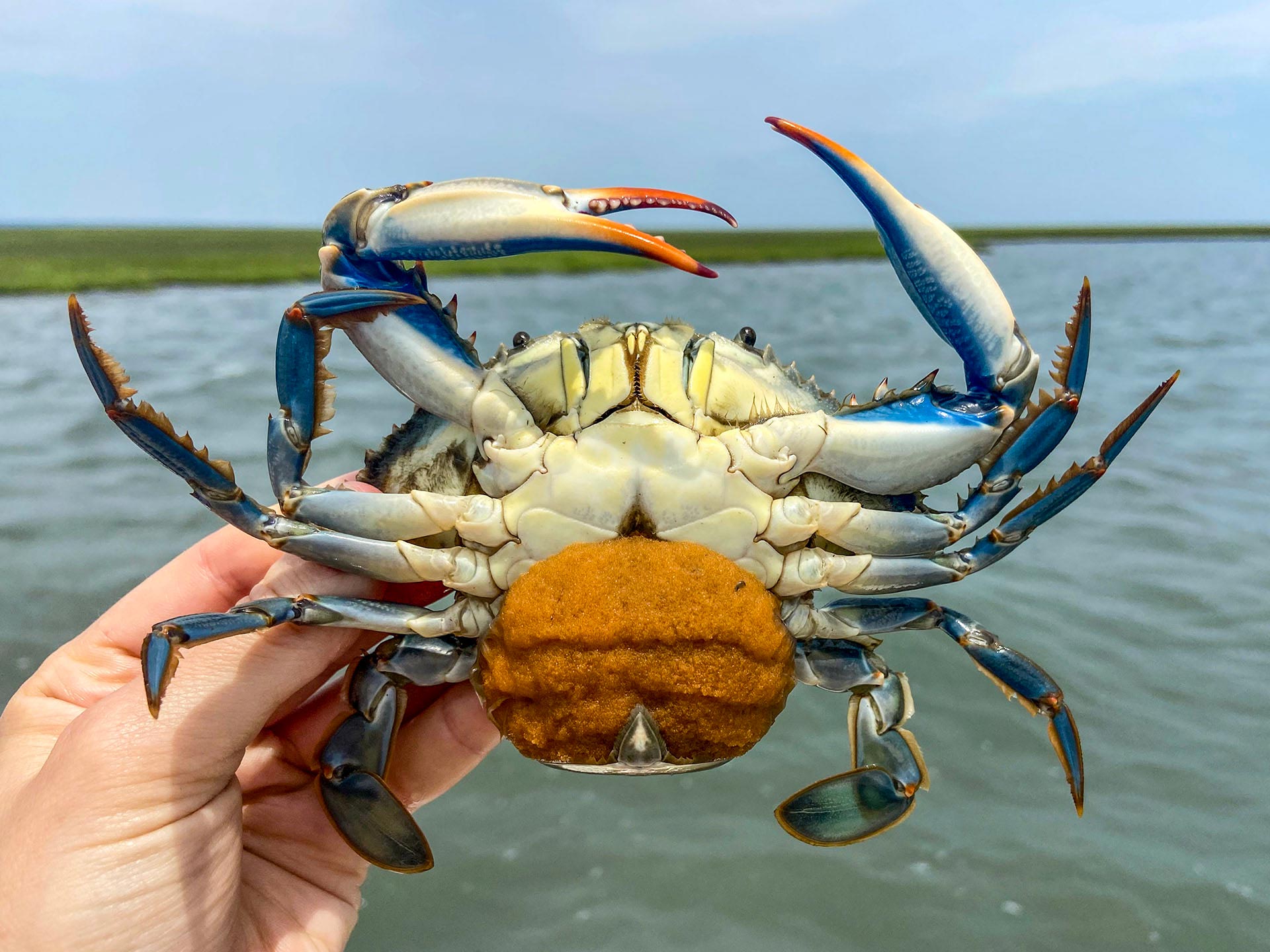
The species in question, Carcinonemertes carcinophila, attaches to and inhabits the egg clutches of female blue crabs. Although they do not consume enough eggs to significantly impact reproductive success, the worms grow and shift in coloration after feeding, making them a potential indicator of whether a female has spawned. Since blue crabs occupy habitats with widely varying salinity, it was previously uncertain if these worms could survive in the lower salinity levels found in parts of the Bay and its tributaries.
“Other species of Carcinonemertes cannot survive in salinity levels below 20 parts per thousand, which is a common occurrence in the Bay’s tributaries and during high-precipitation events,” said Professor Jeffrey Shields at the Batten School & VIMS. “We found this worm to be much tougher than other species.”
Evaluating the worms’ potential as biomarkers
This work builds on earlier research by Alex Schneider, Ph.D. ’24, a former student at the Batten School and VIMS, who examined blue crab reproduction to inform better fishery management strategies. A portion of her dissertation explored how Carcinonemertes carcinophila might be used to determine how many times a female crab has spawned.
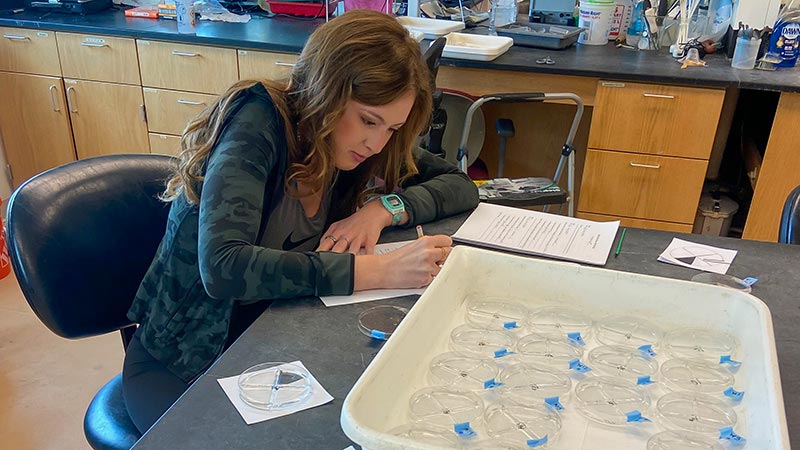
For this study, Schneider partnered with William & Mary undergraduate Alex Pomroy, the project’s lead author. Under the guidance of Professor Jeffrey Shields, the team collected worms from blue crabs and exposed them to a broad range of salinity conditions.
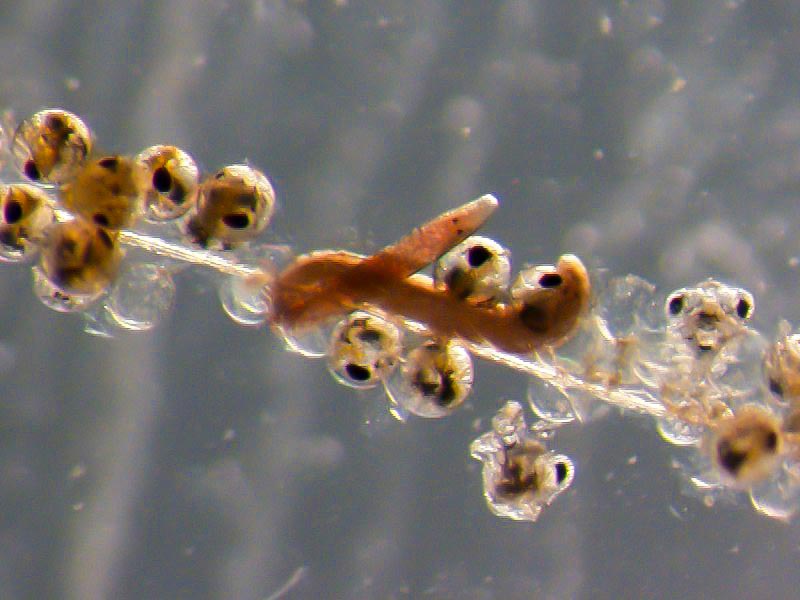
The results showed that the worms performed well in moderate to high salinity levels of 20–30 parts per thousand (psu). Surprisingly, they were also able to adapt and persist at a salinity of 10 psu, and could survive—and recover—after brief exposure (up to 39 hours) to salinity levels as low as five psu.
“Female crabs often migrate from low-salinity waters to high-salinity waters to lay eggs. We found that the worms had a wide salinity tolerance, and that they survived well at the lower salinities representative of where crabs might begin their migrations,” said Pomroy. “This means that the worms are likely to infest crabs throughout their adult lives, confirming their potential as biomarkers for reproduction.”
Implications for fishery management
The blue crab holds significant value as both a commercial and recreational species in the Chesapeake Bay. In fishery models, egg production plays a central role, yet accurately determining how many times a female crab has spawned has remained a challenge.
Females that have never spawned are classified as primiparous, while those that have produced multiple clutches are referred to as multiparous. Research conducted by Schneider and colleagues at the Batten School & VIMS found that female blue crabs generate the largest number of offspring in their first clutch, with reproductive potential—or fecundity—decreasing in later clutches. The work also revealed that almost all crabs spawning in June were primiparous, whereas most individuals spawning later in the season were multiparous.
In another study published in the journal Marine Ecology Progress Series, Schneider and co-authors used the worm to provide the first-ever estimate of the proportion of crabs that have and have not spawned during winter. This information helps managers understand the impacts of commercial and recreational harvest on spawning demographics and the overall composition of the population before the spawning season.
“If you’re trying to increase the blue crab population in the Bay, it makes sense to protect the primiparous crabs if they are producing more offspring,” said Schneider. “The presence and physical characteristics of this worm can serve as a sort of living history of whether a crab has spawned, potentially giving us a tool to identify how fecundity changes over a female’s life and which crabs are the most productive.”
In its state advisory role, the Virginia Institute of Marine Science conducts population surveys and provides scientific guidance to inform fisheries management and is continuing to track the proportion of multiparous spawners using the worms as a biomarker. The results from this and related studies will be shared with all partners involved in managing the Bay’s blue crab fishery. The authors note that additional research on the reproductive ecology of female blue crabs may help to better manage this vitally important species.
Reference: “Salinity tolerance, hyposaline stress recovery, and survival of the nemertean worm, Carcinonemertes carcinophila (Nemertea) in relation to its host, the Atlantic blue crab, Callinectes sapidus” by Alexandria K. Pomroy, Alexandra K. Schneider and Jeffrey D. Shields, 9 July 2025, PLOS ONE.
DOI: 10.1371/journal.pone.0326493
Never miss a breakthrough: Join the SciTechDaily newsletter.
Follow us on Google and Google News.
5 Comments
“The results showed that the worms performed well in moderate to high salinity levels of 20–30 parts per thousand (psu).”
“Parts Per Thousand” is usually abbreviated as “PPT,” or “per mille” with the symbol “‰.” The abbreviation “psu,” stands for “practical salinity units.” While not actually wrong when talking about salinity of ocean water, it obviously does not correspond to Parts Per Thousand.” An online search provides, “Practical salinity units (PSU) are a dimensionless measure used to express the salinity of seawater, based on its electrical conductivity. One PSU is APPROXIMATELY equivalent to one part per thousand (ppt) of salt in water, commonly used in oceanographic studies.”
Whether to capitalize the abbreviation or not, appears to be a practice that is in transition from capitalization to lower-case. It may depend on the editorial practices of the journal publishing the work. Personally, I’m in favor of capitalizing because a concentration based on mass can be accentuated readily by using “PPM,” versus “PPMv” that indicates the concentration is by volume.
As a recreational crabber who is not allowed to harvest female crabs by law, this has me wondering when the change in policy will occur for commercial grabbers. The reason that is floating amongst watermen is that the females only reproduce once in their life. This article clearly states this may not be the case.
This article begs the question; are land-based aquaculture farms for Bluecrabs a viable solution to sustain this valuable food source?
Our idiot governor apparently listens to his morons who have no idea how great the crabbing has been. Negitvity = more wasteful funding…
What are you talking about? Crabs have been small and expensive all summer long in Newport News and Hampton. Lots of hollow crabs in my traps too. Fish markets started high and raised rates one by one.