
Close Menu
    Facebook X (Twitter) Instagram
    SciTechDaily
    • Biology
    • Chemistry
    • Earth
    • Health
    • Physics
    • Science
    • Space
    • Technology
    Facebook X (Twitter) Pinterest YouTube RSS
    SciTechDaily
    Home»Space»Mars Reconnaissance Orbiter Views Faults in Northern Meridiani Planum
    Space

    Mars Reconnaissance Orbiter Views Faults in Northern Meridiani Planum

    By SciTechDailyDecember 13, 2017No Comments2 Mins Read
    Facebook Twitter Pinterest Telegram LinkedIn WhatsApp Email Reddit
    Share
    Facebook Twitter LinkedIn Pinterest Telegram Email Reddit
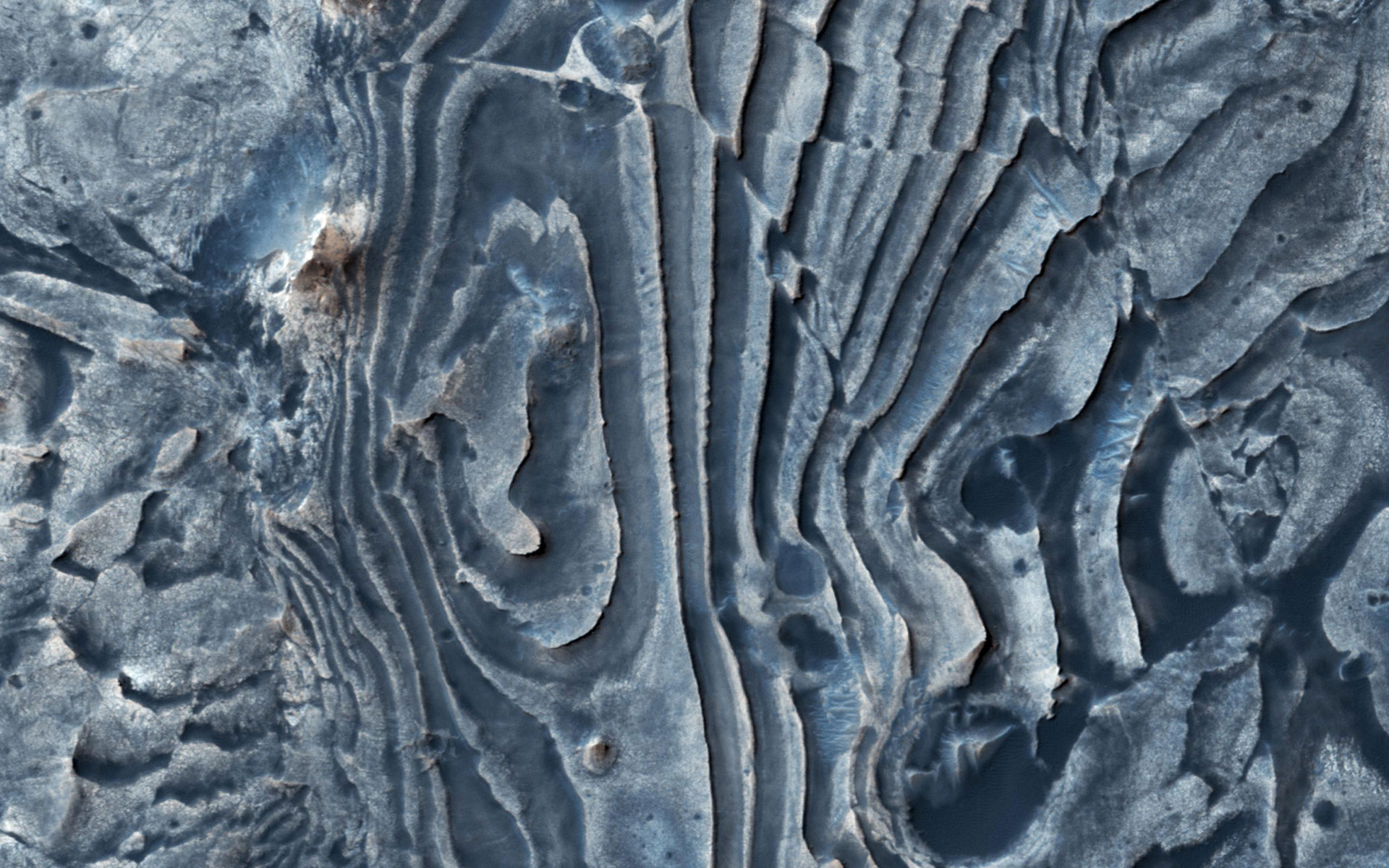
    Mars Reconnaissance Orbiter Image of Northern Meridiani Planum
    The image of the northern Meridiani Planum on Mars reveals faults that have disturbed layered deposits, resulting in clean breaks along the layers and displacement of individual beds. Credit: NASA/JPL-Caltech/University of Arizona

    This image from NASA’s Mars Reconnaissance Orbiter (MRO) of northern Meridiani Planum shows faults that have disrupted layered deposits. Some of the faults produced a clean break along the layers, displacing and offsetting individual beds (yellow arrow).

    Interestingly, the layers continue across the fault and appear stretched out (green arrow). These observations suggest that some of the faulting occurred while the layered deposits were still soft and could undergo deformation, whereas other faults formed later when the layers must have been solidified and produced a clean break.

    The map is projected here at a scale of 50 centimeters (19.7 inches) per pixel. The original image scale is 54.6 centimeters (21.5 inches) per pixel (with 2 x 2 binning); objects on the order of 164 centimeters (64.6 inches) across are resolved. North is up.

    This is a stereo pair with ESP_053038_1835.

    The University of Arizona, Tucson, operates HiRISE, which was built by Ball Aerospace & Technologies Corp., Boulder, Colorado. NASA’s Jet Propulsion Laboratory, a division of Caltech in Pasadena, California, manages the Mars Reconnaissance Orbiter Project for NASA’s Science Mission Directorate, Washington.

    Never miss a breakthrough: Join the SciTechDaily newsletter.
    Follow us on Google and Google News.

    Astronomy Mars Mars Reconnaissance Orbiter Planetary Science
    Share. Facebook Twitter Pinterest LinkedIn Email Reddit

    Related Articles

    New NASA Image of the Northern Plains of Mars

    Mars Orbiter Preparing for Mars InSight Lander’s 2016 Arrival

    New HiRISE Image of a “Fresh” Crater Near Sirenum Fossae

    NASA’s Mars Reconnaissance Orbiter Completes 40,000 Mars Orbits

    Orbiter Examines Clues to Possible Water Flows on Mars

    Mars Reconnaissance Orbiter Examines a New Impact Crater

    Scientists Find Evidence for Granite on Mars

    Data Indicates Temperatures Rise and Fall Twice a Day on Mars

    Mars Orbiter Shows McLaughlin Crater May Have Once Held a Groundwater-Fed Lake

    Leave A Reply Cancel Reply

    • Facebook
    • Twitter
    • Pinterest
    • YouTube

    Don't Miss a Discovery

    Subscribe for the Latest in Science & Tech!

    Trending News

    The Strange “Spacetime Crystal” That Can Suddenly Turn Into a Black Hole

    The Surprising Way Asteroids May Have Helped Life Begin on Earth

    Vast Hidden Structure Discovered Under Miles of Ice in East Antarctica

    A Surprising Discovery Suggests Autism Is Not One Condition

    New Alzheimer’s Discovery Could Change How Scientists Fight the Disease

    Yale Discovery Overturns Long-Held “Evolutionary Dead End” Theory

    UCLA Scientists Uncover a “Hidden Weakness” in Some of the World’s Deadliest Cancers

    Humpback Whale Stuns Scientists With 15,000 Kilometer Journey Across Oceans

    Follow SciTechDaily
    • Facebook
    • Twitter
    • YouTube
    • Pinterest
    • Newsletter
    • RSS
    SciTech News
    • Biology News
    • Chemistry News
    • Earth News
    • Health News
    • Physics News
    • Science News
    • Space News
    • Technology News
    Recent Posts
    • Food Waste Becomes a Powerful Carbon Trap in Climate Breakthrough
    • Battery-Free Artificial Photosynthesis Turns Sunlight, Water, and CO2 Into Fuel
    • How Ancient People Moved a 6-Ton Stone 700 Kilometers to Stonehenge
    • Scientists Finally See How Antibodies Really Attack Viruses
    • The Unexpected Gut Health Risk of Cutting Out Sugar
    Copyright © 1998 - 2026 SciTechDaily. All Rights Reserved.
    • Science News
    • About
    • Contact
    • Editorial Board
    • Privacy Policy
    • Terms of Use

    Type above and press Enter to search. Press Esc to cancel.