
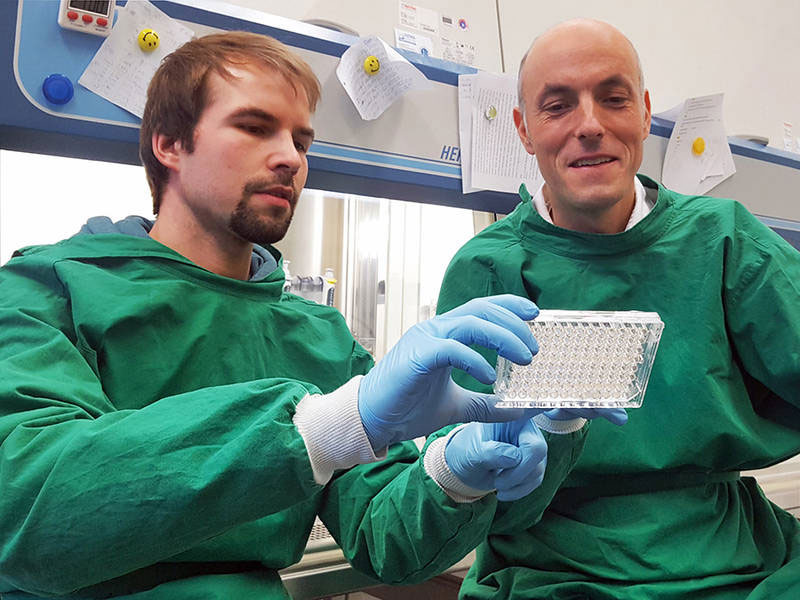
In search of new strategies against life-threatening tuberculosis infections, a team from the Technical University of Munich (TUM), as well as Harvard University and Texas A&M University in the USA have found a new ally. They discovered a substance that interferes with the mycomembrane formation of the bacterium. It is effective even in low concentrations and when combined with known antibiotics their effectiveness is improved by up to 100-fold.
Among the greatest challenges when treating life-threatening tuberculosis infections is the increasing resistance to antibiotics. But the pathogen itself also makes the life of doctors difficult: its dense mycomembrane hampers the effect of many medications. A team of scientists headed by Stephan A. Sieber, Professor of Organic Chemistry at TU Munich, has discovered a substance that perturbs the formation of this membrane significantly.
The mycomembrane of the tuberculosis pathogen Mycobacterium tuberculosis consists of a lipid double layer that encapsulates the cell wall, forming an exterior barrier. Structural hallmarks are mycolic acids, branched beta-hydroxy fatty acids with two long hydrocarbon chains. The team hypothesizes that similarly structured beta lactones could “mask” themselves as mycolic acid to enter the mycolic acid metabolic pathways and then block the decisive enzymes.
HELPFUL DISRUPTER
In the context of an extensive search, the interdisciplinary team of scientists hit the bullseye with the beta lactone EZ120. It does indeed inhibit the biosynthesis of the mycomembrane and kills mycobacteria effectively. Using enzyme assays and mass spectroscopy investigations, Dr. Johannes Lehmann, a researcher at the Chair of Organic Chemistry II at TU Munich, demonstrated during his doctoral work that the new inhibitor blocks especially the enzymes Pks13 and Ag85, which play a key role in the development of mycomembranes.
EZ120 is effective even in low doses, easily passes the mycomembrane, and exhibits only low toxicity to human cells. The combined application of this substance with known antibiotics showed a synergistic effect leading to significantly increased effectiveness.”Vancomycin, a common antibiotic, and EZ120 work together very well,” says Prof. Sieber, who heads the Chair of Organic Chemistry II. “When used together, the dose can be reduced over 100-fold.
“The scientists suspect that disrupting the mycomembrane enables antibiotics to enter the bacteria more easily. This is a new mode of action and might be a starting point for novel tuberculosis therapies.”
The research was funded by the German Research Foundation (SFB 749 and Cluster of Excellence “Center for Integrated Protein Science”), the National Institutes of Health (USA), and the German National Academic Foundation (Studienstiftung des Deutschen Volkes). Researchers from the Harvard T.H. Chan School of Public Health and Texas A & M University (College Station, USA) also participated in the research.
Reference: “An Antibacterial ß-Lactone Kills Mycobacterium tuberculosis by Disrupting Mycolic Acid Biosynthesis” by Dr. Johannes Lehmann, Dr. Tan-Yun Cheng, Dr. Anup Aggarwal, Dr. Annie S. Park, Dr. Evelyn Zeiler, Dr. Ravikiran M. Raju, Dr. Tatos Akopian, Dr. Olga Kandror, Prof. Dr. James C. Sacchettini, Prof. Dr. D. Branch Moody, Prof. Dr. Eric J. Rubin and Prof. Dr. Stephan A. Sieber, 24 October 2017, Angewandte Chem Int Edition.
DOI: 10.1002/anie.201709365
Never miss a breakthrough: Join the SciTechDaily newsletter.
Follow us on Google and Google News.