
Close Menu
    Facebook X (Twitter) Instagram
    SciTechDaily
    • Biology
    • Chemistry
    • Earth
    • Health
    • Physics
    • Science
    • Space
    • Technology
    Facebook X (Twitter) Pinterest YouTube RSS
    SciTechDaily
    Home»Biology»Neuroscientists Demonstrate Integration of Plasticity Mechanisms within a Single Sensory Neuron
    Biology

    Neuroscientists Demonstrate Integration of Plasticity Mechanisms within a Single Sensory Neuron

    By Bill Hathaway, Yale UniversityJanuary 5, 2018No Comments2 Mins Read
    Facebook Twitter Pinterest Telegram LinkedIn WhatsApp Email Reddit
    Share
    Facebook Twitter LinkedIn Pinterest Telegram Email Reddit
    Integration of Plasticity Mechanisms within a Single Sensory Neuron
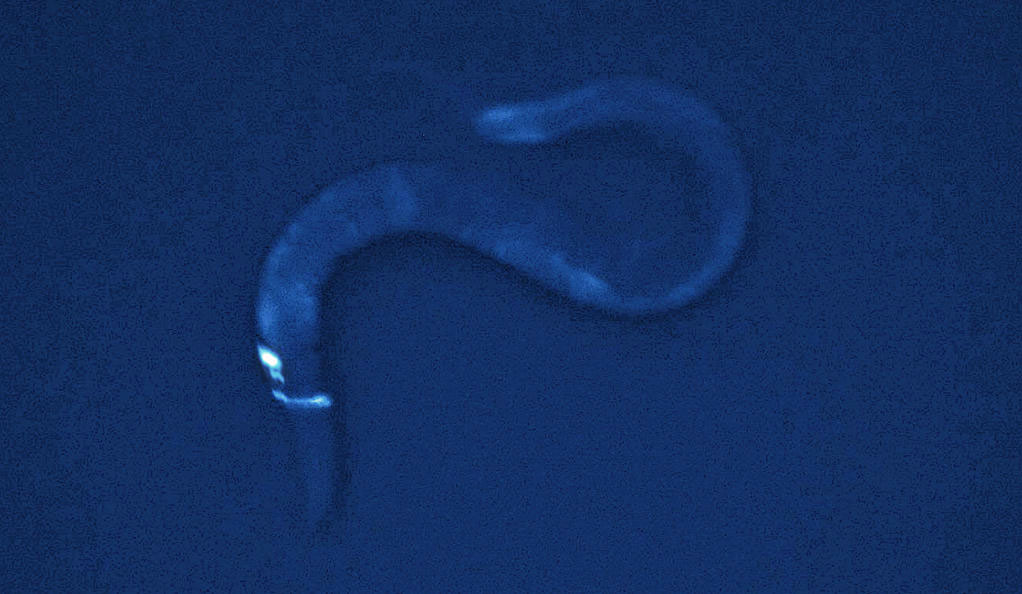
    An individual neuronal cell of the worm C. elegans (captured through the visualization of calcium dynamics using the calcium sensor GCAMP6). Imaging of single neurons in the brains of behaving animals, like in this photo, allowed Yale researchers to reconstruct how single neurons change based on experience, and how their plasticity mechanisms then compute sensory information to actuate a memory.

    The nervous system has the capacity to change based on experience. This plasticity is thought to underpin the formation and retrieval of memories. How the plasticity of individual neurons contribute to learned behavior is a fundamental, and unanswered question in neuroscience. In the January 4 issue of the journal Neuron, Yale scientists show that two plasticity mechanisms act within a single neuron to express a memory in the worm C. elegans.

    C. elegans can be trained to prefer a temperature, and the Yale team, led by neuroscientists Daniel Colón-Ramos and Josh Hawk, studied what happens at the cellular level when animals learn to prefer a new temperature. They found that a sensory neuron in the worm can integrate two plasticity mechanisms to guide learned behavioral preferences. Sensory adaptation allows the neuron to act as a sort of compass, telling the worm which way it is bearing on a temperature gradient. Presynaptic plasticity acts as an “information gate” that, based on learned behavior, governs whether temperature information is relayed to other neurons or not, thereby controlling its movement. Together, these mechanisms create a single-cell logic system that explains how the animal both senses temperature, and responds to it based on a previous memory.

    “Our work shows that each individual neuron is capable of acting as a computer, integrating plasticity mechanisms to process information that initiate complex behaviors,” said Colón-Ramos.

    Reference: “Integration of Plasticity Mechanisms within a Single Sensory Neuron of C. elegans Actuates a Memory” by Josh D. Hawk, Ana C. Calvo, Ping Liu, Agustin Almoril-Porras, Ahmad Aljobeh, María Luisa Torruella-Suárez, Ivy Ren, Nathan Cook, Joel Greenwood, Linjiao Luo, Zhao-Wen Wang, Aravinthan D.T. Samuel and Daniel A. Colón-Ramos, 4 January 2018, Neuron.
    DOI: 10.1016/j.neuron.2017.12.027

    Never miss a breakthrough: Join the SciTechDaily newsletter.
    Follow us on Google and Google News.

    Neurology Neuroscience Yale University
    Share. Facebook Twitter Pinterest LinkedIn Email Reddit

    Related Articles

    Key Process in Brain Development Identified

    New Research Shows Seizures Knock Out Brain Arousal Centers

    Yale Research Shows Immune Cells Are an Ally, Not Enemy, in Battle Against Alzheimer’s

    New Research Identifies Enzyme Crucial to the Shaping and Division of Brain Cells

    Neurobiologists Block the Effects of Stress

    Study Shows Human Brain Development is Divided into Three Major Phases

    Suppressing NgR1 Returns Brain to Adolescent Levels of Plasticity

    Neurologists Repair Neurons Associated With Traumatic Nerve Injury Pain

    GATA1 Plays a Role in the Loss of Connections Between Neurons and in Symptoms of Depression

    Leave A Reply Cancel Reply

    • Facebook
    • Twitter
    • Pinterest
    • YouTube

    Don't Miss a Discovery

    Subscribe for the Latest in Science & Tech!

    Trending News

    After 50 Years, Astronomers Finally Found What the Milky Way’s Black Hole Was Hiding

    The Most Powerful Drug of All Isn’t Found in a Pill Bottle

    Scientists Capture Immune Cells Eating Live Cancer Cells for the First Time

    Why Older Adults Need To Pay Closer Attention to Vitamin B12

    Scientists Say a Daily Probiotic May Help Fight Depression in Older Adults

    This Deadly Disease Was Wiping Out Humans 5,500 Years Ago

    Beyond DNA: Scientists Discover Inheritance That Breaks the Rules of Genetics

    Scientists Just Discovered the Eye Defies a Long-Held Rule of Vision

    Follow SciTechDaily
    • Facebook
    • Twitter
    • YouTube
    • Pinterest
    • Newsletter
    • RSS
    SciTech News
    • Biology News
    • Chemistry News
    • Earth News
    • Health News
    • Physics News
    • Science News
    • Space News
    • Technology News
    Recent Posts
    • Japanese Researchers Unlock a Powerful New Way To Edit and Assemble DNA
    • Rare Goblin Shark Spotted Alive in Its Natural Habitat for the First Time
    • Scientists May Have Discovered How To Heal Damaged Kidneys
    • A Plastic Motor Just Defied a Century of Engineering Assumptions
    • Interstellar Visitor 3I/ATLAS Is Bursting With an Unexpected Chemical
    Copyright © 1998 - 2026 SciTechDaily. All Rights Reserved.
    • Science News
    • About
    • Contact
    • Editorial Board
    • Privacy Policy
    • Terms of Use

    Type above and press Enter to search. Press Esc to cancel.