
Close Menu
    Facebook X (Twitter) Instagram
    SciTechDaily
    • Biology
    • Chemistry
    • Earth
    • Health
    • Physics
    • Science
    • Space
    • Technology
    Facebook X (Twitter) Pinterest YouTube RSS
    SciTechDaily
    Home»Biology»Invasive Species of Asian Mussels Turns Parasites into Hosts
    Biology

    Invasive Species of Asian Mussels Turns Parasites into Hosts

    By SciTechDailyFebruary 15, 2012No Comments2 Mins Read
    Facebook Twitter Pinterest Telegram LinkedIn WhatsApp Email Reddit
    Share
    Facebook Twitter LinkedIn Pinterest Telegram Email Reddit
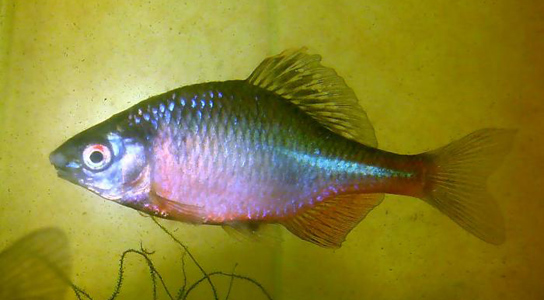
    European Bitterling
    European Bitterling

    In a new study published today in the journal Biology Letters, researchers have found an invasive species of mussels that has caused a complete ecological role reversal, turning a host into a parasite and vice versa.

    The scientists were focused on ecosystems involving the European bitterling (Rhodeus amarus), a small, pale-silver freshwater fish that lays its eggs in the gills of mussels. The mussels release the larvae into the water, where they colonize and develop into fish. Both the bitterling, most of which are found in East Asia, but there’s one species in Europe, and the mussels they colonize have evolved mechanisms to resist each other.
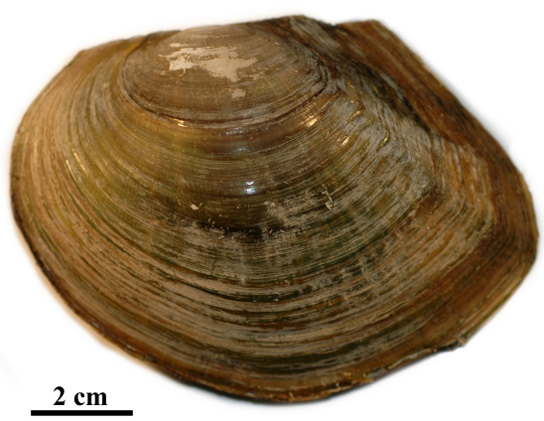
    Anodonta woodiana Chinese mussels

    Martin Reichard, an evolutionary biologist at the Institute of Vertebrate Biology in Brno, Czech Republic, and his colleagues have studied the European bitterlings for years. A few years ago, the scientists began working on a Polish site that had been invaded by a species of Chinese mussels (Anodonta woodiana), which is from the same family as the native mussels.
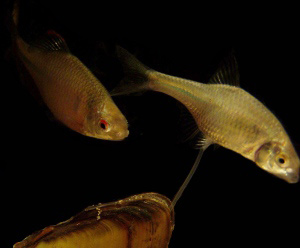
    Small Bitterling PairUsually, the European bitterling has the advantage, however, at the Polish site, A. woodiana ejected the bitterling eggs laid in them, effectively annulling their reproductive output. The bitterlings would then always choose to lay their eggs in the native species of mussels, not A. woodiana.
    The invasive A. woodiana species was able to reverse the host-parasite relationship completely. This might suggest that the mussel species are in different stages of their co-evolution with fish.

    A. woodiana is proliferating across the globe, thanks to its larvae hitching rides on aquacultured fish. It’s not yet known if this will have negative impacts on the ecosystems it invades, however the researchers state that A. woodiana won’t wreak havoc on the scale of the zebra mussel (Dreissena polymorpha) and quagga mussel (Dreissena rostriformis bugensis), which have invaded the Great Lakes in the past three decades, disrupting food webs, damaging infrastructure and fouling native mussel populations.

    Reference: “An invasive species reverses the roles in a host–parasite relationship between bitterling fish and unionid mussels” by Martin Reichard, Milan Vrtílek, Karel Douda and Carl Smith, 15 February 2012, Biology Letters.
    DOI: 10.1098/rsbl.2011.1234

    Never miss a breakthrough: Join the SciTechDaily newsletter.
    Follow us on Google and Google News.

    Ecological Evolutionary Biology Fish Freshwater Mussel Parasite
    Share. Facebook Twitter Pinterest LinkedIn Email Reddit

    Related Articles

    Fish That Walk: Unlocking the Evolutionary Secrets of Sea Robins

    The Fish That Outsmarts Sound: How Danionella cerebrum Hears What Humans Can’t

    New Study: These Bizarre Blood-Sucking Fish Have a “Jaw-Dropping” Evolutionary Origin

    Biologists Reveal How Marine Fish Won An Evolutionary Lottery

    Researchers Discover Switchblade-Like Defensive System in Stonefish

    Lack of Freshwater Places Colorado River Delta Fish at Risk of Extinction

    Geneticists Grow Fish with Limbs to Duplicate Evolutionary Pressure

    Genetic Analysis Reveals New Family Tree for Ray-Finned Fish

    “Map of Life” to Illustrate All Living Things Geographically

    Leave A Reply Cancel Reply

    • Facebook
    • Twitter
    • Pinterest
    • YouTube

    Don't Miss a Discovery

    Subscribe for the Latest in Science & Tech!

    Trending News

    Long COVID Brain Scans Reveal Damage to Dopamine Neurons

    Scientists Warn a Silent Oxygen Crisis Is Spreading Through Earth’s Waters

    James Webb Telescope Discovers Hidden Giant Planet in Famous Star System

    Scientists Build the First 3D Cloak That Makes Objects Invisible To Heat

    Common Food Additive Linked To Gut Inflammation

    Black Hole Collisions May Follow a Surprisingly Simple Rule

    The Eye Has a Hidden Cleanup System and Scientists Just Discovered It

    The Truth About Vikings Is More Complicated Than Museums Admit

    Follow SciTechDaily
    • Facebook
    • Twitter
    • YouTube
    • Pinterest
    • Newsletter
    • RSS
    SciTech News
    • Biology News
    • Chemistry News
    • Earth News
    • Health News
    • Physics News
    • Science News
    • Space News
    • Technology News
    Recent Posts
    • NASA Astronaut Comes Home After 3,856 Orbits of Earth
    • A Rare and Deadly Cancer May Have an Unexpected New Vulnerability
    • Sleep Disorders Don’t Just Exhaust You. New Research Shows They Change Your Brain
    • THC-CBD Treatment Dramatically Reduces Agitation in Dementia Trial
    • Rare 8,000-Year-Old Rock Shelter Captures a Turning Point in Human History
    Copyright © 1998 - 2026 SciTechDaily. All Rights Reserved.
    • Science News
    • About
    • Contact
    • Editorial Board
    • Privacy Policy
    • Terms of Use

    Type above and press Enter to search. Press Esc to cancel.