
A tiny worm turns static electricity into a powerful weapon, launching itself through the air to catch flying prey.
Scientists have discovered that a microscopic parasitic worm can propel itself astonishing distances through the air by using static electricity. The worm is capable of jumping as high as 25 times its own body length to latch onto flying insects. The research, published in PNAS, focuses on the nematode Steinernema carpocapsae and was led by teams at Emory University and the University of California, Berkeley.
“We’ve identified the electrostatic mechanism this worm uses to hit its target, and we’ve shown the importance of this mechanism for the worm’s survival,” says co-author Justin Burton, a physics professor at Emory University whose lab carried out the mathematical analysis of the experiments. “Higher voltage, combined with a tiny breath of wind, greatly boosts the odds of a jumping worm connecting to a flying insect.”
Big Discoveries in Tiny Creatures
“You might expect to find big discoveries in big animals, but the tiny ones also hold a lot of interesting secrets,” says Victor Ortega-Jiménez, co-lead author and assistant professor of biomechanics at the University of California, Berkeley.
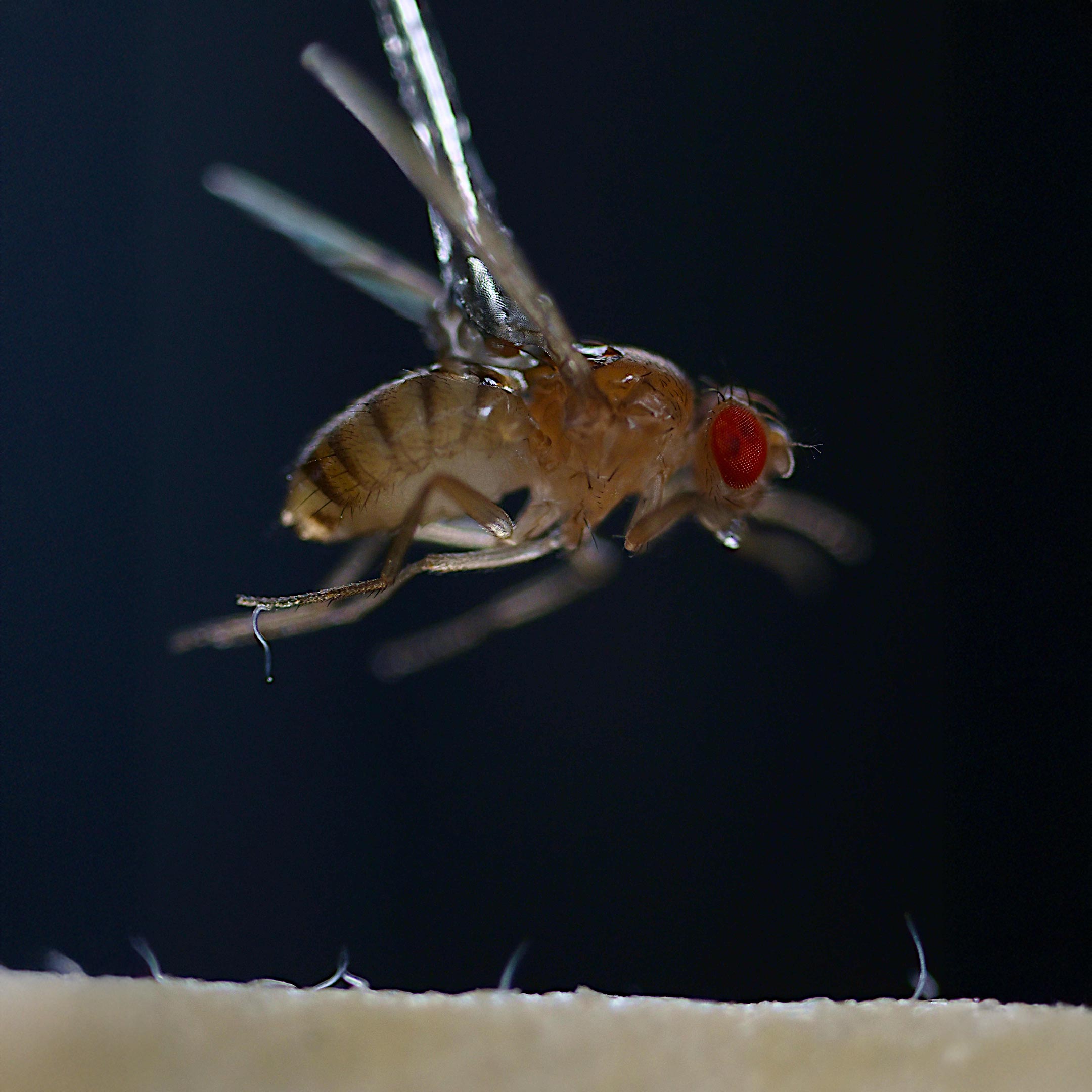
Ortega-Jiménez led the experimental work, using high-speed microscopy to record the movements of the parasitic worm, whose length is about the diameter of a needle point, as it launched itself toward electrically charged fruit flies.
The experiments showed that flying insects naturally generate electrical charges of several hundred volts as their wings move through the air. This charge induces an opposite electrical charge in the worm, creating an attractive force that pulls the two together. The team identified electrostatic induction as the process responsible for this interaction.
“Using physics we learned something new and interesting about an adaptive strategy in an organism,” says Ranjiangshang Ran, co-lead author of the study and a postdoctoral fellow in Burton’s lab. “We’re helping to pioneer the emerging field of electrostatic ecology.”
Other contributors include Saad Bhamla and Sunny Kumar from the Georgia Institute of Technology, where early experiments were carried out, and Adler Dillman, a nematode biologist at the University of California, Riverside.
Static Electricity in the Lives of Small Organisms
Static electricity is the brief shock people sometimes feel when touching a metal doorknob or pulling off a sweater. It occurs when electrons build up and discharge rapidly upon contact with a conductor.
At human scale, this effect is mostly a nuisance. But growing evidence shows that static electricity can play a vital role in how small organisms interact with their environment.
In 2013, Ortega-Jiménez discovered that spider webs can take advantage of the electrical charge carried by flying insects, drawing them in through electrostatic attraction as they pass nearby.
Other studies have shown that bees rely on electrostatics to collect pollen, flower mites use electrical forces to hitch rides on hummingbirds, and ballooning spiders drift long distances by releasing electrically charged silk strands.
Burton and Ortega-Jiménez also recently co-authored a commentary in Trends in Parasitology examining the role of electrostatic forces in the behavior of ticks.
“Ticks can get sucked up from the ground by fluffy animals, purely through the static electricity in the animal’s fur,” Burton explains.
While testing this phenomenon, Ortega-Jiménez developed a method to precisely control the electrical charge of a tethered tick. That technical advance turned out to be essential for launching the new experiments on nematodes.
How the Jumping Worm Attacks
For the current study, the researchers set out to understand how electrostatic forces and air movement together influence how successfully S. carpocapsae connects with flying insects.
The worm is an unsegmented roundworm that kills insects by releasing symbiotic bacteria inside its host. It lives in soil across much of the world, excluding the Poles, and is widely used in agriculture as a biological pest control agent.
When the worm senses an insect above it, the animal coils its body into a loop and suddenly launches upward, reaching heights up to 25 times its body length. That is comparable to a human jumping higher than a 10-story building.
“I believe these nematodes are some of the smallest, best jumpers in the world,” Ortega-Jiménez says. During these acrobatic leaps, the worms can rotate as fast as 1,000 times per second.
If the worm successfully reaches its target, it enters the insect’s body through a natural opening. It then releases its bacteria, which kill the insect within 48 hours. The worm feeds on the bacteria and insect tissue, lays eggs, and produces multiple generations inside the dead host before new juvenile worms emerge to repeat the cycle.
Designing Delicate Experiments
To study the physics behind this behavior, the researchers built experiments that carefully replicated natural conditions.
Flying insect wings can generate hundreds of volts as they interact with charged particles in the air. To measure this effect precisely, Ortega-Jiménez attached a tiny wire connected to a high-voltage power supply to the back of each fruit fly used in the experiments.
“It’s very difficult to glue a wire to a fruit fly,” he says. “Usually, it took me half an hour, or sometimes an hour.”
Getting the worms to jump on cue was another challenge. The researchers placed them on moistened paper that had to be damp enough to encourage movement without interfering with jumping. A gentle puff of air or slight mechanical disturbance was often needed to trigger a leap toward a suspended fruit fly.
Dozens of trials were recorded using a high-speed camera capturing 10,000 frames per second, allowing the team to track the midair motion of the nearly invisible worms. Some experiments were also conducted inside a miniature wind tunnel to test how even faint air currents influenced success.
Turning Motion Into Data
Ran analyzed roughly 60 videos by digitally tracing the worms’ flight paths using specialized software. When a worm moved out of focus, manual tracking was required to capture its position accurately.
To interpret the data, Ran used a mathematical technique called Markov chain Monte Carlo (MCMC). (“Markov” refers to the mathematician who developed the method, while “Monte Carlo” references the gambling hub in Monaco.)
“MCMC allows you to do random explorations, using different sets of parameters, to determine a mathematical probability for an outcome,” Ran says.
The analysis tested about 50,000 possible combinations of factors for each jump, including insect voltage, worm size, and launch speed. Without electrostatic effects, only one out of 19 worm jumps reached the target.
When electrostatic charge was included, success rates rose sharply. At 100 volts, the chance of success remained below 10 percent. At 800 volts, the probability climbed to about 80 percent, a voltage range commonly produced by flying insects.
Jumping is costly for the worm and exposes it to risks such as predators and dehydration.
“Our findings suggest that, without electrostatics, it would make no sense for this jumping predatory behavior to have evolved in these worms,” Ran says.
Linking Past Physics to Future Ecology
The team initially suspected that electrostatic induction explained the interaction between the worm and its prey. While reviewing historical research, they found that their model matched predictions made by Scottish physicist James Clerk Maxwell in 1870.
“Maxwell, one of the most prolific physicists of all time, had a wild imagination, similar to Einstein,” Ran says. “It turns out that our model for the worm-charging mechanism agreed with a prediction for electrostatic induction that Maxwell made in 1870. There are many buried treasures in scientific history. Sometimes being a scientist is like being an archeologist.”
The researchers also examined the effects of air resistance, which plays a much larger role at tiny scales. They compared it to the difference between a bowling ball moving through the air and a feather that drifts slowly due to drag.
Simulations combining electric charge with varying wind speeds showed that even a gentle breeze of 0.2 meters per second significantly increased the worm’s chances of hitting its target.
The findings provide a new framework for exploring how electrical forces shape interactions in nature.
“We live in an electrical world, electricity is all around us, but the electrostatics of small organisms remains mostly an enigma,” Ortega-Jiménez says. “We are developing the tools to investigate many more valuable questions surrounding this mystery.”
Reference: “Electrostatics facilitate midair host attachment in parasitic jumping nematodes” by Ranjiangshang Ran, Justin C. Burton, Sunny Kumar, Saad Bhamla, Adler R. Dillman and Victor M. Ortega-Jimenez, 14 October 2025, Proceedings of the National Academy of Sciences.
DOI: 10.1073/pnas.2503555122
The work was supported by a grant from the W.M. Keck Foundation and the Tarbutton Postdoctoral Fellowship of Emory College of Arts and Sciences.
Never miss a breakthrough: Join the SciTechDaily newsletter.
Follow us on Google and Google News.
1 Comment
Then they say God made the world in 6days and left the 7th day for rest and prayer !!!!!!