
Close Menu
    Facebook X (Twitter) Instagram
    SciTechDaily
    • Biology
    • Chemistry
    • Earth
    • Health
    • Physics
    • Science
    • Space
    • Technology
    Facebook X (Twitter) Pinterest YouTube RSS
    SciTechDaily
    Home»Chemistry»Scientists Discover a New Cousin of Diamond That Was Thought To Exist Only in Theory
    Chemistry

    Scientists Discover a New Cousin of Diamond That Was Thought To Exist Only in Theory

    By University of GothenburgOctober 14, 2026No Comments4 Mins Read
    Facebook Twitter Pinterest Telegram LinkedIn WhatsApp Email Reddit
    Share
    Facebook Twitter LinkedIn Pinterest Telegram Email Reddit
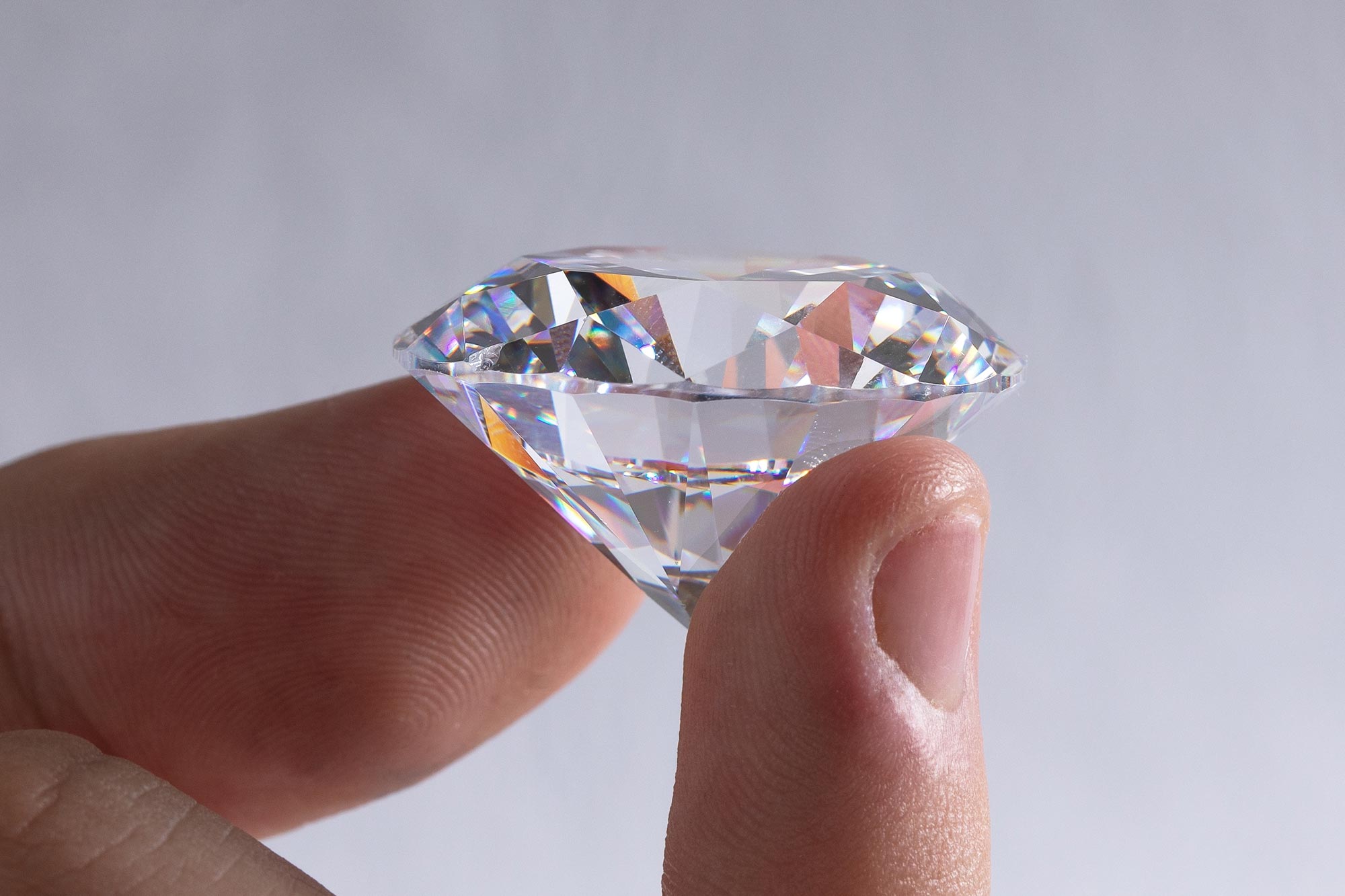
    Natural Round Cut Diamond Close
    A shimmering diamond represents one of carbon’s most familiar forms. Scientists have now created a new, porous, diamond-like structure that reveals another surprising way carbon atoms can arrange themselves. Credit: Shutterstock

    Diamond and graphite have a new carbon cousin called diamondiyne, with a crystal structure confirmed so far only in microscopic patches.

    A carbon structure proposed 35 years ago has finally taken shape in a thin film where two liquids meet. Using relatively inexpensive equipment, researchers at the University of Gothenburg have created diamondiyne for the first time, adding a new three-dimensional structure to the forms carbon can take.

    Diamondiyne is a carbon allotrope, a form of the element distinguished by how its atoms are arranged. Diamond and graphite are familiar examples. To create diamondiyne, the researchers joined carbon atoms through triple bonds. The material crystallizes into a network of tetrahedra, shapes with four triangular faces, connected corner to corner in all three dimensions.

    “The structure creates voids between the tetrahedra. The carbon allotrope can therefore be compared to a porous diamond. But unlike diamonds, diamondiyne does not require high pressure to make the carbon atoms bond to one another,” says Karl Börjesson, professor of physical chemistry at the University of Gothenburg, who leads the research team.

    Crystal patterns confirmed in tiny patches

    Electron microscopy at Stockholm University confirmed the crystal structure, although only in patches on the film’s surface. Many things can go wrong during formation and prevent the carbon atoms from assembling into diamondiyne.
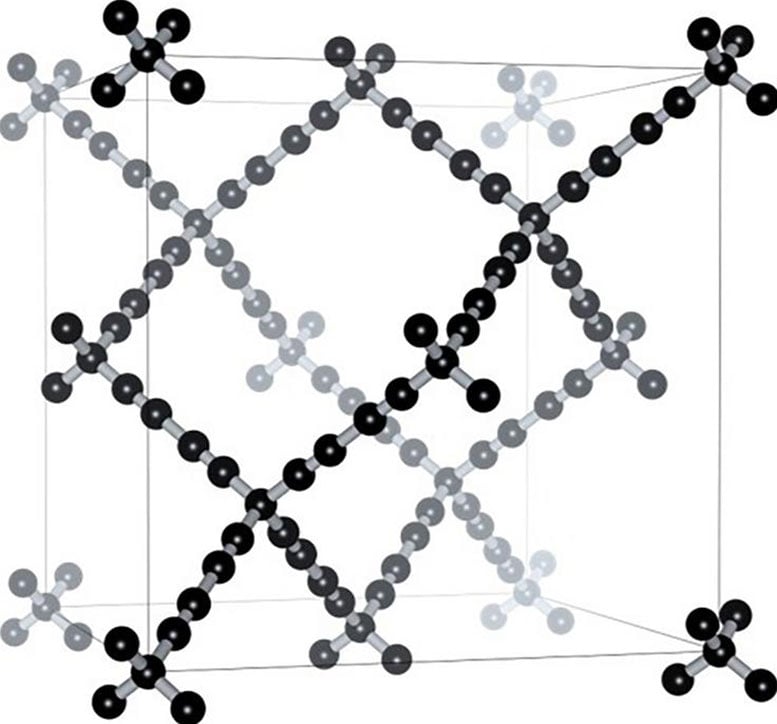
    Diamondiyne Porous Carbon Crystal Structure
    The carbon allotrope is called diamondiyne and it creates a porous material with the basic shape as a tetrahedron. Credit: Yizhou Yang

    “We have at least managed to produce repeating patterns of diamondiyne in a volume measuring 10 nanometers on each side, 10 × 10⁻⁹ meters, and the images of the patterns correspond well with the theoretical models,” says Börjesson.

    Carbon frameworks without metal ions

    The discovery grew out of the team’s longstanding effort to create porous materials in which carbon-based molecules bind together without metal ions. These materials are called covalent organic frameworks, or COFs. They differ from metal-organic frameworks, or MOFs, which combine carbon-based molecules with metal ions and whose development earned the 2025 Nobel Prize in Chemistry.

    Karl Börjesson
    Karl Börjesson has spent many years working to produce diamondiyne, which had previously only been described in theory. Credit: Erika Hoff

    A colleague told Börjesson about a website where theoretical chemists had compiled an almost endless list of carbon allotropes that should be possible to create. Diamondiyne’s tetrahedral structure had been described theoretically decades before the team succeeded in making it.

    “It has taken us an incredibly long time, but we finally succeeded. I am very pleased,” says Börjesson.

    For many years, known carbon allotropes were limited to diamond, graphite, and three artificially produced forms: fullerenes, carbon nanotubes, and graphene. The development of fullerenes and graphene was recognized with Nobel Prizes, largely because the idea that these materials could exist was itself new. Researchers have created many additional allotropes in recent years, with diamondiyne the first of this newer group to have a three-dimensional structure.

    “We will now investigate the properties of diamondiyne and how it might be used. One exciting aspect of the porous structure is that several diamondiyne structures could potentially be interwoven through each other’s voids,” says Börjesson.

    Reference: “Diamondiyne: A 3D Carbon Allotrope With Mixed sp–sp3 Hybridization” by Yizhou Yang, Jie Xu, Yanyan Chen, Yu Xia, Sami Zeliouche, Clara Schäfer, Martin Ratsch, Ebba Matic, Martin Rahm, Lars Evenäs, Angela Beth Grommet, Tom Willhammar and Karl Börjesson, 14 September 2026, Angewandte Chemie International Edition.
    DOI: 10.1002/anie.4062963

    Never miss a breakthrough: Join the SciTechDaily newsletter.
    Follow us on Google and Google News.

    Carbon Electron Microscopy Materials Science Molecular Chemistry University of Gothenburg
    Share. Facebook Twitter Pinterest LinkedIn Email Reddit

    Related Articles

    Chemists Defy Decades-Old Rules With “Free Electron” Breakthrough

    Scientists Create Powerful New Form of Aluminum That Could Replace Rare Earth Metals

    Scientists Create the Impossible: New Compound Challenges Fundamental Principle of Chemistry

    Record-Shattering Molecule Stores Data at “Dark Side of the Moon” Temperatures

    Weak Forces, Super Materials: The Breakthrough Changing Material Science

    Superstructure Carbons: The Newest Breakthrough That Could Revolutionize Energy

    Russian Scientists Synthesize a New Ultra-Hard Material

    Using X-Ray Imaging to Help Improve Lithium-Sulfur Battery Technology

    LCLS Low-Energy Test Just Shy of the 284-Electronvolt Carbon Edge

    Leave A Reply Cancel Reply

    • Facebook
    • Twitter
    • Pinterest
    • YouTube

    Don't Miss a Discovery

    Subscribe for the Latest in Science & Tech!

    Trending News

    Beyond Ozempic? New Weight Loss Drug Shows Stunning Results in Major Clinical Trial

    Scientists Create a Nuclear Clock So Precise It Barely Loses a Second in 30 Million Years

    Scientists Discover Groundbreaking Clues to Tissue Regrowth and “Immortality” in the Ocean

    A New Test Upends a Long-Held Assumption About Dark Matter

    Scientists Discover an Unexpected New Way To Fight Alzheimer’s Before It Starts

    Sleeping Less Than 5 Hours Was Linked to Higher Risk of 37 Diseases

    This 345-Million-Year-Old Fossil Fooled Scientists for Decades

    Scientists Restore Limited Vision in Blind Patients Using Gene Therapy and Special Goggles

    Follow SciTechDaily
    • Facebook
    • Twitter
    • YouTube
    • Pinterest
    • Newsletter
    • RSS
    SciTech News
    • Biology News
    • Chemistry News
    • Earth News
    • Health News
    • Physics News
    • Science News
    • Space News
    • Technology News
    Recent Posts
    • Scientists Discover a New Cousin of Diamond That Was Thought To Exist Only in Theory
    • A Missing Molecule May Explain Why Muscles Weaken With Age
    • Antibiotic Resistance Is Making This Dangerous Gut Bacterium Even Harder To Kill
    • Scientists Discover a Hidden Trigger That Keeps Inflammation Alive
    • Scientists Tested Diet Drinks for 2 Years. The Results May Surprise You
    Copyright © 1998 - 2026 SciTechDaily. All Rights Reserved.
    • Science News
    • About
    • Contact
    • Editorial Board
    • Privacy Policy
    • Terms of Use

    Type above and press Enter to search. Press Esc to cancel.