
Close Menu
    Facebook X (Twitter) Instagram
    SciTechDaily
    • Biology
    • Chemistry
    • Earth
    • Health
    • Physics
    • Science
    • Space
    • Technology
    Facebook X (Twitter) Pinterest YouTube RSS
    SciTechDaily
    Home»Space»This Stunning Hubble Image Is Playing Tricks on Your Eyes
    Space

    This Stunning Hubble Image Is Playing Tricks on Your Eyes

    By ESA/HubbleFebruary 9, 20261 Comment3 Mins Read
    Facebook Twitter Pinterest Telegram LinkedIn WhatsApp Email Reddit
    Share
    Facebook Twitter LinkedIn Pinterest Telegram Email Reddit
    Arp 4 Hubble
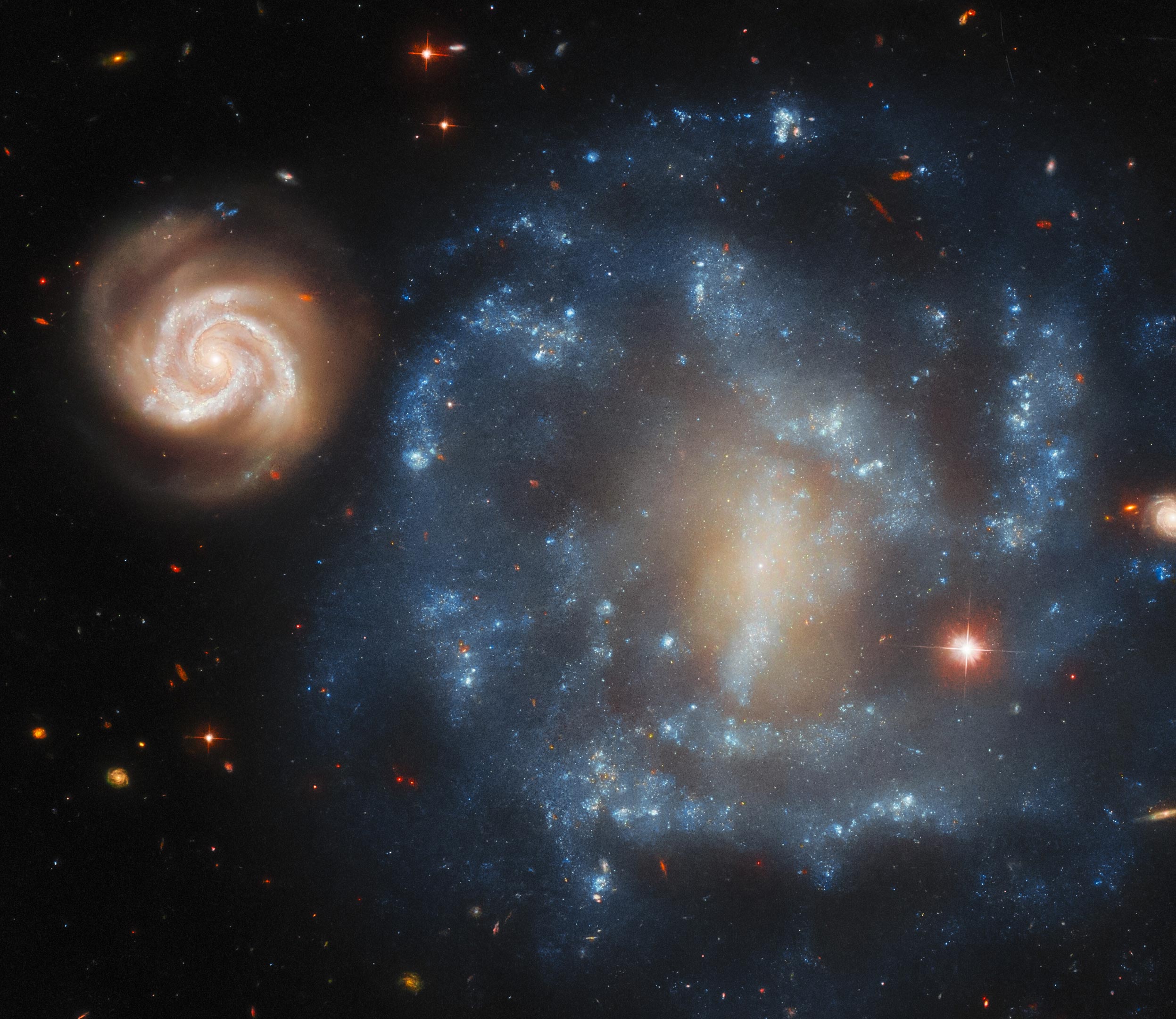
    At first glance, this cosmic duo looks like a small, energetic spiral galaxy dancing around a much larger, shadowy companion. But the pairing is a trick of perspective. Credit: ESA/Hubble & NASA, J. Dalcanton, Dark Energy Survey/DOE/FNAL/DECam/CTIO/NOIRLab/NSF/AURA

    What looks like a galactic dance is really a cosmic optical illusion—two galaxies, worlds apart, perfectly aligned by chance.

    At first glance, this scene appears to be a tight galactic partnership. A small, luminous spiral seems to skim the outer edge of a much larger spiral that appears dark and unsettled. The image suggests an intimate cosmic encounter, but appearances can be misleading. The galaxies shown in this Hubble Picture of the Week are collectively known as Arp 4, located in the constellation Cetus (the Whale).

    The Origins of Arp 4 and Peculiar Galaxies

    The name Arp 4 comes from the Atlas of Peculiar Galaxies, a collection assembled in the 1960s by astronomer Halton Arp. The atlas focused on what Arp described as “unusual galaxies,” objects chosen for their strange shapes and unexpected structures. By documenting these odd forms, astronomers hoped to better understand how galaxies change and evolve over time.

    Since its launch, the Hubble Space Telescope has transformed this field of study, capturing remarkably detailed views of fantastically unusual examples from Arp’s atlas. Arp 4 belongs to a group near the beginning of the catalog classified as “low surface brightness” galaxies. These galaxies emit very little light and can be difficult to observe, even though they may be quite large.

    A Faint Giant and a Bright Spiral

    The larger galaxy in the image, also known as MCG-02-05-050, is a textbook example of a low surface brightness galaxy. Its spiral arms appear broken and incomplete, and its disk is faint and diffuse. In contrast, the nearby spiral labeled MCG-02-05-050a looks compact, bright, and actively forming stars, making it appear much smaller but more energetic.

    A Cosmic Coincidence Across Vast Distances

    Despite their apparent closeness, these two galaxies are separated by an enormous distance. MCG-02-05-050 lies about 65 million light-years from Earth, while MCG-02-05-050a is roughly 675 million light-years away, more than ten times farther. Because of this difference, the brighter spiral is likely the larger galaxy, while the dimmer one is actually smaller than it appears.

    Their pairing in this image is not the result of interaction or shared history. It is simply a chance alignment along our line of sight. Even so, from Earth’s perspective, this visual coincidence creates a striking and memorable view. Arp 4 stands as a reminder that in astronomy, what looks close together in the sky can be separated by vast stretches of space.

    Never miss a breakthrough: Join the SciTechDaily newsletter.
    Follow us on Google and Google News.

    Astronomy European Space Agency Hubble Space Telescope
    Share. Facebook Twitter Pinterest LinkedIn Email Reddit

    Related Articles

    A Diamond Necklace of Cosmic Proportions

    Hubble Snaps a Stunning Close-Up of a Magnificent Spiral Galaxy

    Extraordinary Hubble Image: Light Bends From the Beyond

    Hubble Space Telescope Sees Volcanic Activity Reforming the Atmosphere on a Rocky Exoplanet

    Hubble Spies a Luminous Heart With Dark Tendrils

    Spectacular Return to the Veil Nebula

    Hubble Spots a Peculiar Sight: Unusual Spiral Galaxy With a Heavy Arm

    A Flash of Life: Hubble Spies an Unusual Planetary Nebula

    Through the Cosmic Clouds: Hubble Spots a Beautiful Stellar Nursery

    1 Comment

    1. Bao-hua ZHANG on February 10, 2026 12:57 am

      VERY GOOD!
      Based on the Topological Vortex Theory (TVT), topological spin creates all things and shapes the world.

      Reply
    Leave A Reply Cancel Reply

    • Facebook
    • Twitter
    • Pinterest
    • YouTube

    Don't Miss a Discovery

    Subscribe for the Latest in Science & Tech!

    Trending News

    Scientists Recreate a Nuclear Fireball and Uncover Fallout’s Hidden Chemistry

    These Tiny Gut Particles Could Be Accelerating Aging Throughout the Body

    Doctors Changed One Thing and Weight Gain Stopped

    Magnetic Fields May Solve a Longstanding Binary Star Mystery

    The Probiotic Breakthrough for Natural Anxiety Relief and Better Mental Health

    Animal vs. Plant Protein: Scientists Found a Surprising Nutritional Difference

    According to Scientists, This Simple Dietary Change Is Linked to Lower Depression Scores

    Researchers Discover a Hidden Vitamin D Problem That Persists Year-Round

    Follow SciTechDaily
    • Facebook
    • Twitter
    • YouTube
    • Pinterest
    • Newsletter
    • RSS
    SciTech News
    • Biology News
    • Chemistry News
    • Earth News
    • Health News
    • Physics News
    • Science News
    • Space News
    • Technology News
    Recent Posts
    • Scientists Tracked 4,500 Animals During COVID – What They Discovered Was Surprising
    • Hidden Phase of Matter Finally Captured After Decades of Predictions
    • The Strange “Spacetime Crystal” That Can Suddenly Turn Into a Black Hole
    • A Hidden Gut Signal May Be Driving Sleep Apnea’s Deadly Heart Risks
    • This AI-Designed “Universal Vaccine” Could Stop Future Pandemics Before They Start
    Copyright © 1998 - 2026 SciTechDaily. All Rights Reserved.
    • Science News
    • About
    • Contact
    • Editorial Board
    • Privacy Policy
    • Terms of Use

    Type above and press Enter to search. Press Esc to cancel.