
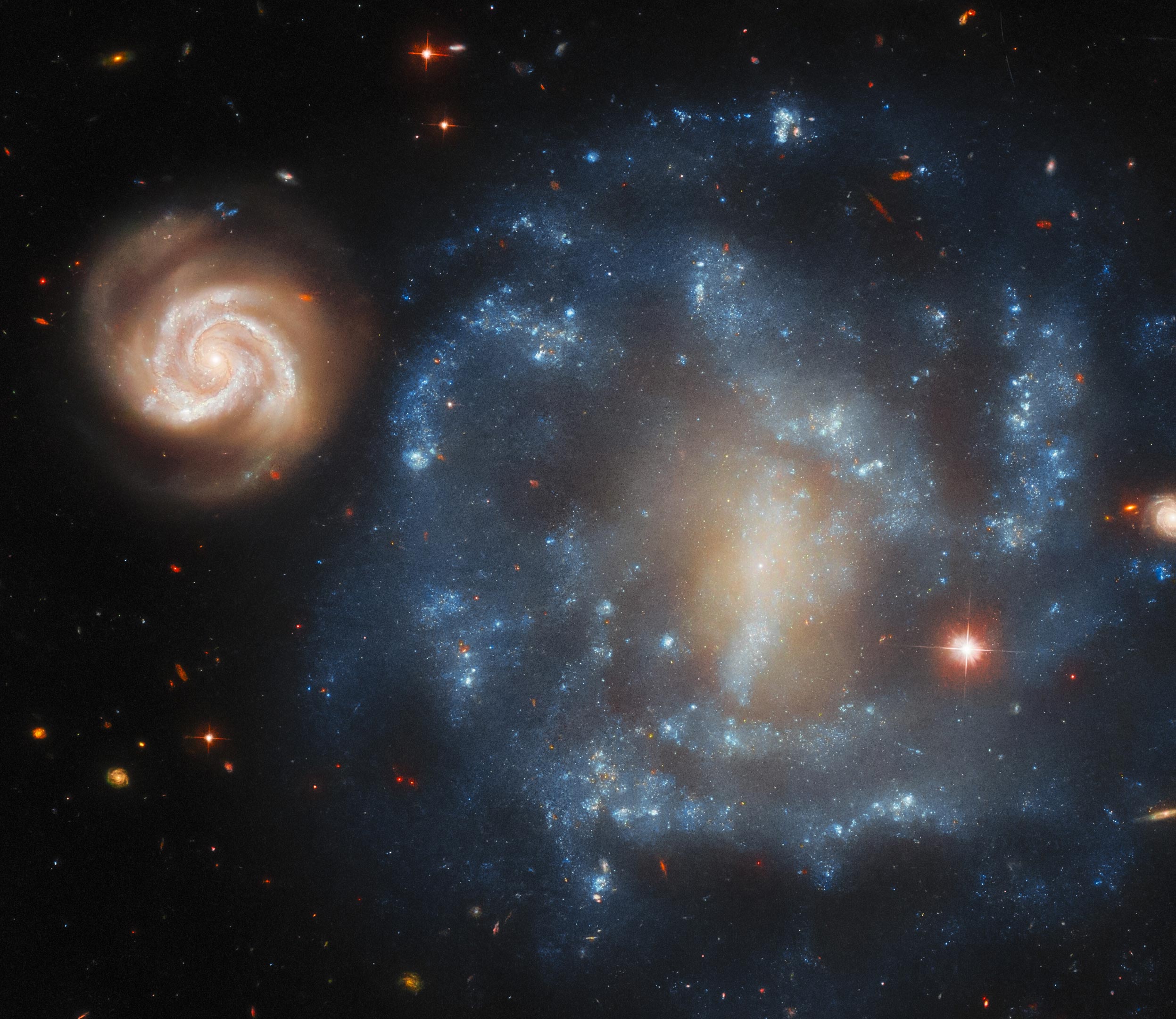
What looks like a galactic dance is really a cosmic optical illusion—two galaxies, worlds apart, perfectly aligned by chance.
At first glance, this scene appears to be a tight galactic partnership. A small, luminous spiral seems to skim the outer edge of a much larger spiral that appears dark and unsettled. The image suggests an intimate cosmic encounter, but appearances can be misleading. The galaxies shown in this Hubble Picture of the Week are collectively known as Arp 4, located in the constellation Cetus (the Whale).
The Origins of Arp 4 and Peculiar Galaxies
The name Arp 4 comes from the Atlas of Peculiar Galaxies, a collection assembled in the 1960s by astronomer Halton Arp. The atlas focused on what Arp described as “unusual galaxies,” objects chosen for their strange shapes and unexpected structures. By documenting these odd forms, astronomers hoped to better understand how galaxies change and evolve over time.
Since its launch, the Hubble Space Telescope has transformed this field of study, capturing remarkably detailed views of fantastically unusual examples from Arp’s atlas. Arp 4 belongs to a group near the beginning of the catalog classified as “low surface brightness” galaxies. These galaxies emit very little light and can be difficult to observe, even though they may be quite large.
A Faint Giant and a Bright Spiral
The larger galaxy in the image, also known as MCG-02-05-050, is a textbook example of a low surface brightness galaxy. Its spiral arms appear broken and incomplete, and its disk is faint and diffuse. In contrast, the nearby spiral labeled MCG-02-05-050a looks compact, bright, and actively forming stars, making it appear much smaller but more energetic.
A Cosmic Coincidence Across Vast Distances
Despite their apparent closeness, these two galaxies are separated by an enormous distance. MCG-02-05-050 lies about 65 million light-years from Earth, while MCG-02-05-050a is roughly 675 million light-years away, more than ten times farther. Because of this difference, the brighter spiral is likely the larger galaxy, while the dimmer one is actually smaller than it appears.
Their pairing in this image is not the result of interaction or shared history. It is simply a chance alignment along our line of sight. Even so, from Earth’s perspective, this visual coincidence creates a striking and memorable view. Arp 4 stands as a reminder that in astronomy, what looks close together in the sky can be separated by vast stretches of space.
Never miss a breakthrough: Join the SciTechDaily newsletter.
Follow us on Google and Google News.
1 Comment
VERY GOOD!
Based on the Topological Vortex Theory (TVT), topological spin creates all things and shapes the world.