

Close Menu
    Facebook X (Twitter) Instagram
    SciTechDaily
    • Biology
    • Chemistry
    • Earth
    • Health
    • Physics
    • Science
    • Space
    • Technology
    Facebook X (Twitter) Pinterest YouTube RSS
    SciTechDaily
    Home»Physics»Scientists Break Light’s Limits With “Narwhal” Wavefunctions
    Physics

    Scientists Break Light’s Limits With “Narwhal” Wavefunctions

    By Light Publishing CenterMarch 23, 20261 Comment4 Mins Read
    Facebook Twitter Pinterest Telegram LinkedIn WhatsApp Email Reddit
    Share
    Facebook Twitter LinkedIn Pinterest Telegram Email Reddit
    Narwhal Shaped Wavefunction
    Narwhal-shaped wavefunctions describe a unique way of confining light to extremely small spaces. The mode volume measures how tightly light is confined and affects how strongly it interacts with matter. It is defined as the total electric energy spread across space divided by its peak value. These wavefunctions combine sharp local enhancement with rapid overall decay, allowing light to be compressed far beyond usual limits without energy loss. Credit: Renmin Ma et al.

    A long-standing limitation in photonics may be giving way to a new regime of light control.

    Photonic technologies have struggled to shrink at the same pace as electronics. The limitation comes from basic physics. The uncertainty principle links how tightly light can be confined to its wavelength, which in the visible and near-infrared range can be up to a thousand times larger than the de Broglie wavelength of electrons used in circuits. As a result, photonic chips remain relatively large, and optical imaging faces strict resolution limits.

    Plasmonics once appeared to offer a solution by using metals to compress light into regions smaller than its wavelength. However, metals inevitably lose energy as heat, a drawback that has slowed progress toward efficient, scalable devices.

    A New Theoretical Breakthrough

    In 2024, a team led by Ren-Min Ma at Peking University, China reported a major advance in Nature. They developed the singular dispersion equation, a theoretical framework that explains how light can be confined to extremely small scales in lossless dielectric materials. Because this method relies only on dielectrics, it avoids ohmic losses and opens the door to more compact and energy-efficient photonic technologies.
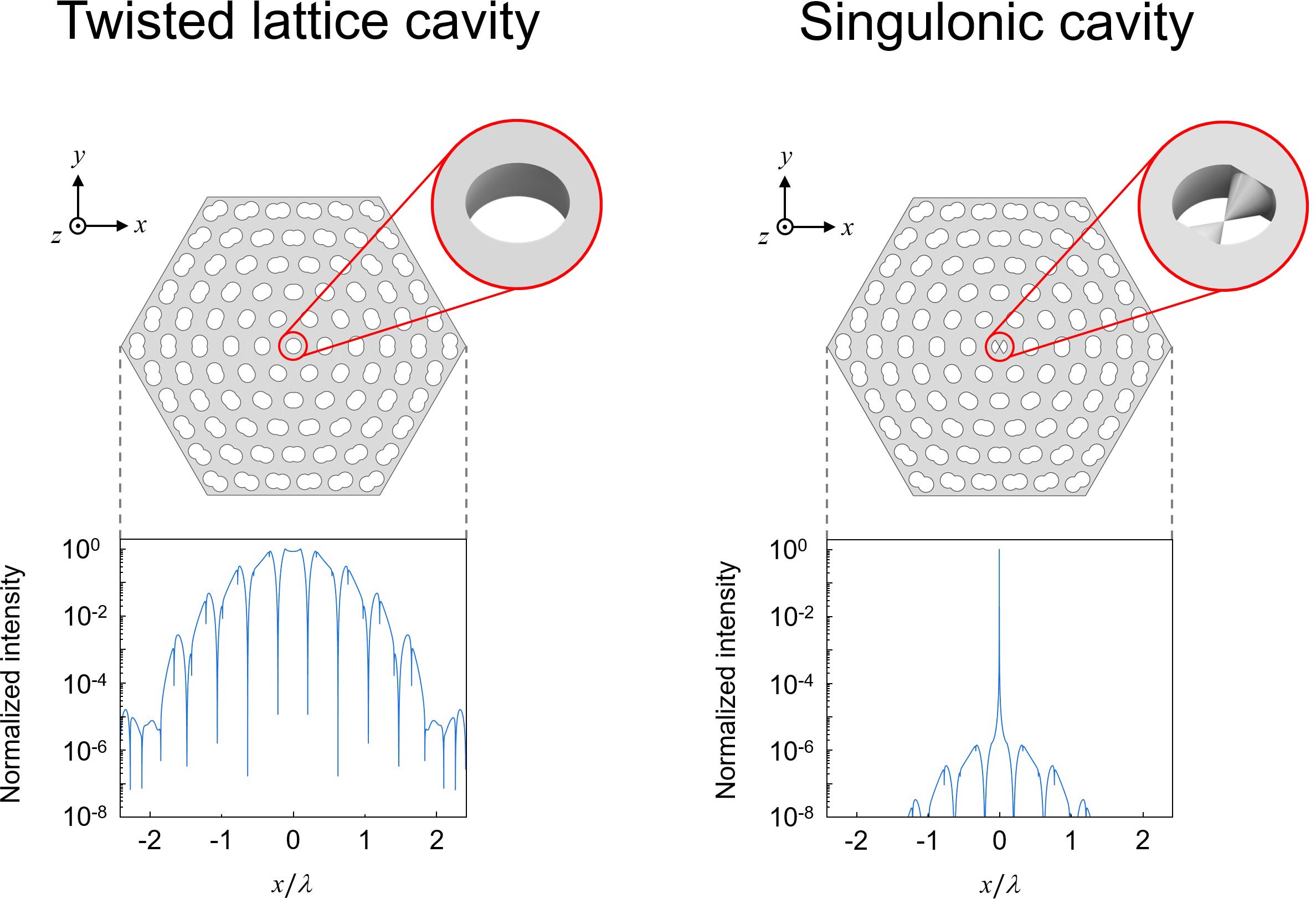
    Comparison Between a Twisted Lattice Cavity and a Singulonic Cavity
    Comparison between a twisted lattice cavity and a singulonic cavity. Left: schematic and field distribution (in logarithmic scale) of a twisted lattice cavity; Right: schematic and field distribution (in logarithmic scale) of a singulonic cavity. The power-law divergence of the narwhal-shaped wavefunction enhances the electric field intensity by more than six orders of magnitude in the deep-subwavelength region. Credit: Renmin Ma et al.

    In a follow-up study published in eLight, the researchers showed that this extreme confinement is linked to a new type of electromagnetic eigenmode known as narwhal-shaped wavefunctions. These modes feature a combination of strong local enhancement that follows a power law and a broader exponential decay, enabling electromagnetic fields to concentrate far beyond traditional limits.

    Experimental Demonstration of Extreme Confinement

    To test these ideas, the team designed a three-dimensional singular dielectric resonator that achieves sub-diffraction confinement in all spatial directions. Near-field scanning measurements allowed them to directly observe narwhal-shaped wavefunctions, revealing both their rapid growth near the singularity and their gradual decay at larger distances.

    The results closely aligned with theoretical predictions and full three-dimensional simulations, reaching an extremely small mode volume of 5 × 10⁻⁷ λ³.
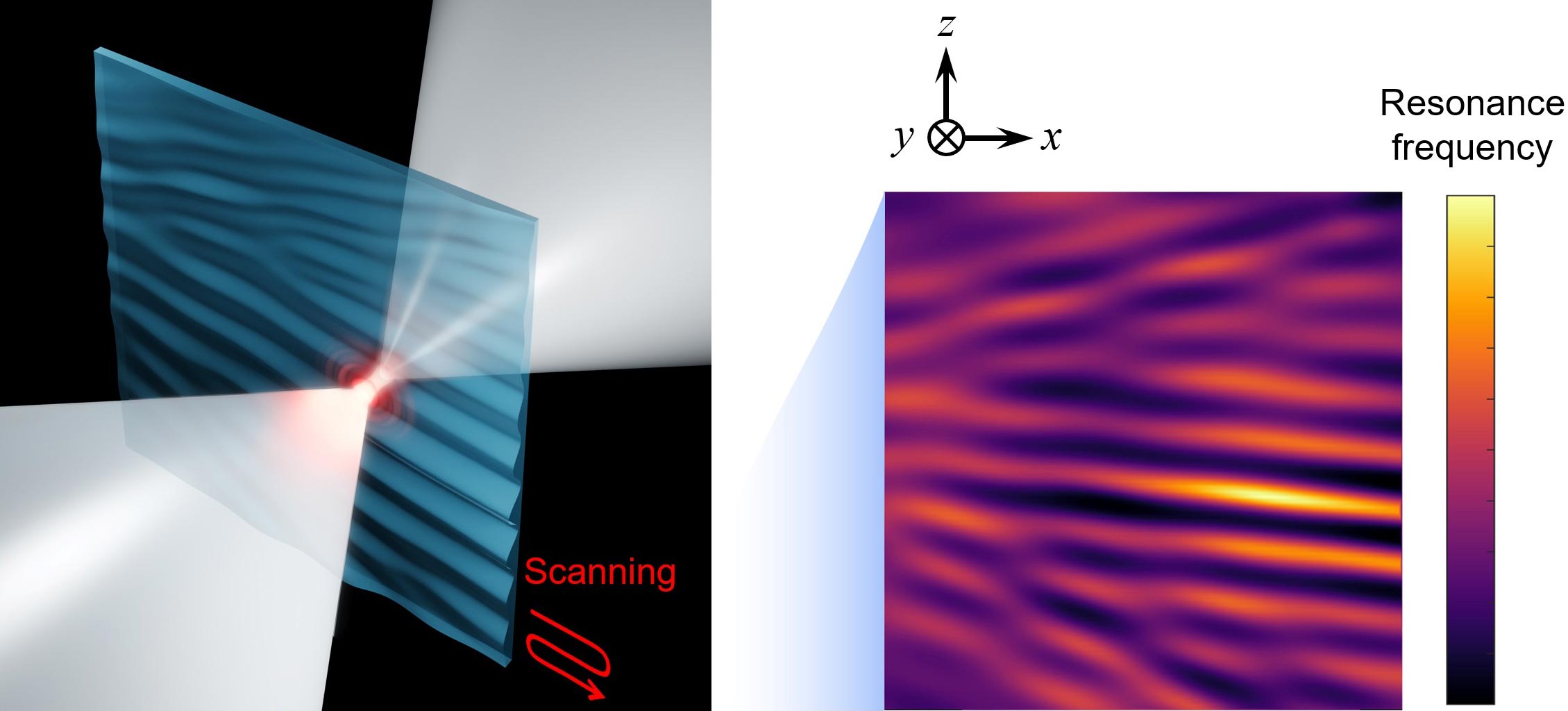
    Singular Field Microscopy Graphic
    Singular field microscopy. The singular optical microscope exploits the extreme mode-volume compression of narwhal-shaped wavefunctions to resolve fine structures. In experiments, it achieved an imaging spatial resolution of λ/1000. Credit:
    Renmin Ma et al.

    The researchers also used these highly localized wavefunctions to develop a new imaging approach called the singular optical microscope. By exciting eigenmodes within singular dielectric cavities, the technique generates tightly confined electromagnetic fields whose resonance shifts respond to very small structural details. This enabled a record spatial resolution of λ/1000 and allowed imaging of deeply subwavelength patterns, including the letters “PKU” and “SFM.”

    The findings show that the singular dispersion equation produces narwhal-shaped wavefunctions, unusual modes that confine light to extreme scales in lossless dielectrics.

    This work lays the foundation for what the team calls singulonics, a new direction in nanophotonics focused on controlling light at deep subwavelength scales without energy loss. The advance could support more efficient information processing, inspire new developments in quantum optics, and push the limits of super-resolution imaging.

    Reference: “Singulonics: narwhal-shaped wavefunctions for sub-diffraction-limited nanophotonics and imaging” by Wen-Zhi Mao, Hong-Yi Luan and Ren-Min Ma, 1 October 2025, eLight.
    DOI: 10.1186/s43593-025-00104-x

    Never miss a breakthrough: Join the SciTechDaily newsletter.
    Follow us on Google and Google News.

    Light Optics Photonics Quantum Physics
    Share. Facebook Twitter Pinterest LinkedIn Email Reddit

    Related Articles

    Scientists Uncover Hidden Property of Light That Twists Matter Sideways

    Scientists Uncover “Astonishing” Hidden Property of Light

    New Physics Discovery Reveals Mirror Reflections Aren’t As Perfect as Scientists Thought

    Entangled in Innovation: How Multiphoton Magic Is Revolutionizing Quantum Technology

    Novel Quantum Theory of Light-Induced Matter Opens Door to Cutting-Edge Optical Technologies

    Stanford Engineers and Physicists Study Quantum View of “Combs” of Light

    Scientists Realize Noiseless Photon-Echo Protocol – Key to Long-Distance Quantum Communication

    Complex Shapes of Photons for Fast Photonic Quantum Computations and Safe Data Transfer

    Physicists Test the Response Time of Electrons

    1 Comment

    1. Bao-hua ZHANG on March 24, 2026 12:06 am

      The findings show that the singular dispersion equation produces narwhal-shaped wavefunctions, unusual modes that confine light to extreme scales in lossless dielectrics.
      VERY GOOD.

      Please ask researchers to think deeply:
      1. Is the physical essence of light numerical or geometric?
      2. Is geometric shape a physical reality?
      3. Which is closer to the physical essence of nature, digitization or geometrization?
      4. Is the wavefunction a physical reality?

      Reply
    Leave A Reply Cancel Reply

    • Facebook
    • Twitter
    • Pinterest
    • YouTube

    Don't Miss a Discovery

    Subscribe for the Latest in Science & Tech!

    Trending News

    On the Brink of Extinction, These Giant Sea Turtles Are Doing Something Unexpected

    Coffee May Be Changing Your Gut in Ways Scientists Are Only Beginning To Understand

    Scientists Uncover Why a Common Nutrient Can Be Dangerous for Blood Vessels

    Mysterious Radio Signals From 5,000 Light-Years Away Lead Scientists to a Surprising Discovery

    New FDA-Approved Pill Lowers High Blood Pressure and May Slow Kidney Disease

    Scientists Just Challenged a Decades-Old Belief About How Cells Work

    Scientists Uncover a Natural Molecule That Makes Muscles Stronger and More Resistant to Fatigue

    Scientists Find That Mice, Not Deer, Hold a Major Clue to Lyme Disease Risk

    Follow SciTechDaily
    • Facebook
    • Twitter
    • YouTube
    • Pinterest
    • Newsletter
    • RSS
    SciTech News
    • Biology News
    • Chemistry News
    • Earth News
    • Health News
    • Physics News
    • Science News
    • Space News
    • Technology News
    Recent Posts
    • NASA-Funded Study Reveals a Hidden Effect of Space Radiation on the Brain
    • Scientists Discover That Jupiter and Dead Stars Could Hold Clues to Dark Matter’s Biggest Mystery
    • “This Star System Should Not Exist”: Astronomers Discover a Cosmic Mystery Just 28 Light-Years Away
    • A Newly Discovered Group of Immune Cells May Be Working Against You
    • Scientists Discover an Ancient Herbal Remedy May Help Curb Binge Drinking
    Copyright © 1998 - 2026 SciTechDaily. All Rights Reserved.
    • Science News
    • About
    • Contact
    • Editorial Board
    • Privacy Policy
    • Terms of Use

    Type above and press Enter to search. Press Esc to cancel.