

A long-standing limitation in photonics may be giving way to a new regime of light control.
Photonic technologies have struggled to shrink at the same pace as electronics. The limitation comes from basic physics. The uncertainty principle links how tightly light can be confined to its wavelength, which in the visible and near-infrared range can be up to a thousand times larger than the de Broglie wavelength of electrons used in circuits. As a result, photonic chips remain relatively large, and optical imaging faces strict resolution limits.
Plasmonics once appeared to offer a solution by using metals to compress light into regions smaller than its wavelength. However, metals inevitably lose energy as heat, a drawback that has slowed progress toward efficient, scalable devices.
A New Theoretical Breakthrough
In 2024, a team led by Ren-Min Ma at Peking University, China reported a major advance in Nature. They developed the singular dispersion equation, a theoretical framework that explains how light can be confined to extremely small scales in lossless dielectric materials. Because this method relies only on dielectrics, it avoids ohmic losses and opens the door to more compact and energy-efficient photonic technologies.
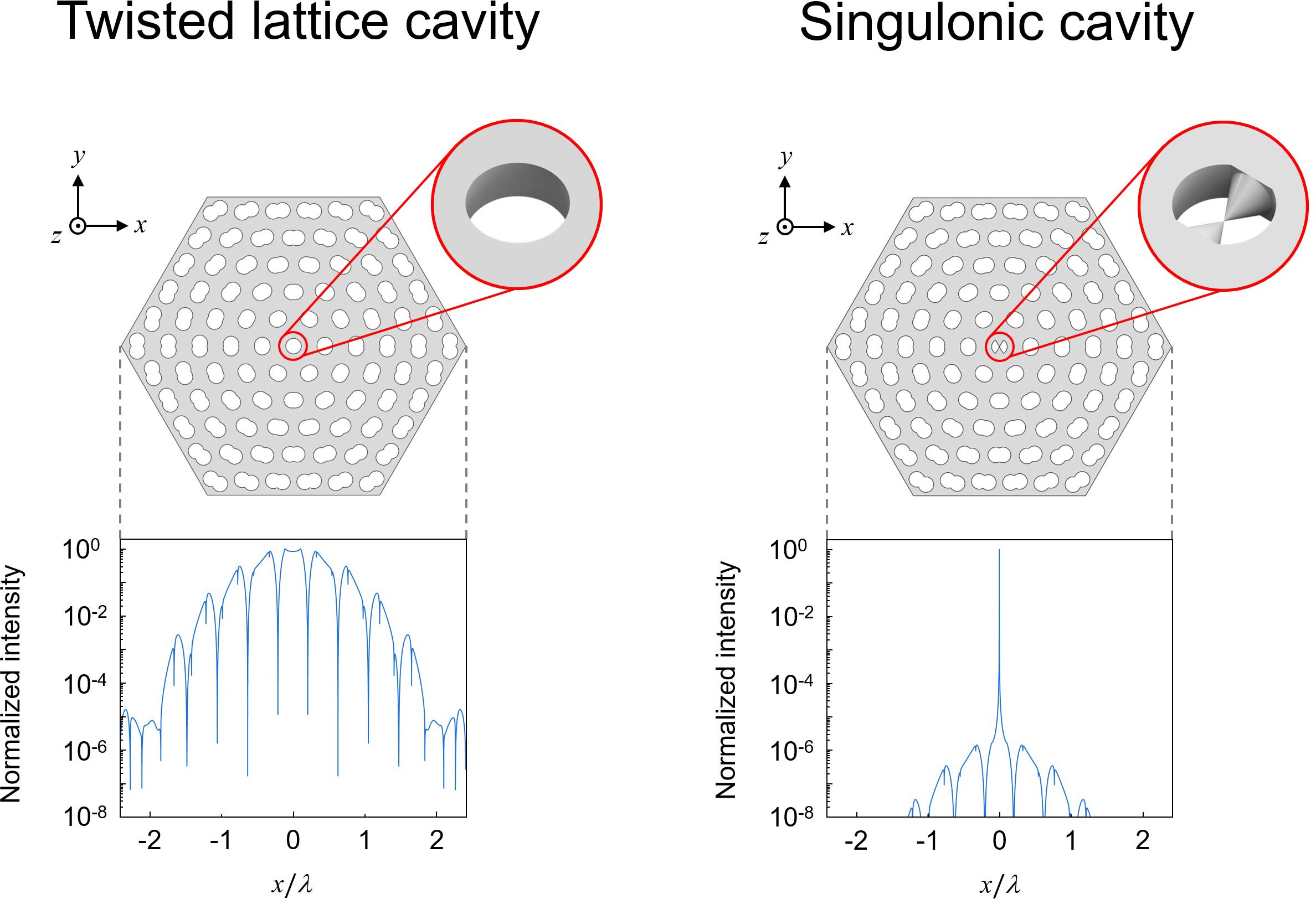
In a follow-up study published in eLight, the researchers showed that this extreme confinement is linked to a new type of electromagnetic eigenmode known as narwhal-shaped wavefunctions. These modes feature a combination of strong local enhancement that follows a power law and a broader exponential decay, enabling electromagnetic fields to concentrate far beyond traditional limits.
Experimental Demonstration of Extreme Confinement
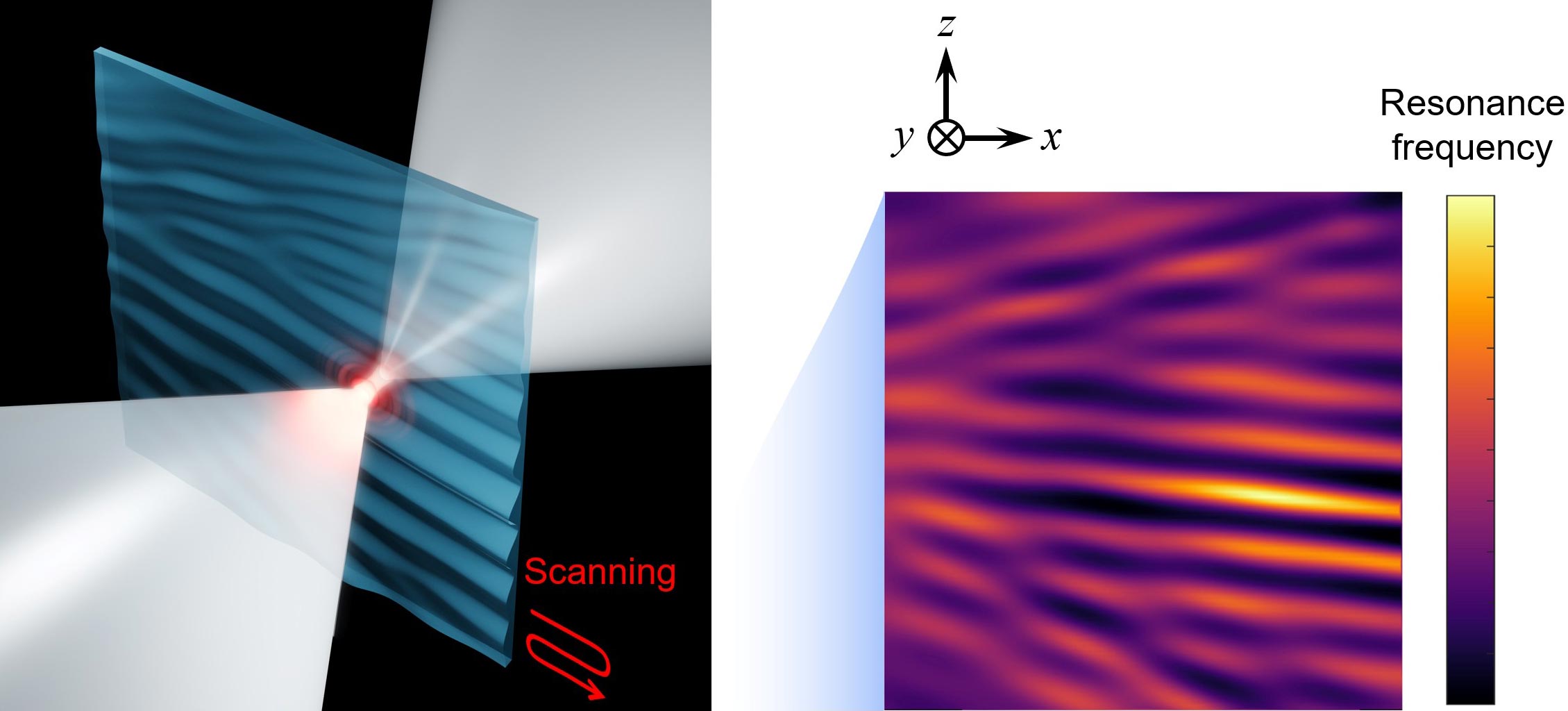
To test these ideas, the team designed a three-dimensional singular dielectric resonator that achieves sub-diffraction confinement in all spatial directions. Near-field scanning measurements allowed them to directly observe narwhal-shaped wavefunctions, revealing both their rapid growth near the singularity and their gradual decay at larger distances.
The results closely aligned with theoretical predictions and full three-dimensional simulations, reaching an extremely small mode volume of 5 × 10⁻⁷ λ³.
Renmin Ma et al.
The researchers also used these highly localized wavefunctions to develop a new imaging approach called the singular optical microscope. By exciting eigenmodes within singular dielectric cavities, the technique generates tightly confined electromagnetic fields whose resonance shifts respond to very small structural details. This enabled a record spatial resolution of λ/1000 and allowed imaging of deeply subwavelength patterns, including the letters “PKU” and “SFM.”
The findings show that the singular dispersion equation produces narwhal-shaped wavefunctions, unusual modes that confine light to extreme scales in lossless dielectrics.
This work lays the foundation for what the team calls singulonics, a new direction in nanophotonics focused on controlling light at deep subwavelength scales without energy loss. The advance could support more efficient information processing, inspire new developments in quantum optics, and push the limits of super-resolution imaging.
Reference: “Singulonics: narwhal-shaped wavefunctions for sub-diffraction-limited nanophotonics and imaging” by Wen-Zhi Mao, Hong-Yi Luan and Ren-Min Ma, 1 October 2025, eLight.
DOI: 10.1186/s43593-025-00104-x
Never miss a breakthrough: Join the SciTechDaily newsletter.
Follow us on Google and Google News.
1 Comment
The findings show that the singular dispersion equation produces narwhal-shaped wavefunctions, unusual modes that confine light to extreme scales in lossless dielectrics.
VERY GOOD.
Please ask researchers to think deeply:
1. Is the physical essence of light numerical or geometric?
2. Is geometric shape a physical reality?
3. Which is closer to the physical essence of nature, digitization or geometrization?
4. Is the wavefunction a physical reality?