
The warmth of planets and dead stars is helping scientists narrow the possibilities for dark matter, offering new clues about the mysterious substance that makes up most of the universe’s matter.
Most of the matter in the universe is something scientists have never directly seen. Known as dark matter, it is thought to make up about 85% of all matter, yet its true nature remains a mystery. Researchers know it exists largely because of its gravitational effects, but they still do not know what it is made of.
Scientists have spent decades searching for particles that could explain dark matter, without directly detecting any. One possibility is that some particles move so slowly that they barely register in laboratory experiments. However, those same particles might be easier to find in places much larger than any detector on Earth: planets and stars.
Researchers Alejandro Ibarra, Merlin Reichard, and Gaurav Tomar investigated whether these celestial bodies could act as natural traps for dark matter. Their study, published in the Journal of Cosmology and Astroparticle Physics (JCAP), found no evidence of dark matter but helped rule out certain possibilities about its properties.
Slow dark matter could become trapped
Dark matter is known to interact through gravity, but scientists suspect it may also have extremely weak electrical or magnetic properties. Some particles could carry a tiny electric charge or behave like miniature magnets, allowing them to interact with ordinary matter in ways that are difficult to detect.
Speed could make those interactions even harder to observe. When a slow-moving particle strikes material inside a detector, it may transfer too little energy to produce a measurable signal. Inside a planet or star, however, even a small loss of energy could be enough to prevent the particle from escaping the object’s gravitational pull.
Over billions of years, these trapped particles could accumulate near the center of a planet or star. If their properties allow it, they might eventually collide and undergo a process called annihilation, transforming into other particles. Some of the resulting particles could escape into space, while others could release energy that warms the surrounding material.
Neutrinos and heat test dark matter
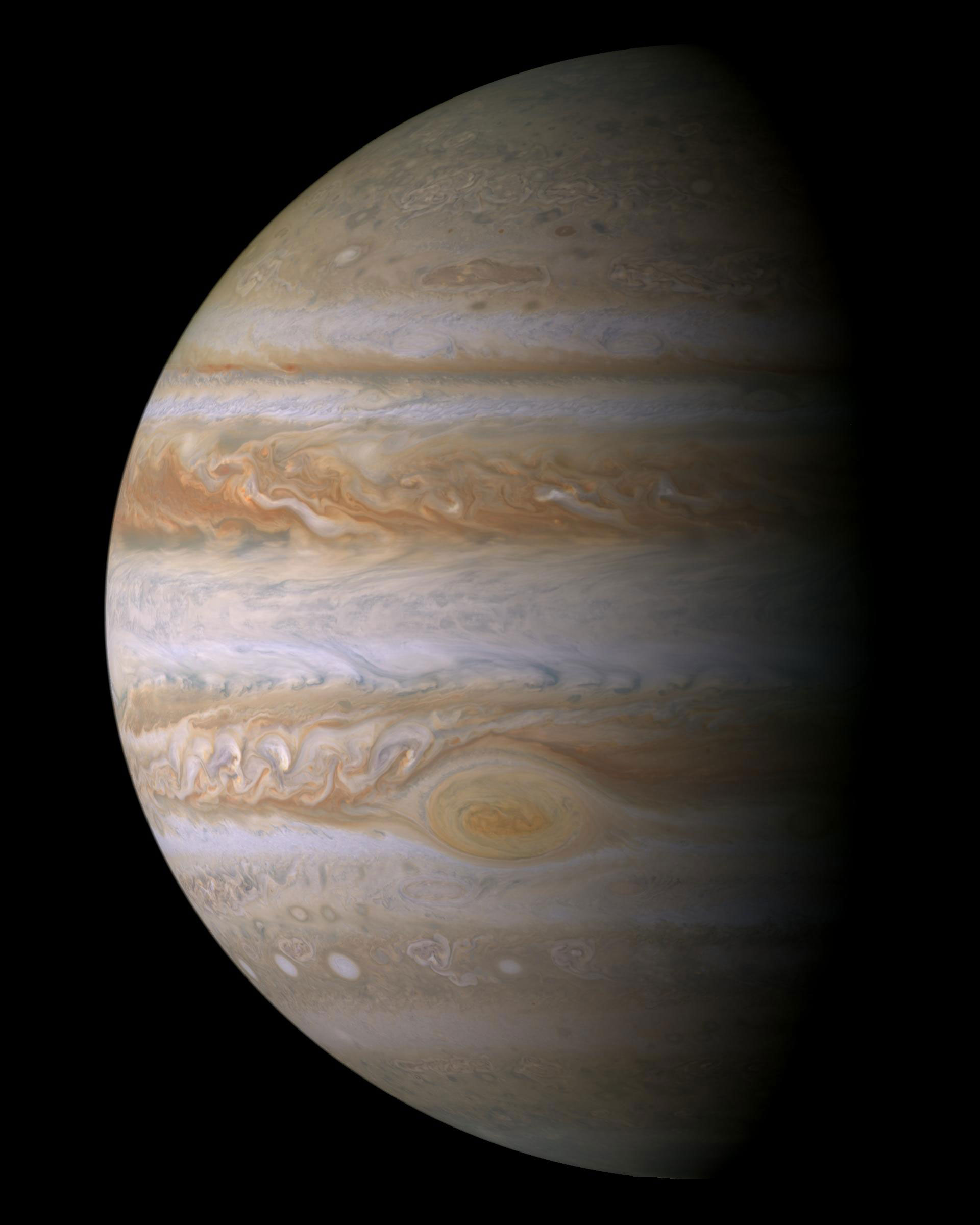
“In this work, we considered four celestial bodies: Earth, the Sun, Jupiter and white dwarfs,” explains Gaurav Tomar, a researcher at the Center for Quantum Spacetime at Sogang University in South Korea and the study’s corresponding author. “There are dedicated experiments, for example IceCube at the South Pole, looking for neutrinos from the Sun and Earth. For Jupiter and white dwarfs, we considered the heating possibilities.”
The researchers used two different approaches to look for signs of dark matter. For Earth and the Sun, they examined existing searches for neutrinos, tiny particles that can travel through enormous amounts of matter without being stopped. If dark matter particles were annihilating deep inside these bodies, some of the resulting neutrinos might reach detectors and provide evidence of what was happening.
For Jupiter and white dwarfs, which are dense remnants of stars, the team looked at heat instead. Unlike the Sun, these objects are not powered by ongoing nuclear fusion, making them potentially useful places to investigate whether another source of energy is contributing to their warmth.
The researchers calculated how much heat different types of dark matter could produce if captured inside these objects, then compared those predictions with the energy the objects actually emit. If a particular type of dark matter would generate more heat than an object releases, that scenario could be ruled out.
By combining these calculations with existing observations, the team excluded several combinations of dark matter particle mass and electromagnetic properties that previous experiments had not eliminated. Earth was particularly useful for investigating particles with extremely small electric charges, while white dwarfs helped constrain other possible electromagnetic interactions.
Unknown dark matter levels limit certainty
The findings also come with an important uncertainty. How much dark matter a celestial body could capture depends partly on how much dark matter surrounds it. For white dwarfs in particular, researchers must rely on estimates because the local dark matter density is not always known.
“We do not know the dark matter density there. We used estimated values, so if those values change, our limits could become weaker or stronger,” Tomar notes.
He was referring to the M4 star cluster, where the white dwarfs examined in the study are located. The amount of dark matter in that region has not been directly measured and must instead be estimated using models.
Looking ahead, Tomar suggests searching for even colder white dwarfs in regions thought to contain more dark matter. Because these stars emit relatively little heat, any additional warming from trapped particles could be easier to identify. Planets orbiting stars beyond our solar system could also offer new opportunities to investigate whether dark matter is quietly accumulating inside celestial bodies.
Reference: “Celestial probes of dark matter electromagnetic interactions” by Alejandro Ibarra, Merlin Reichard and Gaurav Tomar, August 27, 2026, arXiv.
DOI: 2608.27957
Never miss a breakthrough: Join the SciTechDaily newsletter.
Follow us on Google and Google News.