
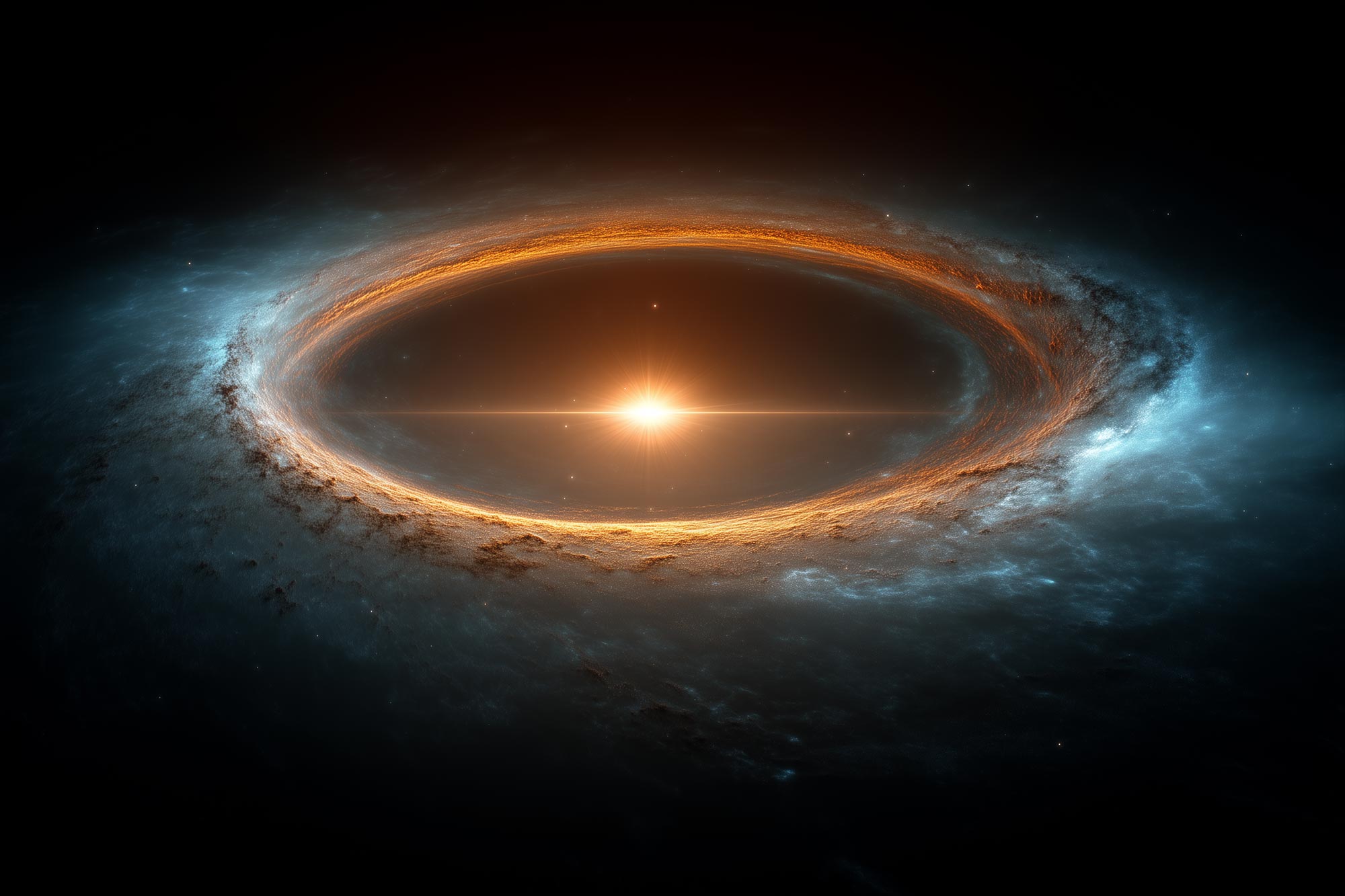
A new study suggests that mysterious “dark dwarfs” could provide crucial insights into the true nature of dark matter.
Celestial objects known as dark dwarfs might be concealed near the center of our galaxy, and scientists believe they could help unlock the secrets of one of the biggest mysteries in modern cosmology: dark matter.
In a newly published study in the Journal of Cosmology and Astroparticle Physics, a team of researchers from the UK and Hawaii introduces the concept of dark dwarfs and outlines how we might detect them using instruments that are already available, including the James Webb Space Telescope.
The international research team chose the name “dark dwarfs” not because these objects are inherently dark, but because of their close relationship with dark matter—a topic that remains central to astrophysics and cosmology today.
“We think that 25% of the universe is composed of a type of matter that doesn’t emit light, making it invisible to our eyes and telescopes. We only detect it through its gravitational effects. That’s why we call it dark matter,” explains Jeremy Sakstein, Professor of Physics at the University of Hawai‘i and one of the study’s authors.
Understanding the Unknown
While scientists have confirmed the presence of dark matter and observed how it behaves, its true nature remains unknown. Over the past five decades, many theories have been suggested, but none have been supported by enough experimental data to be confirmed. Research efforts like this one aim to offer practical ways to move closer to a solution.
Among the most well-known dark matter candidates are the Weakly Interacting Massive Particles (WIMPs)—very massive particles that interact very weakly with ordinary matter: they pass through things unnoticed, don’t emit light and don’t respond to electromagnetic forces (so they don’t reflect light and remain invisible), and reveal themselves only through their gravitational effects. This type of dark matter would be necessary for dark dwarfs to exist. “Dark matter interacts gravitationally, so it could be captured by stars and accumulate inside them. If that happens, it might also interact with itself and annihilate, releasing energy that heats the star,” Sakstein explains.
Ordinary stars—like our Sun—shine because nuclear fusion processes occur in their cores, generating large amounts of heat and energy. Fusion happens when a star’s mass is large enough that gravitational forces compress matter toward the centre with such intensity that they trigger reactions between atomic nuclei. This process releases a huge amount of energy, which we see as light. Dark dwarfs also emit light—but not because of nuclear fusion.
“Dark dwarfs are very low mass objects, about 8% of the Sun’s mass,” Sakstein explains. Such a small mass is not sufficient to trigger fusion reactions. For this reason, such objects—although very common in the universe—usually only emit a faint light (due to the energy produced by their relatively small gravitational contraction) and are known to scientists as brown dwarfs.
When Brown Dwarfs Become Something More
However, if brown dwarfs are located in regions where dark matter is particularly abundant—such as the centre of our galaxy—they can transform into something else. “These objects collect the dark matter that helps them become a dark dwarf. The more dark matter you have around, the more you can capture,” Sakstein explains. “And, the more dark matter ends up inside the star, the more energy will be produced through its annihilation.”
But all of this relies on a specific type of dark matter. “For dark dwarfs to exist, dark matter has to be made of WIMPs, or any heavy particle that interacts with itself so strongly to produce visible matter,” Sakstein says. Other candidates proposed to explain dark matter—such as axions, fuzzy ultralight particles, or sterile neutrinos—are all too light to produce the expected effect in these objects. Only massive particles, capable of interacting with each other and annihilating into visible energy, could power a dark dwarf.
This entire hypothesis, however, would have little value if there weren’t a concrete way to identify a dark dwarf. For this reason, Sakstein and colleagues propose a distinctive marker: “There were a few markers, but we suggested the Lithium-7 because it would really be a unique effect,” the scientist explains. Lithium-7 burns very easily and is quickly consumed in ordinary stars. “So if you were able to find an object which looked like a dark dwarf, you could look for the presence of this lithium because it wouldn’t be there if it was a brown dwarf or a similar object.”
Tools like the James Webb Space Telescope might already be able to detect extremely cold celestial objects like dark dwarfs. But, according to Sakstein, there’s another possibility: “The other thing you could do is to look at a whole population of objects and ask, in a statistical manner, if it is better described by having a sub-population of dark dwarfs or not.”
If in the coming years, we manage to identify one or more dark dwarfs, how strong would that clue be in support of the hypothesis that dark matter is made of WIMPs?
“Reasonably strong. With light dark matter candidates, something like an axion, I don’t think you’d be able to get something like a dark dwarf. They don’t accumulate inside stars. If we manage to find a dark dwarf, it would provide compelling evidence that dark matter is heavy, interacts strongly with itself, but only weakly with the Standard Model. This includes classes of WIMPs, but it would include some other more exotic models as well,” concludes Sakstein. Observing a dark dwarf wouldn’t conclusively tell us that dark matter is a WIMP, but it would mean that it is either a WIMP or something that, for all intents and purposes, behaves like a WIMP.”
Reference: “Dark dwarfs: dark matter-powered sub-stellar objects awaiting discovery at the galactic center” by Djuna Croon, Jeremy Sakstein, Juri Smirnov and Jack Streeter, 7 July 2025, Journal of Cosmology and Astroparticle Physics.
DOI: 10.1088/1475-7516/2025/07/019
Never miss a breakthrough: Join the SciTechDaily newsletter.
Follow us on Google and Google News.
3 Comments
Could but won’t, because of two things.
1. Dark matter doesn’t exist.
2. Nothing that shows up on SciTechDaily as something that “could” do things ever actually does.
D note 250906_1236,1444_Source1.Reinterpreting【
Source 1.
https://scitechdaily.com/these-strange-stars-could-reveal-the-true-nature-of-dark-matter/
1.
These strange stars can reveal the true nature of dark matter
Courtesy of Sisa Media Lab September 5, 2025
_A newly proposed type of star, called dark dwarf, may be hiding in the heart of our galaxy.
_ These faint, small-mass stars can gain energy through the disappearance of dark matter particles rather than fusion, which may reveal the identity of one of the universe’s biggest mysteries.
【>>>>
> Dark dwarfs are created from the msoss.bank of dark matter,
>> It’s probably the remains (Kedeheon evil spirit) that entered the ordinary material world. Uh-huh.
<<<<>>>
>>>messoss amplifies the system galaxy by doubling the size of the gravitational msbase.galaxy. The sample is sample4.
>>>Messoss.galaxy is also subject to gravity. It just appeared in the natural world as dark matter transformed into ozer.wimp.zsp. Hmm.
<<<<>>>
>The dark matter msoss responds to the instantaneous acceleration (n1*) of heavy quantum entanglement only to gravity and not to the light electromagnetic force (n2*) with the acceleration of light.
<<<<>_This type of dark matter is essential for dark dwarfs to exist. “Dark matter can be captured by stars and accumulated inside because it interacts gravitationally,” says Sachstein.
>>> By the way, some of the debris collapsed by msoss.bank was transferred from the gravitational system to the electromagnetic system, and it became a dark dwarf containing a mixture of gravity and electromagnetic force.
>Good good! Idea! James Brown!
https://youtu.be/GaB9F3R9cIY?si=IRu8wRVe6SJK0Ocd
<<<For this reason, these celestial bodies are very common in space, but they usually emit only faint light due to the energy produced by relatively small gravitational contractions, which scientists call brown dwarfs.
2-3. When a brown dwarf becomes something bigger
_But if a brown dwarf is located in an area particularly rich in dark matter, such as the center of our galaxy, it can turn into another celestial body.
_”These objects collect dark matter and become dark dwarfs. The more dark matter you have around you, the more dark matter you can capture,” explains Sachstein.
_”And the more dark matter builds up inside the star, the more energy is generated through the disappearance of the dark matter.”
【>>>>>
>> Dark matter turns into dark energy and produces light elementary particles. The sample is sample2.qcell.nqvixer.qms.
sample2.qoms(standard)
0 0 0 0 0 0 0 0 1 1=2,0
0 0 0 0 0 0 1 1 0 0
0 0 0 0 0 0 1 1 0 0
0 0 0 0 0 1 0 0 1 0
0 0 0 1 1 0 0 0 0 0
0 1 0 1 0 0 0 0 0 0
0 0 1 0 0 1 0 0 0 0
0 1 0 0 1 0 0 0 0 0
2 0 0 0 0 0 0 0 0 0
0 0 1 0 0 0 0 0 0 1
<<<<<】
ㅡㅡㅡㅡㅡㅡㅡㅡㅡㅡ
3.
_But all of this relies on certain types of dark matter.
B Memo 2604241845_Source1.Reinterpretation【()】
Source1.
https://scitechdaily.com/these-strange-stars-could-reveal-the-true-nature-of-dark-matter/
1.
_Could these strange stars reveal the true nature of dark matter?
_A new type of celestial body, newly proposed as a ‘dark dwarf,’ may be hiding in the center of our galaxy.
_(These faint, low-mass stars can obtain energy through the annihilation of dark matter particles rather than nuclear fusion), and this suggests the possibility of revealing the true nature of dark matter, one of the greatest mysteries of the universe.
ㅡ b1.【() Such a star is probably composed of dark matter quantized into qqcells. The path would probably be sample2.darkstar.qqcell.nqvixer.eqpms.dark_energy. Hmm. 1626.
sample2.qoms(standard)
0 0 0 0 0 0 0 1 1=2,0
0 0 0 0 0 1 1 0 0
0 0 0 0 0 1 1 0 0
0 0 0 0 1 0 0 1 0
0 0 0 1 1 0 0 0 0 0
0 1 0 1 0 0 0 0 0 0
0 0 1 0 0 1 0 0 0 0 0
0 1 0 0 1 0 0 0 0 0
0 1 0 0 1 0 0 0 0 0
2 0 0 0 0 0 0 0 0 0 0
0 0 1 0 0 0 0 0 0 1
】
_According to new research, the mysterious “dark dwarf” is dark matter’s It is said that it can provide important insights into the true nature.
1-1.
_(There is a possibility that celestial bodies known as dark dwarfs are hidden near the center of our galaxy), and scientists believe that these objects could help unravel the secrets of dark matter, one of the greatest mysteries of modern cosmology.
ㅡb2.【() If dark dwarfs are composed of dark.qqmatter(*),
ㅡIt is highly likely that they have entered the quantum state of sample4.oser.qqcell.msoss.dark_matter within msbase.galaxy. Uh-huh. 1833.
sample4.msoss(standard)
zxdxybzyz
zxdzxezxz
xxbyyxzz
zybzzfxzy
cadccbcdc
cdbdcbdbb
xzezxdyyx
zxezybzyy
bddbcbdca
】
1-2.
In a study recently published in the Journal of Cosmology and Astroparticle Physics, research teams from the UK and Hawaii introduced the concept of “dark dwarfs” and proposed methods to detect them using available equipment, including the James Webb Space Telescope.
The international research team did not name these objects “dark dwarfs” because they are inherently dark, but rather because of their close relationship with dark matter, a core topic in modern astrophysics and cosmology.
“We believe that 25% of the universe is composed of matter that does not emit light. This matter cannot be seen with our eyes or telescopes and can only be detected through gravitational effects. That is why we call this matter dark matter,” explains Jeremy Sachstein, a physics professor at the University of Hawaii and one of the authors of the study.
2-1. “Saxstein explains, ‘Because dark matter interacts gravitationally, it can be captured by stars and accumulate inside them. If that happens, the dark matter interacts with itself to annihilate, releasing energy, and this energy could heat the star.'”
Ordinary stars, like our Sun, emit light because nuclear fusion processes occur in their cores, generating immense heat and energy.
Nuclear fusion occurs when a star’s mass is large enough that gravity strongly compresses matter toward the center, triggering reactions between atomic nuclei. A massive amount of energy is released during this process, which we observe as light. Dark dwarfs also emit light, but not due to nuclear fusion.
2-2.
“Dark dwarfs are celestial bodies with very small masses, about 8% of the Sun’s mass,” Saxstein explains. Such a small mass is not sufficient to trigger nuclear fusion reactions. Therefore, these celestial bodies, which are common in the universe, generally emit only faint light (due to the energy generated by relatively small gravitational contractions), and scientists call them brown dwarfs.
_When a Brown Dwarf Becomes More Than Just a Star
However, if a brown dwarf is located in a region particularly rich in dark matter, such as the center of our galaxy, it can transform into a different form.
2-3.
“These celestial bodies gather dark matter to become dark dwarfs,” explains Saxstein. “The more dark matter there is around, the more can be captured.” He continues, “And the more dark matter accumulates inside the star, the more energy is generated during the annihilation process.”
“However, all of this depends on a specific type of dark matter.” Professor Saxstein states, “For a dark dwarf to exist, the dark matter must consist of WIMPs—heavy particles that interact with themselves strongly enough to generate visible matter.” Other candidates proposed to explain dark matter, such as axions, fuzzy ultralight particles, or sterile neutrinos, are all too light to produce the expected effects in these celestial bodies. Only heavy particles capable of interacting with each other and extinguishing into visible energy can supply energy to dark dwarfs.
3-1.
If one or more dark dwarfs are discovered within the next few years, how strongly would that clue support the hypothesis that dark matter is composed of WIMPs?
3-2.
_”This is quite strong evidence. It would be difficult to discover something like a dark dwarf using light dark matter candidates like axions. This is because dark dwarfs do not accumulate inside stars.
_If a dark dwarf is discovered, it would be strong evidence that dark matter is heavy, interacts strongly with itself, but interacts weakly with the Standard Model.
ㅡa1.【If a star or dwarf of dark matter exists, it is within the msoss region. 1806.
ㅡIf that matter is a WIMP, it would be heavier than the electrons in the electromagnetic field msbase parpi.normal_matter; given the property of dark matter not reacting with photons, it might be sufficient for it to remain in a dark dwarf.
】