
Close Menu
    Facebook X (Twitter) Instagram
    SciTechDaily
    • Biology
    • Chemistry
    • Earth
    • Health
    • Physics
    • Science
    • Space
    • Technology
    Facebook X (Twitter) Pinterest YouTube RSS
    SciTechDaily
    Home»Technology»Wind and Solar Power Could Generate Most But Not All of the Electricity in the USA
    Technology

    Wind and Solar Power Could Generate Most But Not All of the Electricity in the USA

    By Ken Caldeira, Carnegie Institution for ScienceFebruary 27, 20181 Comment3 Mins Read
    Facebook Twitter Pinterest Telegram LinkedIn WhatsApp Email Reddit
    Share
    Facebook Twitter LinkedIn Pinterest Telegram Email Reddit
    New Study Shows Wind and Solar Could Meet Most USA Electricity Needs
    New study shows wind and solar could meet most USA electricity needs.

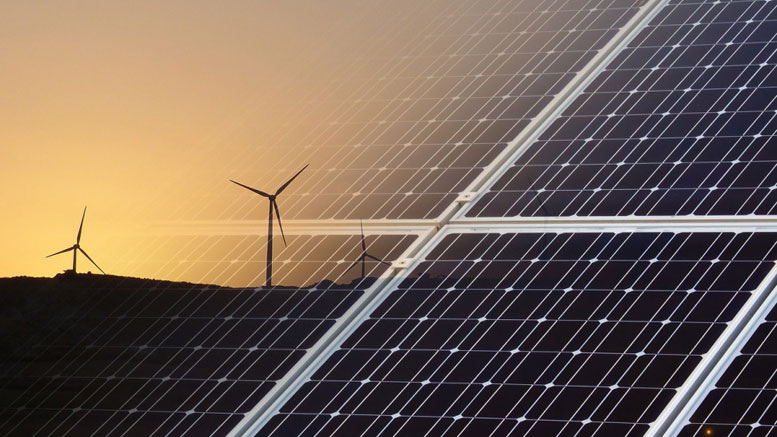
    Wind and solar power could generate most but not all electricity in the United States, according to an analysis of 36 years of weather data by Carnegie’s Ken Caldeira, and three Carnegie-affiliated energy experts: Matthew Shaner, Steven Davis (of University of California Irvine), and Nathan Lewis (of Caltech).

    Right now, about 38 percent of carbon dioxide emissions come from electricity production, which must be reduced to combat climate change.

    The team found that as the amount of electricity produced by solar and wind increases, avoiding major blackouts becomes increasingly challenging. Policymakers and planners need to consider that wind and solar resources will have natural variability, the team said.

    “Our team took a simplified approach aimed at understanding fundamental geophysical constraints on wind and solar power,” explained lead author Shaner. “We looked at solar and wind power availability on an hourly basis across the U.S. and determined how much of current electricity demand could be met by varying amounts of solar panels, wind turbines, and energy storage, in addition to changes in the electricity grid.”
    Wind and Solar Could Meet Most USA Electricity Needs
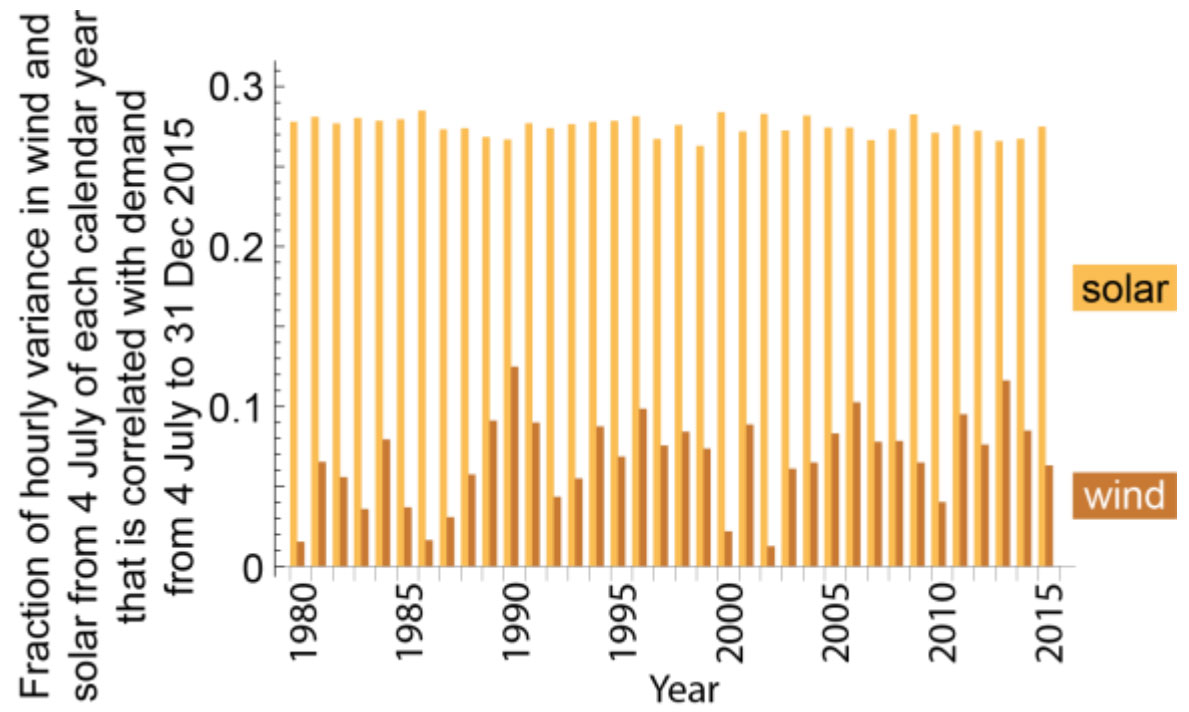
    Figure S 14| R2 of correlations between hourly wind and demand, and solar and demand, data. In all cases, demand data is from 4 July to 31 December 2015. Correlations are calculated for wind and solar generation data for 4 July to 31 December of each listed year. Note that year 2015 is not an outlier, indicating that the differences in correlations coming from cycling of demand data are unlikely to substantially affect our results. Matthew R. Shaner, et al., “Geophysical constraints on the reliability of solar and wind power in the United States,” Energy Environ. Sci., 2018; doi:10.1039/C7EE03029K

    According to the team’s findings, solar power resources reached peak generating ability in June and July, and wind resources peak in March and April and slump during July and August. So, the resources have a complementary effect that would allow each to help alleviate the other’s deficiencies. But this wouldn’t be enough to overcome the non-seasonal variation in solar and wind resources.

    Their assessments showed that reliable electricity generation with 80 percent solar and wind would require a continent-scale transmission grid with at least 12 hours of storage to overcome ordinary day-to-day variation.

    But to bump up to 100 percent of electricity coming from solar and wind power would require significantly greater and costlier energy infrastructure changes to overcome seasonal cycles and extreme weather events. It would be necessary to have either the capacity to store the generated electricity for several weeks—something not economically feasible today—or the ability to generate a surplus of electricity, much of which would be infrequently used. Likewise, a continent-scale transmission grid would also be required.

    “Our work indicates that wind and solar would need to be supplemented by some kind of dispatchable power like natural gas or huge amounts of storage,” Caldeira added. “Natural gas emits greenhouse gases and the storage is super expensive, so we need a search for better ways of supplying electricity when the sun is not shining, and the wind is not blowing.”

    Reference: “Geophysical constraints on the reliability of solar and wind power in the United States” by Matthew R. Shaner, Steven J. Davis, Nathan S. Lewis and Ken Caldeira, 27 February 2018, Energy Environmental Science.
    DOI: 10.1039/C7EE03029K

    Never miss a breakthrough: Join the SciTechDaily newsletter.
    Follow us on Google and Google News.

    Carnegie Institution for Science Environmental Science Green Technology Solar Power Sustainability Wind Power
    Share. Facebook Twitter Pinterest LinkedIn Email Reddit

    Related Articles

    Wind Farms Cause More Environmental Impact Than Previously Thought

    When and Where Advanced Photovoltaics Are Economic to Install

    Nanostructure Increases Solar-to-Hydrogen Conversion Efficiency by a Factor of Eleven

    New Technique Allows for Rapid Solar Cell Screening

    Scientists Demonstrate Efficient, Light-Powered Production of Fuel via Artificial Photosynthesis

    High Density Wind Farms Generate Less Electricity Than Thought

    Polymer Solar Cell Efficiency Improved With Infrared-Absorbing Polymer

    Lithium Iron Phosphate Batteries Could Lead to Cheaper, More Efficient Solar Energy

    Researchers Develop IE2 for Analyzing Solar Cell Materials

    1 Comment

    1. Roger Teague on February 27, 2018 2:30 pm

      Great article. Finally someone talking about the real limitations of Green power. For wind and solar power to be feasible, there must be much better methods to store the electricity they produce. Until there are better storage methods, fossil power will have to remain as the back-up. It is very costly keeping fossil plants on stand-by for periods when the wind does not blow or the sun does not shine.

      Reply
    Leave A Reply Cancel Reply

    • Facebook
    • Twitter
    • Pinterest
    • YouTube

    Don't Miss a Discovery

    Subscribe for the Latest in Science & Tech!

    Trending News

    Breakthrough Bowel Cancer Trial Leaves Patients Cancer-Free for Nearly 3 Years

    Natural Compound Shows Powerful Potential Against Rheumatoid Arthritis

    100,000-Year-Old Neanderthal Fossils in Poland Reveal Unexpected Genetic Connections

    Simple “Gut Reset” May Prevent Weight Gain After Ozempic or Wegovy

    2.8 Days to Disaster: Scientists Warn Low Earth Orbit Could Suddenly Collapse

    Common Food Compound Shows Surprising Power Against Superbugs

    5 Simple Ways To Remember More and Forget Less

    The Atomic Gap That Could Cost the Semiconductor Industry Billions

    Follow SciTechDaily
    • Facebook
    • Twitter
    • YouTube
    • Pinterest
    • Newsletter
    • RSS
    SciTech News
    • Biology News
    • Chemistry News
    • Earth News
    • Health News
    • Physics News
    • Science News
    • Space News
    • Technology News
    Recent Posts
    • Scientists Discover Stem Cells That Could Regrow Teeth and Bone
    • Scientists Discover Natural Molecule That Stops Alzheimer’s Protein Clumps From Forming
    • Early Cannabis Use May Stall Key Brain Skills in Teens
    • Popular Vitamin D Supplement Has “Previously Unknown” Negative Effect, Study Finds
    • Powerful Antioxidant Found To Play a Key Role in Proper Protein Folding
    Copyright © 1998 - 2026 SciTechDaily. All Rights Reserved.
    • Science News
    • About
    • Contact
    • Editorial Board
    • Privacy Policy
    • Terms of Use

    Type above and press Enter to search. Press Esc to cancel.